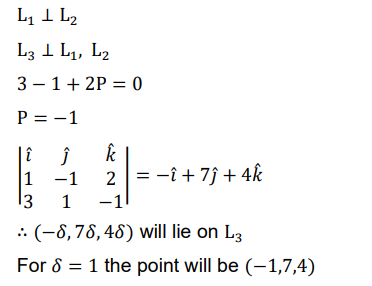
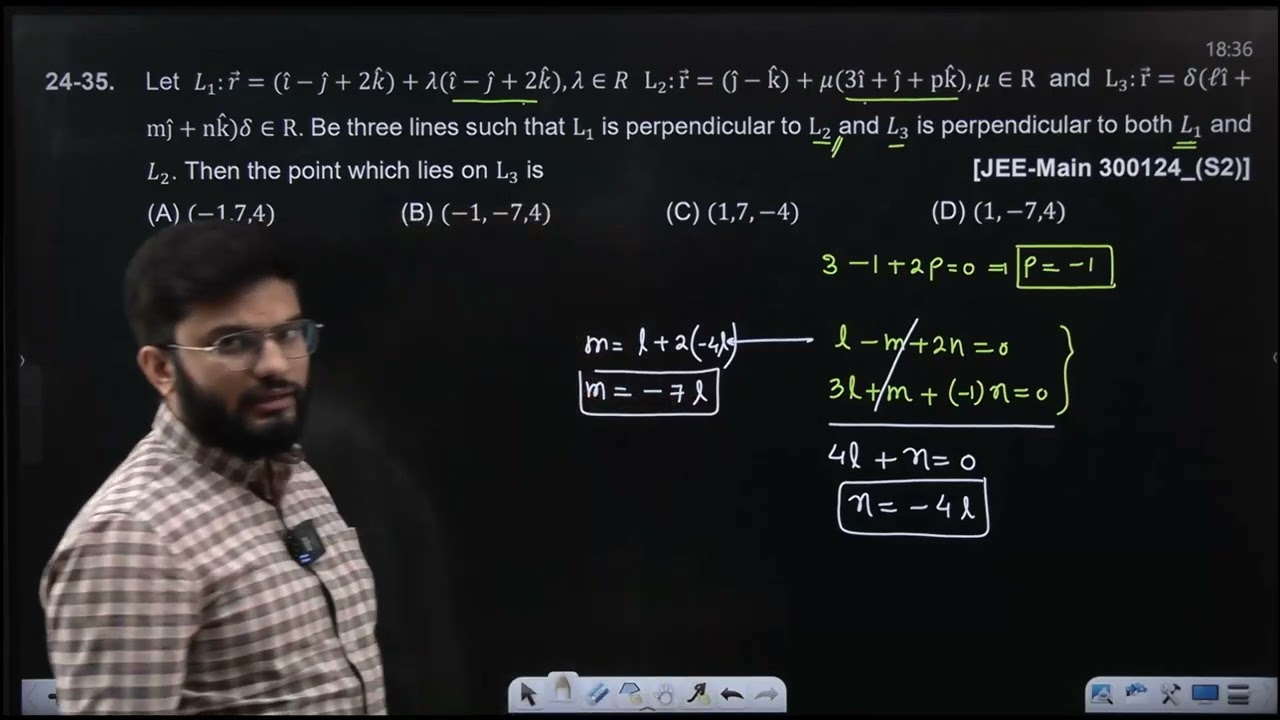
Let $L_1: \vec{r}=(\hat{\imath}-\hat{\jmath}+2 \hat{k})+\lambda(\hat{\imath}-\hat{\jmath}+2 \hat{k}), \lambda \in R \mathrm{~L}_2: \overrightarrow{\mathrm{r}}=(\hat{\jmath}-\hat{\mathrm{k}})+\mu(3 \hat{\imath}+\hat{\jmath}+\mathrm{p} \hat{\mathrm{k}}), \mu \in \mathrm{R}$ and $\mathrm{L}_3: \overrightarrow{\mathrm{r}}=\delta(\ell \hat{\imath}+\mathrm{m} \hat{\jmath}+ \mathrm{n} \hat{\mathrm{k}}) \delta \in \mathrm{R}$
Be three lines such that $\mathrm{L}_1$ is perpendicular to $\mathrm{L}_2$ and $L_3$ is perpendicular to both $L_1$ and $L_2$. Then the point which lies on $\mathrm{L}_3$ is
Hello 👋 Welcome to Competishun – India’s most trusted platform for JEE & NEET preparation. Need help with JEE / NEET courses, fees, batches, test series or free study material? Chat with us now 👇