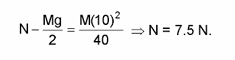
A small block of mass 1 kg is released from rest at the top of a rough track. The track is a circular arc of radius 40 m . The block slides along the track without toppling and a frictional force acts on it in the direction opposite to the instantaneous velocity. The work done in overcoming the friction up to the point $Q$, as shown in the figure below, is 150 J . (Take the acceleration due to gravity, $\mathrm{g}=10 \mathrm{~m} \mathrm{~s}^{-2}$ )
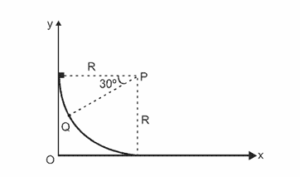
The magnitude of the normal reaction that acts on the block at the point $Q$ is :
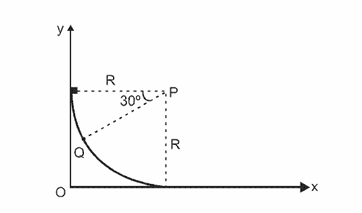 The magnitude of the normal reaction that acts on the block at the point $Q$ is :