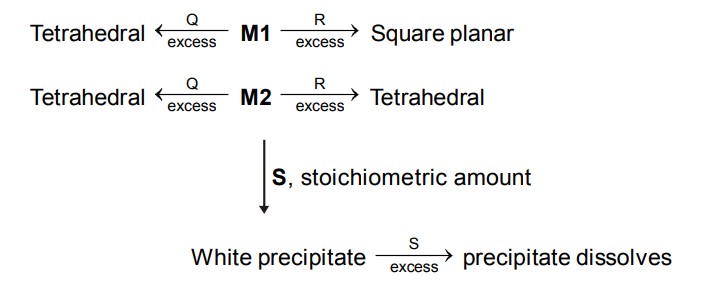
An aqueous solution of metal ion M1 reacts separately with reagents Q and R in excess to give tetrahedral
and square planar complexes, respectively. An aqueous solution of another metal ion M2 always forms
tetrahedral complexes with these reagents. Aqueous solution of M2 on reaction with reagent S gives
white precipitate which dissolves in excess of S. The reactions are summarized in the scheme given
below :
SCHEME:
M1, Q and R, respectively are :
Select the correct option:
A
$\mathrm{Zn}^{2+}, \mathrm{KCN}$ and HCl
B
$\mathrm{Ni}^{2+}, \mathrm{HCl}$ and KCN
C
$\mathrm{Cd}^{2+}, \mathrm{KCN}$ and HCl
D
$\mathrm{Co}^{2+}, \mathrm{HCl}$ and KCN
✓ Correct! Well done.
✗ Incorrect. Try again or view the solution.
Solution
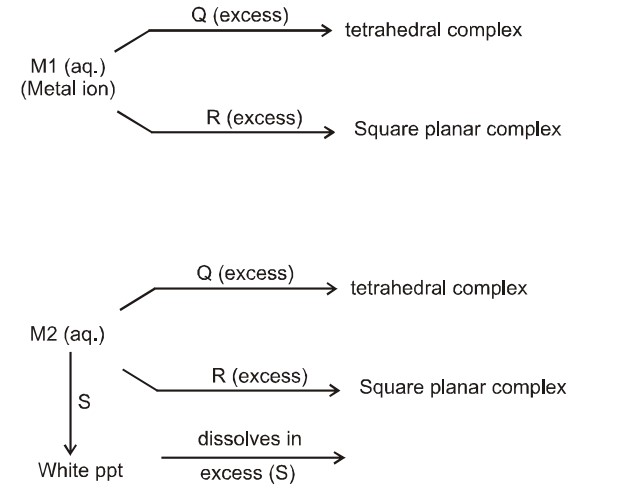
Reaction with ( S ) indicates amphoteric nature of M2 . Amongst the options mentioned for ( S )
[Note : M2 may be $\mathrm{Zn}^{2+}$, which (a) is amphoteric (b) has cordination number 4 and (c) always from tetrahedral complexes. It may be noted that $\mathrm{Be}^{2+}$ will also qualify with these characterstics]
Let us consider the possiblities of M1. M1 should be able to form square planner complex (dsp ${ }^2$ hybridisation) as well as tetrahedral ( $\mathrm{sp}^3$ ). This rules out $\mathrm{Zn}^{2+} \& \mathrm{Cd}^{2+}\left[\because \mathrm{d}^{10}\right.$ configuration will not allow $\mathrm{dsp}^2$ hybridization]
$\mathrm{Ni}^{2+}$ is most suitable
$\mathrm{Ni}^{2+}$ (aq.) $+4 \mathrm{CN}^{-}$(excess) $\rightleftharpoons \mathrm{Ni}(\mathrm{CN})_4^{2-}$ (square planner)
$\mathrm{Ni}^{2+}$ (aq.) $+\mathrm{Cl}^{-}$(excess) $\rightleftharpoons \mathrm{NiCl}_4{ }^{2-}$ (tetrahedral)
[Note : $\mathrm{Co}^{2+}+6 \mathrm{CN}^{-}$(excess) ⟶ $\mathrm{Co}(\mathrm{CN})_6^{4-}$, an octahedral compelex]
Hello 👋 Welcome to Competishun – India’s most trusted platform for JEE & NEET preparation. Need help with JEE / NEET courses, fees, batches, test series or free study material? Chat with us now 👇
 M1, Q and R, respectively are :
 Reaction with ( S ) indicates amphoteric nature of M2 . Amongst the options mentioned for ( S )