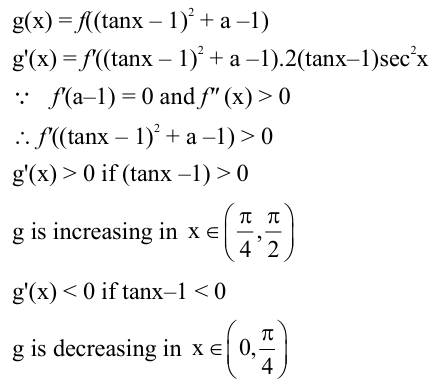
Let $f: \mathbf{R} \rightarrow \mathbf{R}$ be a twice differentiable function such that $f^{\prime \prime}(x)>0$ for all $x \in \mathbf{R}$ and $f^{\prime}(\mathrm{a}-1)=0$, where a is a real number. Let $\mathrm{g}(x)=f\left(\tan ^2 x-2 \tan x+\mathrm{a}\right), 0<x<\frac{\pi}{2}$.
Consider the following two statements :
(I) g is increasing in $\left(0, \frac{\pi}{4}\right)$
(II) g is deceasing in $\left(\frac{\pi}{4}, \frac{\pi}{2}\right)$
Then,