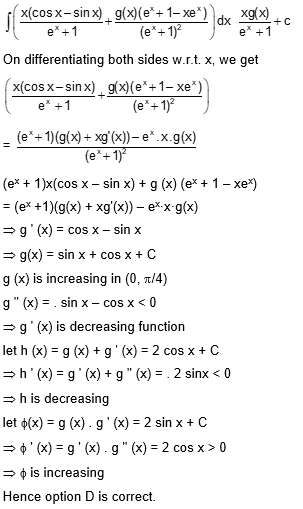
Let $\mathrm{g}:(0, \infty) \rightarrow \mathrm{R}$ be a differentiable function such that $\int\left(\frac{x(\cos x-\sin x)}{e^x+1}+\frac{g(x)\left(e^x+1-x e^x\right)}{\left(e^x+1\right)^2}\right) d x=\frac{x g(x)}{e^x+1}+c$, for all $x>0$, where $c$ is an arbitrary constant. Then
Select the correct option:
A
is decreasing in $\left(0, \frac{\pi}{4}\right)$
B
$g^{\prime}$ is increasing in $\left(0, \frac{\pi}{4}\right)$
C
$\mathrm{g}+\mathrm{g}^{\prime}$ is increasing in $\left(0, \frac{\pi}{2}\right)$
D
$g-g$ ' is increasing in $\left(0, \frac{\pi}{2}\right)$
Hello 👋 Welcome to Competishun – India’s most trusted platform for JEE & NEET preparation. Need help with JEE / NEET courses, fees, batches, test series or free study material? Chat with us now 👇