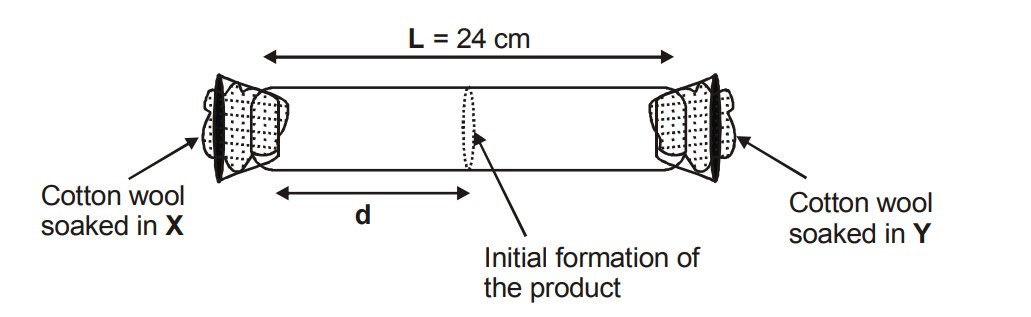
$\mathbf{X}$ and $\mathbf{Y}$ are two volatile liquids with molar weights of $10 \mathrm{~g} \mathrm{~mol}^{-1}$ and $40 \mathrm{~g} \mathrm{~mol}^{-1}$ respectively. Two cotton plugs, one soaked in $\mathbf{X}$ and the other soaked in $\mathbf{Y}$, are simultaneously placed at the ends of a tube of length $\mathbf{L}=24 \mathrm{~cm}$, as shown in the figure. The tube is filled with an inert gas at 1 atmosphere pressure and a temperature of 300 K . Vapours of $\mathbf{X}$ and $\mathbf{Y}$ react to form a product which is first observed at a distance $\mathbf{d} \mathbf{c m}$ from the plug soaked in $\mathbf{X}$. Take $\mathbf{X}$ and $\mathbf{Y}$ to have equal molecular diameters and assume ideal behaviour for the inert gas and the two vapours.
The experimental value of d is found to be smaller than the estimate obtained using Graham’s law. This
is due to :
Select the correct option:
A
larger mean free path for X as compared to that of Y.
B
larger mean free path for Y as compared to that of X.
C
increased collision frequency of Y with the inert gas as compared to that of X with the inert gas
D
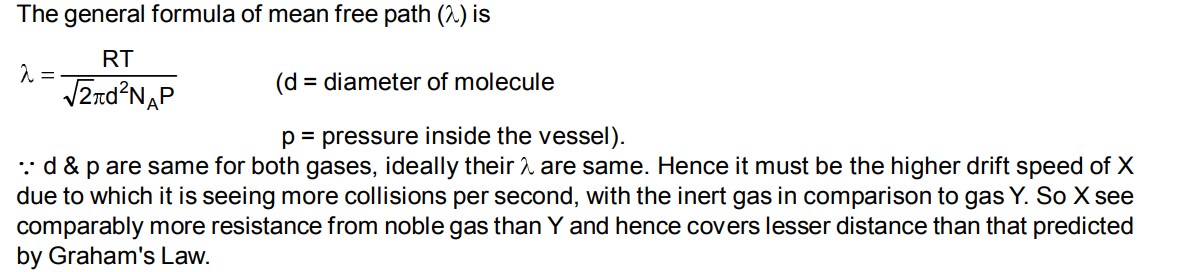
increased collision frequency of X with the inert gas as compared to that of Y with the inert gas.
Hello 👋 Welcome to Competishun – India’s most trusted platform for JEE & NEET preparation. Need help with JEE / NEET courses, fees, batches, test series or free study material? Chat with us now 👇
 The experimental value of d is found to be smaller than the estimate obtained using Graham’s law. This
is due to :
The experimental value of d is found to be smaller than the estimate obtained using Graham’s law. This
is due to :