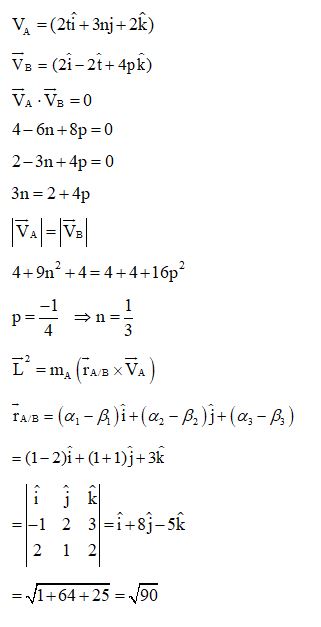
The position vectors of two 1 kg particles, (A) and (B), are given by $\overrightarrow{\mathbf{r}}_{\mathrm{A}}=\left(\alpha_1 \mathrm{t}^2 \hat{i}+\alpha_2 \hat{j}+\alpha_3 \hat{t}\right) \mathrm{m}$ and $\overrightarrow{\mathrm{r}}_{\mathrm{B}}=\left(\beta_1 \mathrm{t} \hat{i}+\beta_2 \mathrm{t}^2 \hat{j}+\beta_3 t \hat{k}\right) \mathrm{m}$, respectively; $\left(\alpha_1=1 \mathrm{~m} / \mathrm{s}^2, \alpha_2=3 \mathrm{~nm} / \mathrm{s}, \alpha_3=2 \mathrm{~m} / \mathrm{s}, \beta_1=2 \mathrm{~m} / \mathrm{s}, \beta_2=-1 \mathrm{~m} / \mathrm{s}^2, \beta_3=4 \mathrm{pm} / \mathrm{s}\right)$, where t is time, n and p are constants. At $t=1 \mathrm{~s},\left|\vec{V}_A\right|=\left|\vec{V}_B\right|$ and velocities $\vec{V}_A$ and $\vec{V}_B$ of the particles are orthogonal to each other. At $t=1 \mathrm{~s}$, the magnitude of angular momentum of particle (A) with respect to the position of particle (B) is $\sqrt{\mathrm{L}} \mathrm{kgm}^2 \mathrm{~s}^{-1}$. The value of L is $\_\_\_\_$ .