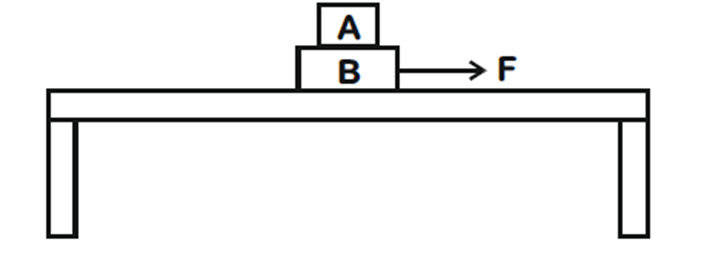
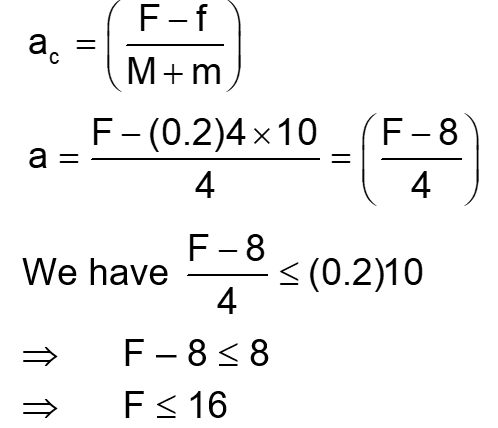
Two blocks $A$ and $B$ of masses $m_A=1 \mathrm{~kg}$ and $\mathrm{m}_{\mathrm{B}}=3 \mathrm{~kg}$ are kept on the table as shown in figure. The coefficient of friction between $A$ and $B$ is 0.2 and between $B$ and the surface of the table is also 0.2 . The maximum force $F$ that can be applied on B horizontally, so that the block A does not slide over the block B is:
[Take $\mathrm{g}=10 \mathrm{~m} / \mathrm{s}^2$ ]
Hello 👋 Welcome to Competishun – India’s most trusted platform for JEE & NEET preparation. Need help with JEE / NEET courses, fees, batches, test series or free study material? Chat with us now 👇