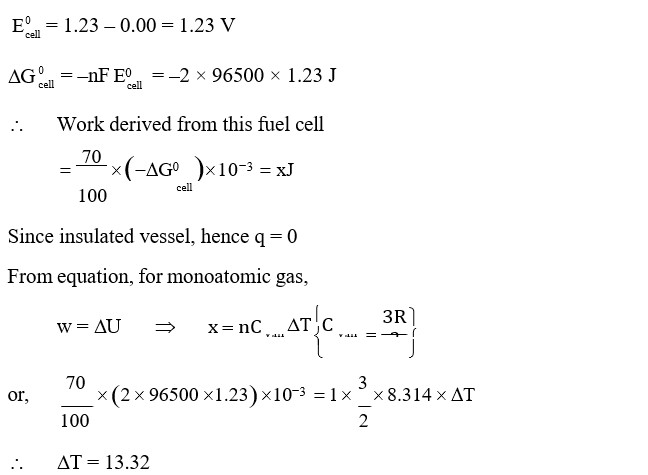
Consider a 70% efficient hydrogen-oxygen fuel cell working under standard conditions at 1 bar and 298 K. Its cell reaction is
$
\mathrm{H}_2(\mathrm{~g})+\frac{1}{2} \mathrm{O}_2(\mathrm{~g}) \rightarrow \mathrm{H}_2 \mathrm{O}(\ell) .
$
The work derived from the cell on the consumption of $1.0 \times 10^{-3} \mathrm{~mol}$ of $\mathrm{H}_2(\mathrm{~g})$ is used to compress 1.00 mol of a monoatomic ideal gas in a thermally insulted container. What is the change in the temperature (in K ) of the ideal gas ?
The standard reduction potentials for the two half-cells are given below.
$
\begin{gathered}
\mathrm{O}_2(\mathrm{~g})+4 \mathrm{H}^{+} \text {(aq.) }+4 \mathrm{e}^{-} \rightarrow 2 \mathrm{H}_2 \mathrm{O}(\ell), \mathrm{E}^{\circ}=1.23 \mathrm{~V} \\
2 \mathrm{H}^{+} \text {(aq.) }+2 \mathrm{e}^{-} \rightarrow \mathrm{H}_2(\mathrm{~g}), \mathrm{E}^{\circ}=0.00 \mathrm{~V}
\end{gathered}
$
Use $\mathrm{F}=96500 \mathrm{C} \mathrm{mol}^{-1}, \mathrm{R}=8.314 \mathrm{~J} \mathrm{~mol}^{-1} \mathrm{~K}^{-1}$
Hello 👋 Welcome to Competishun – India’s most trusted platform for JEE & NEET preparation. Need help with JEE / NEET courses, fees, batches, test series or free study material? Chat with us now 👇