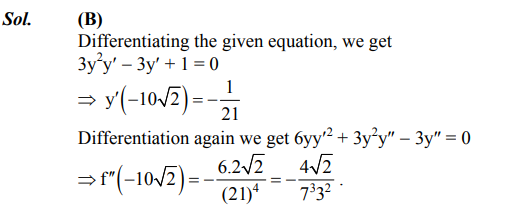
Consider the functions defined implicitly by the equation $y^3-3 y+x=0$ on various intervals in the real line. If $x \in(-\infty,-2) \cup(2, \infty)$, the equation implicitly defines a unique real valued differentiable function $y=f(x)$. If $\mathrm{x} \in(-2,2)$, the equation implicitly defines a unique real valued differentiable function $\mathrm{y}=\mathrm{g}(\mathrm{x})$ satisfying $\mathrm{g}(0)=0$.
If $\mathrm{f}(-10 \sqrt{2})=2 \sqrt{2}$, then $\mathrm{f}^{\prime \prime}(-10 \sqrt{2})=$