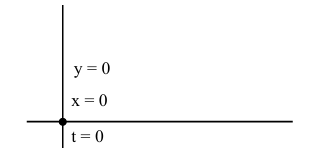
Starting at time $t=0$ from the origin with speed $1 \mathrm{~ms}^{-1}$, a particle follows a two-dimensional trajectory in the $x-y$ plane so that its coordinates are related by the equation $y=\frac{x^2}{2}$. The $x$ and $y$ components of its acceleration are denoted by $a_x$ and $a_y$, respectively. Then
Select ALL correct options:
A
$a_x=1 \mathrm{~ms}^{-2}$ implies that when the particle is at the origin, $a_y=1 \mathrm{~ms}^{-2}$
B
$a_x=0$ implies $a_y=1 \mathrm{~ms}^{-2}$ at all times
C
at $t=0$, the particle's velocity points in the $x$-direction
D
$a_x=0$ implies that at $t=1 \mathrm{~s}$, the angle between the particle's velocity and the $x$ axis is $45^{\circ}$
✓ Correct! Well done.
✗ Incorrect. Try again or view the solution.
⚠ Partially correct. Some answers are missing.
Solution
$$
y=\frac{x^2}{2}
$$
$$
\begin{aligned}
& \text { at } \left.t=0, \begin{array}{l}
x=0, y=0 \\
u=1
\end{array}\right\} \text { given } \\
& y=\frac{x^2}{2} \\
& \frac{d y}{d t}=\frac{1}{2} \cdot 2 x \frac{d x}{d t} \\
& \Rightarrow v_y=x v_x
\end{aligned}
$$
difference wrt time
$$
\begin{aligned}
& a_y=\frac{d x}{d t} \cdot V_x+x a_x \\
& a_y=v_x^2+x a_x
\end{aligned}
$$
Option
(A) If $\mathrm{a}_{\mathrm{x}}=1$ and particle is at origin
$$
(x=0, y=0)
$$
$$
\begin{aligned}
& a_y=v_x^2 \\
& a_y=1^2=1
\end{aligned}
$$
At origin, at $\mathrm{t}=0 \mathrm{sec}$
speed $=1$ given
(B) Option
$$
a_y=v_x^2+x a_z
$$
given in option $\mathrm{B}, \mathrm{a}_{\mathrm{x}}=0$
$$
\Rightarrow a_y=v_z{ }^2
$$
If $a_x=0, v_x=$ constant $=1$, (all the time)
$\Rightarrow \mathrm{a}_y=\mathrm{I}^2=\mathrm{I}$ (all the time)
(C) at $\mathrm{t}=0, \mathrm{x}=0 \quad \mathrm{v}_{\mathrm{y}}=\mathrm{x} \mathrm{v}_{\mathrm{x}}$
speed $=1$
$$
\begin{aligned}
& v_y=0 \\
& v_z=1
\end{aligned}
$$
(D)
$$
\begin{aligned}
& a_y=v_x^2+x a_2 \\
& v_y=x v_x \\
& a_x=0 \text { (given in D option) } \\
& \Rightarrow a_y=v_x^2
\end{aligned}
$$
If $\mathrm{a}_{\mathrm{x}}=0 \Rightarrow \mathrm{~V}_{\mathrm{x}}=$ constant initially $\left(\mathrm{v}_{\mathrm{x}}=1\right)$
$$
\Rightarrow a_y=1^2=1
$$
at $\mathrm{t}=1 \mathrm{sec}$
$$
v_y=0+a_y \times t=1 \times 1=1
$$
$$
\tan \theta=\frac{v_y}{v_s}=x
$$
( $\theta \rightarrow$ angle with x axis)
$$
\tan \theta=\frac{v_7}{v_s}=\frac{1}{1}=1
$$
$$
\theta=45^{\circ}
$$
Hello 👋 Welcome to Competishun – India’s most trusted platform for JEE & NEET preparation. Need help with JEE / NEET courses, fees, batches, test series or free study material? Chat with us now 👇