Let $\quad M=\left\{(x, y) \in \mathbb{R} \times \mathbb{R}: x^2+y^2 \leq r^2\right\}$,
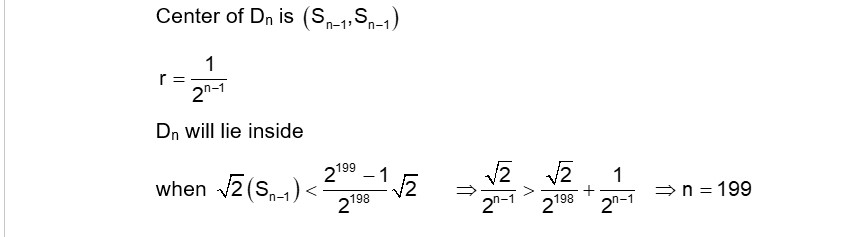
where $\mathrm{r}>0$. Consider the geometric progression $\mathrm{a}_{\mathrm{n}}=\frac{1}{2^{\mathrm{n}-1}}, \mathrm{n}=1,2,3 \ldots$. Let $\mathrm{S}_0=0$ and, for $\mathrm{n} \geq 1$, let $\mathrm{S}_{\mathrm{n}}$ denote the sum of the first $n$ terms of this progression. For $n \geq 1$, let $C_n$ denote the circle with center $\left(S_{n-1}, 0\right)$ and radius $a_n$, and $D_n$ denote the circle with center $\left(S_{n-1}, S_{n-1}\right)$ and radius $a_n$.
Consider $M$ with $r=\frac{\left(2^{199}-1\right) \sqrt{2}}{2^{198}}$. The number of all those circles $D_n$ that are inside $M$ is
Hello 👋 Welcome to Competishun – India’s most trusted platform for JEE & NEET preparation. Need help with JEE / NEET courses, fees, batches, test series or free study material? Chat with us now 👇