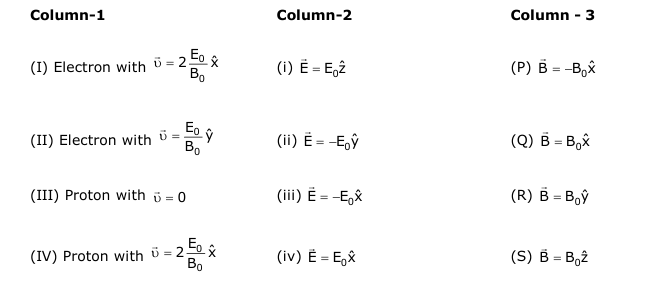
A charged particle (electron or proton) is introduced at the origin ( $x=0, y=0, z=0$ ) with a given initial velocity $\overrightarrow{\mathrm{v}}$. A uniform electric field $\overrightarrow{\mathrm{E}}$ and a uniform magnetic field $\overrightarrow{\mathrm{B}}$ exist everywhere. The velocity $\vec{v}$, electric field $\vec{E}$ and magnetic field $\vec{B}$ are given in columns 1,2 and 3 respectively. The quantities $\mathrm{E}_0, \mathrm{~B}_0$ are positive in magnitude.
In which case would the particle move in a straight line along the negative direction of $y$-axis (i.e., move along - $\hat{\mathrm{y}}$ ) ?
Hello 👋 Welcome to Competishun – India’s most trusted platform for JEE & NEET preparation. Need help with JEE / NEET courses, fees, batches, test series or free study material? Chat with us now 👇