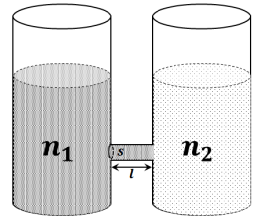
As shown schematically in the figure, two vessels contain water solutions (at temperature $T$ ) of potassium permanganate $\left(\mathrm{KMnO}_4\right)$ of different concentrations $n_1$ and $n_2\left(n_1>n_2\right)$ molecules per unit volume with $\Delta n=\left(n_1-n_2\right) \ll n_1$. When they are connected by a tube of small length $\ell$ and cross-sectional area $\mathrm{S}, \mathrm{KMnO}_4$ starts to diffuse from the left to the right vessel through the tube. Consider the collection of molecules to behave as dilute ideal gases and the difference in their partial pressure in the two vessels causing the diffusion. The speed v of the molecules is limited by the viscous force $-\beta v$ on each molecule, where $\beta$ is a constant. Neglecting all terms of the order $(\Delta n)^2$, which of the following is/are correct? ( $k_B$ is the Boltzmann constant)-
Select ALL correct options:
A
the force causing the molecules to move across the tube is $\Delta n k_B T S$
B
force balance implies $n_1 \beta v \ell=\Delta n k_B T$
C
total number of molecules going across the tube per sec is $\left(\frac{\Delta \mathrm{n}}{\ell}\right)\left(\frac{\mathrm{k}_{\mathrm{B}} \mathrm{T}}{\beta}\right) \mathrm{S}$
D
rate of molecules getting transferred through the tube does not change with time
✓ Correct! Well done.
✗ Incorrect. Try again or view the solution.
⚠ Partially correct. Some answers are missing.
Solution
Sol. $n_1 \gg\left(n_1-n_2\right)=\Delta n$
$$
\begin{aligned}
& \mathrm{p}_1=\frac{\mathrm{n}_1 \mathrm{RT}}{\mathrm{~N}_{\mathrm{A}}} \quad \mathrm{p}_2=\frac{\mathrm{n}_2 \mathrm{RT}}{\mathrm{~N}_{\mathrm{A}}} \\
\mathrm{~F}=\left(\mathrm{n}_1-\mathrm{n}_2\right) \mathrm{k}_{\mathrm{B}} \mathrm{TS}=\Delta \mathrm{nk}_{\mathrm{B}} \mathrm{TS}(\mathrm{~A}) & \\
\mathrm{V} & =\frac{\Delta \mathrm{nk}_{\mathrm{B}} \mathrm{TS}}{\beta}
\end{aligned}
$$
Force balance ⇒ Pressure × Area $=$ Total number of molecules $\times \beta v$
$$
\begin{aligned}
& \Delta \mathrm{n}_{\mathrm{B}} \mathrm{TS}=\ell \mathrm{n}_1 \mathrm{~S} \beta \mathrm{v} \\
\Rightarrow & \mathrm{n}_1 \beta \mathrm{v} \ell=\Delta \mathrm{n}_{\mathrm{B}} \mathrm{~T}
\end{aligned}
$$
Total number of molecules $/ \mathrm{sec}=\frac{\left(\mathrm{n}_1 \mathrm{vdt}\right) \mathrm{S}}{\mathrm{dt}}$
$$
\begin{aligned}
& =\mathrm{n}_1 \mathrm{vS}=\frac{\Delta \mathrm{nk}_{\mathrm{B}} \mathrm{TvS}}{\beta \mathrm{v} \ell} \\
& =\left(\frac{\Delta \mathrm{n}}{\ell}\right)\left(\frac{\mathrm{k}_{\mathrm{B}} \mathrm{~T}}{\beta}\right) \mathrm{S}
\end{aligned}
$$
As $\Delta \mathrm{n}$ will decrease with time therefore rate of molecules getting transfer decreases with time.
Hello 👋 Welcome to Competishun – India’s most trusted platform for JEE & NEET preparation. Need help with JEE / NEET courses, fees, batches, test series or free study material? Chat with us now 👇