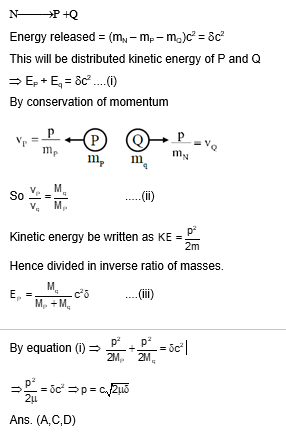
A heavy nucleus N , at rest, undergoes fission $\mathrm{N} \rightarrow \mathrm{P}+\mathrm{Q}$, where P and Q are two lighter nuclei. Let $\delta=\mathrm{M}_{\mathrm{N}}-\mathrm{M}_{\mathrm{P}}-\mathrm{M}_{\mathrm{Q}}$, where $\mathrm{M}_{\mathrm{P}}, \mathrm{M}_{\mathrm{Q}}$ and $\mathrm{M}_{\mathrm{N}}$ are the masses of $\mathrm{P}, \mathrm{Q}$ and N , respectively. $\mathrm{E}_{\mathrm{P}}$ and $E_0$ are the kinetic energies of $P$ and $Q$, respectively. The speed of $P$ and $Q$ are $v_p$ and $v_Q$, respectively. If c is the speed of light, which of the following statement(s) is(are) correct ?
Select ALL correct options:
A
$E_P+E_Q=c^2 \delta$
B
$E_P=\left(\frac{M_P}{M_P+M_Q}\right) c^2 \delta$
C
$\frac{v_p}{v_Q}=\frac{M_Q}{M_p}$
D
The magnitude of momentum for $P$ as well as $Q$ is $c \sqrt{2 \mu \delta}$, where $\mu=\frac{M_p M_o}{\left(M_p+M_o\right)}$
Hello 👋 Welcome to Competishun – India’s most trusted platform for JEE & NEET preparation. Need help with JEE / NEET courses, fees, batches, test series or free study material? Chat with us now 👇