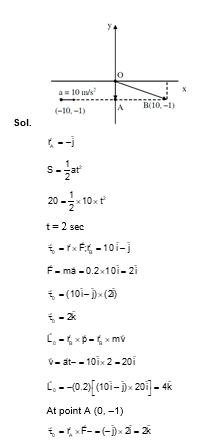
A particle of mass $M=0.2 \mathrm{~kg}$ is initially at rest in the $x y$-plane at a point $(x=-1, y=-h)$, where $\mathrm{I}=10 \mathrm{~m}$ and $\mathrm{h}=1 \mathrm{~m}$. The particle is accelerated at time $\mathrm{t}=0$ with a constant acceleration $\mathrm{a}=10 \mathrm{m} / \mathrm{s}^2$ along the positive x -direction. Its angular momentum and torque with respect to the origin, in SI units, are represented by $\vec{L}$ and $t$, respectively. $\hat{i} \hat{j}$ and $\hat{k}$ are unit vectors along the positive $x, y$ and z -directions, respectively. If $\hat{\mathrm{k}}=\hat{\mathrm{i}} \times \hat{\mathrm{j}}$ then which of the following statement(s) is(are) correct?
Select ALL correct options:
A
The particle arrives at the point $(x=I, y=-h)$ at time $t=2 s$.
B
$t=2 \hat{k}$ when the particle passes through the point $(x=1, y=-h)$
C
$\overrightarrow{\mathrm{L}}=4 \hat{\mathrm{k}}$ when the particle passes through the point $(x=1, y=-h)$
D
$t=\hat{k}$ when the particle passes through the point $(x=0, y=-h)$
Hello 👋 Welcome to Competishun – India’s most trusted platform for JEE & NEET preparation. Need help with JEE / NEET courses, fees, batches, test series or free study material? Chat with us now 👇