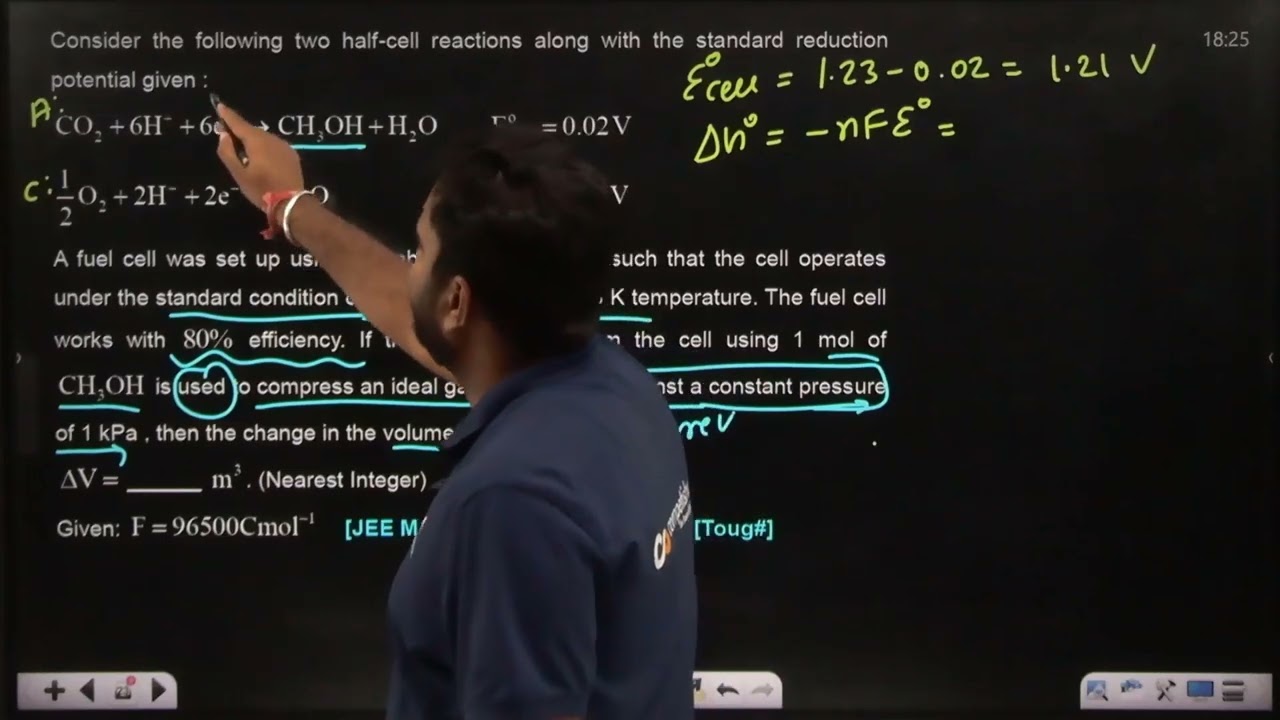
Consider the following two half-cell reactions along with the standard reduction potential given :
$$
\begin{array}{ll}
\mathrm{CO}_2+6 \mathrm{H}^{+}+6 \mathrm{e}^{-} \rightarrow \mathrm{CH}_3 \mathrm{OH}+\mathrm{H}_2 \mathrm{O} & \mathrm{E}_{\mathrm{red}}^{\mathrm{o}}=0.02 \mathrm{~V} \\
\frac{1}{2} \mathrm{O}_2+2 \mathrm{H}^{+}+2 \mathrm{e}^{-} \rightarrow \mathrm{H}_2 \mathrm{O} & \mathrm{E}_{\mathrm{red}}^{\mathrm{o}}=1.23 \mathrm{~V}
\end{array}
$$
A fuel cell was set up using the above two reactions such that the cell operates under the standard condition of 1 bar pressure and 298 K temperature. The fuel cell works with $80 \%$ efficiency. If the work derived from the cell using 1 mol of $\mathrm{CH}_3 \mathrm{OH}$ is used to compress an ideal gas isothermally against a constant pressure of 1 kPa , then the change in the volume of the gas,
$$
\Delta \mathrm{V}=\ldots \mathrm{m}^3 \text {. (nearest integer) }
$$
Given: $\mathrm{F}=96500 \mathrm{Cmol}^{-1}$
Hello 👋 Welcome to Competishun – India’s most trusted platform for JEE & NEET preparation. Need help with JEE / NEET courses, fees, batches, test series or free study material? Chat with us now 👇