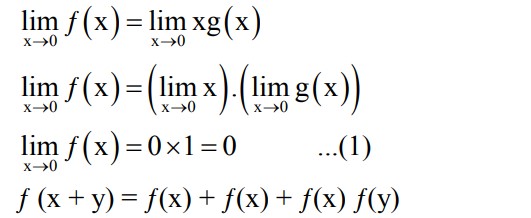
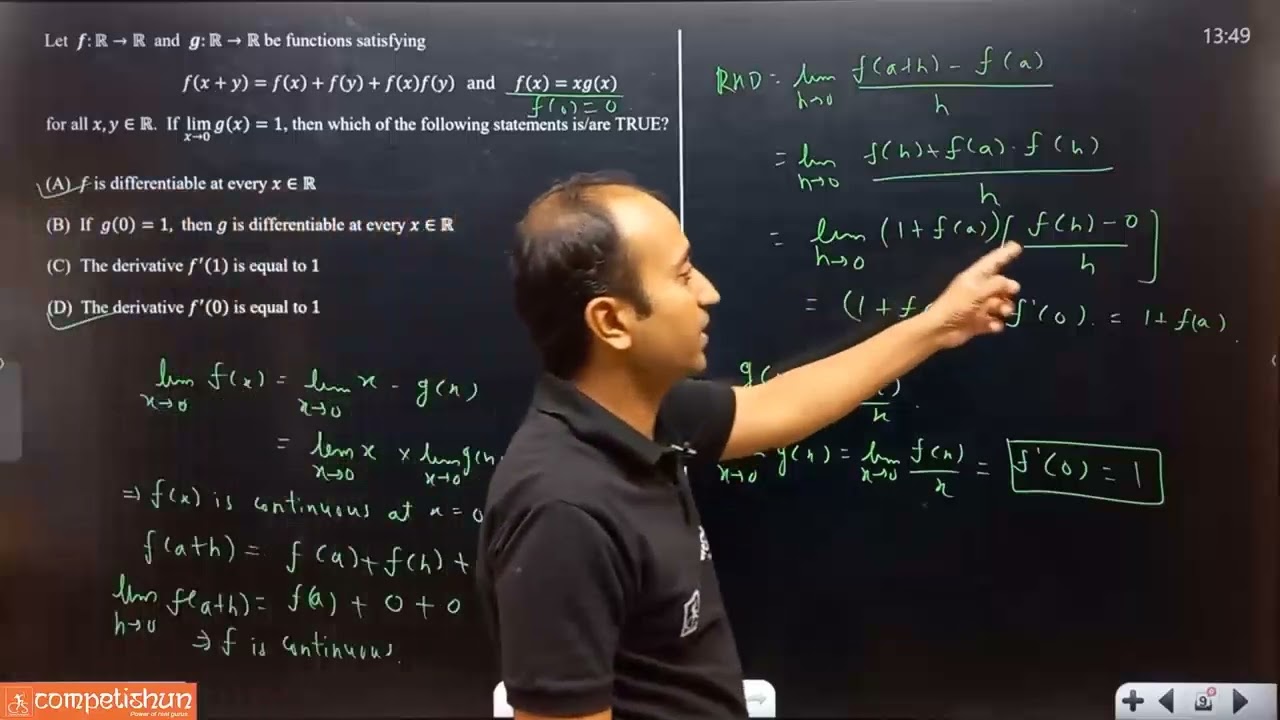
since ƒ(x) = xg(x)
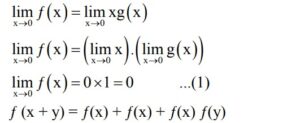
Now we check continuity of $f(\mathrm{x})$
at $x=a$
$
\begin{aligned}
& \lim _{\mathrm{h} \rightarrow 0} f(\mathrm{a}+\mathrm{h})=f(\mathrm{a})+f(\mathrm{~b})+f(\mathrm{a})+f(\mathrm{~h}) \\
& \lim _{\mathrm{x} \rightarrow 0}(f(\mathrm{a})+f(\mathrm{~h})(1+f(\mathrm{a}))) \\
& \lim _{\mathrm{h} \rightarrow 0} f(\mathrm{a}+\mathrm{h})=f(\mathrm{a})
\end{aligned}
$
$\therefore f(\mathrm{x})$ is continuous $\forall \mathrm{x} \in \mathrm{R}$
$
\begin{aligned}
& \lim _{x \rightarrow 0} f(x)=f(0)=0 \quad\left(\lim _{x \rightarrow 0} f(x)=0\right) \\
& \therefore f(0)=0
\end{aligned}
$
and $\lim _{x \rightarrow 0} \frac{f^{\prime}(x)}{1}=1$
$
\therefore f^{\prime}(0)=1
$
Now
$
f(\mathrm{x}+\mathrm{y})=f(\mathrm{x})+f(\mathrm{y})+f(\mathrm{x}) f(\mathrm{y})
$
using partial derivative (w.r.t. y)
$
\begin{aligned}
& f^{\prime}(\mathrm{x}+\mathrm{y})+f^{\prime}(\mathrm{y})+f(\mathrm{x})+f^{\prime}(\mathrm{y}) \\
& \text { put } \mathrm{y}=0 \\
& f^{\prime}(\mathrm{x})=f^{\prime}(0)+f(\mathrm{x}) f^{\prime}(0) \\
& f^{\prime}(\mathrm{x})=1+f(\mathrm{x}) \\
& \int \frac{f^{\prime}(\mathrm{x})}{1+f(\mathrm{x})} \mathrm{d} \mathrm{x}=\int 1 \mathrm{dx} \\
& \ell \mathrm{n}|(1+f(\mathrm{x}))|=\mathrm{x}+\mathrm{C} \\
& f(0)=0 ; \mathrm{c}=0 \therefore|1+f(\mathrm{x})|=\mathrm{e}^{\mathrm{x}} \\
& 1+f(\mathrm{x})= \pm \mathrm{e}^{\mathrm{x}} \text { or } f(\mathrm{x})= \pm \mathrm{e}^{\mathrm{x}}-1
\end{aligned}
$
Now $f(0)=0 \therefore f(\mathrm{x})=\mathrm{e}^{\mathrm{x}}-1$
$
\therefore f(\mathrm{x})=\mathrm{e}^{\mathrm{x}}-1
$
option (A) is correct and $f^{\prime}(\mathrm{x})=\mathrm{e}^{\mathrm{x}} f^{\prime}(0)=1$ option(D) is correct
$
\begin{aligned}
& \mathrm{g}(\mathrm{x})=\frac{f(\mathrm{x})}{\mathrm{x}}=\left\{\begin{array}{ccc}
\frac{\mathrm{e}^{\mathrm{x}}-1}{\mathrm{x}} & ; & \mathrm{x} \neq 0 \\
1 & ; & \mathrm{x}=0
\end{array}\right\} \\
& \mathrm{g}^{\prime}(0+\mathrm{h})=\lim _{\mathrm{h} \rightarrow 0} \frac{\mathrm{~g}(0+\mathrm{h})-\mathrm{g}(0)}{\mathrm{h}} \\
& =\lim _{\mathrm{h} \rightarrow 0} \frac{\frac{\mathrm{e}^{\mathrm{h}}-1}{\mathrm{~h}}-1}{\mathrm{~h}}=\frac{1}{2}
\end{aligned}
$
option B is correct