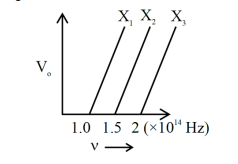
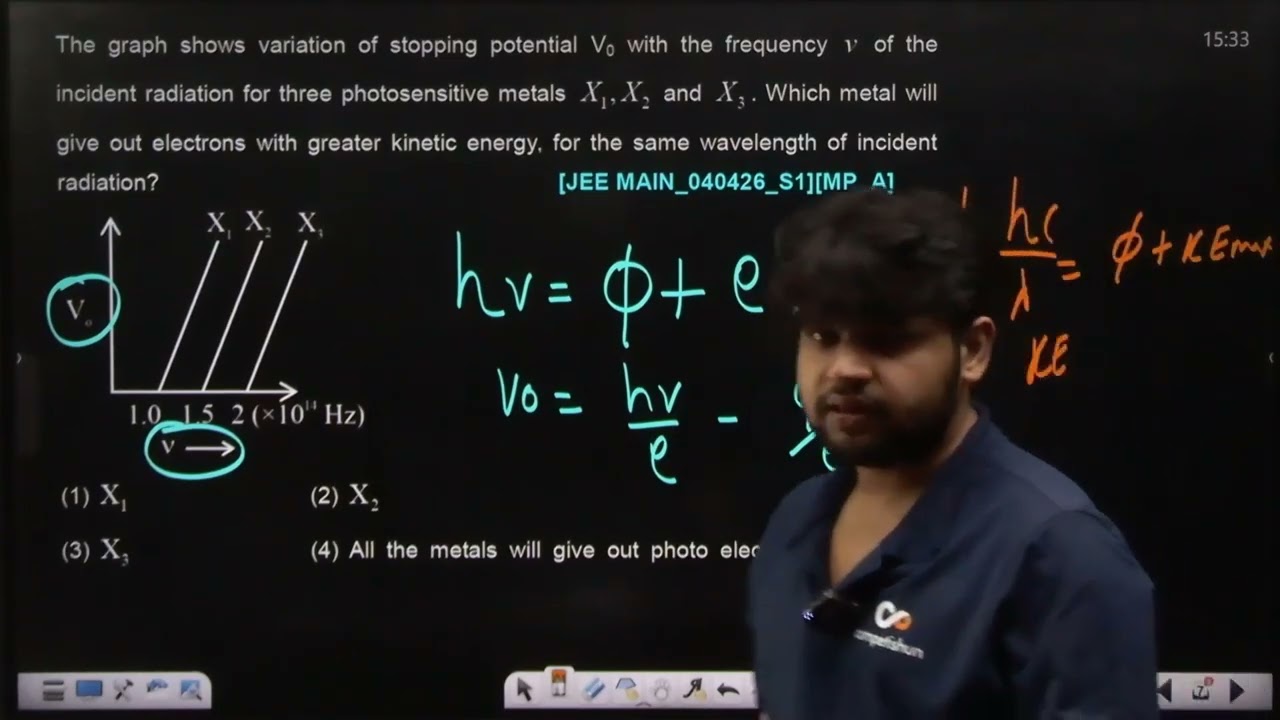
The graph shows variation of stopping potential $V_0$ with the frequency $v$ of the incident radiation for three photosensitive metals $\mathrm{X}_1, \mathrm{X}_2$ and $\mathrm{X}_3$. Which metal will give out electrons with greater kinetic energy, for the same wavelength of incident radiation?
Select the correct option:
A
$X_1$
B
$X_2$
C
$X_3$
D
All the metals will give out photo electrons with same kinetic energies.
✓ Correct! Well done.
✗ Incorrect. Try again or view the solution.
Solution
Sol.
1. From Einstein's photoelectric equation:
$$
K_{\max }=h v-\phi
$$
where $K_{\max }$ is the maximum kinetic energy, $h$ is Planck's constant, $v$ is the frequency of incident radiation, and $\phi$ is the work function.
2. The work function $\phi$ is related to the threshold frequency $v_0$ by:
$$
\phi=h v_0
$$
3. Substituting $\phi$ into the kinetic energy equation:
$$
K_{\max }=h v-h v_0
$$
4. For a constant incident wavelength $\lambda$ (and thus constant frequency $\nu=c / \lambda$ ):
$$
K_{\max } \propto-v_0
$$
This implies that the metal with the lowest threshold frequency $v_0$ will yield electrons with the highest maximum kinetic energy.
5. From the provided $V_0$ vs $v$ graph, the x-intercepts represent the threshold frequencies:
- For $X_1: v_{0,1}=1.0 \times 10^{14} \mathrm{~Hz}$
- For $X_2: v_{0,2}=1.5 \times 10^{14} \mathrm{~Hz}$
- For $X_3: v_{0,3}=2.0 \times 10^{14} \mathrm{~Hz}$
6. Comparing the values:
$$
v_{0,1}
Hello 👋 Welcome to Competishun – India’s most trusted platform for JEE & NEET preparation. Need help with JEE / NEET courses, fees, batches, test series or free study material? Chat with us now 👇