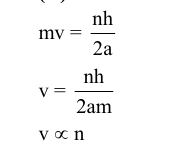
When a particle is restricted to move along x -axis between $\mathrm{x}=0$ and $\mathrm{x}=\mathrm{a}$, where a is of nanometer dimension, its energy can take only certain specific values. The allowed energies of the particle moving in such a restricted region, correspond to the formation of standing waves with nodes at its ends $x=0$ and $x=a$. The wavelength of this standing wave is related to the linear momentum p of the particle according to the de Broglie relation. The energy of the particle of mass $m$ is related to its linear momentum as $E=p^2 / 2 m$. Thus, the energy of the particle can be denoted by a quantum number ' $n$ ' taking values $1,2,3, \ldots$. ( $n=1$, called the ground state) corresponding to the number of loops in the standing wave.
Use the model described above to answer the following three questions for a particle moving in the line $\mathrm{x}=0$ to $\mathrm{x}=\mathrm{a}$. Take $\mathrm{h}=6.6 \times 10^{-34} \mathrm{Js}$ and $\mathrm{e}=1.6 \times 10^{-19} \mathrm{C}$.
The speed of the particle that can take discrete values is proportional to
Hello 👋 Welcome to Competishun – India’s most trusted platform for JEE & NEET preparation. Need help with JEE / NEET courses, fees, batches, test series or free study material? Chat with us now 👇