Let $\mathrm{a}, \mathrm{b}$ and c be three real numbers satisfying $\left[\begin{array}{lll}\mathrm{a} & \mathrm{b} & \mathrm{c}\end{array}\right]\left[\begin{array}{lll}1 & 9 & 7 \\ 8 & 2 & 7 \\ 7 & 3 & 7\end{array}\right]=\left[\begin{array}{lll}0 & 0 & 0\end{array}\right]$
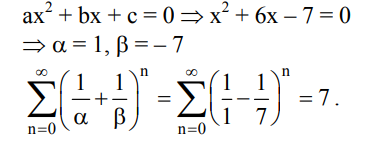
Let $\mathrm{b}=6$, with a and c satisfying (E). If $\alpha$ and $\beta$ are the roots of the quadratic equation $\mathrm{ax}^2+\mathrm{bx}+\mathrm{c}=0$, then $\sum_{n=0}^{\infty}\left(\frac{1}{\alpha}+\frac{1}{\beta}\right)^n$ is
Hello 👋 Welcome to Competishun – India’s most trusted platform for JEE & NEET preparation. Need help with JEE / NEET courses, fees, batches, test series or free study material? Chat with us now 👇