Competishun Header

Report Issue

JEE Advanced 2020
Paper-2 2020
Multiple correct answers - Select all that apply
Question
Let 𝒇:ℝ→ℝ and π’ˆ:ℝ→ℝ be functions satisfying 𝑓(π‘₯+𝑦)=𝑓(π‘₯)+𝑓(𝑦)+𝑓(π‘₯)𝑓(𝑦) and 𝑓(π‘₯)=π‘₯𝑔(π‘₯) for all π‘₯,π‘¦βˆˆβ„. If $\lim _{x \rightarrow 0} g(x)=1$, then which of the following statements is/are TRUE?
Select ALL correct options:
A
𝑓 is differentiable at every π‘₯βˆˆβ„
B
If g(0)=1, then 𝑔 is differentiable at every π‘₯βˆˆβ„
C
The derivative 𝑓′(1) is equal to 1
D
The derivative 𝑓′(0) is equal to 1
βœ“ Correct! Well done.
βœ— Incorrect. Try again or view the solution.
⚠ Partially correct. Some answers are missing.
Solution
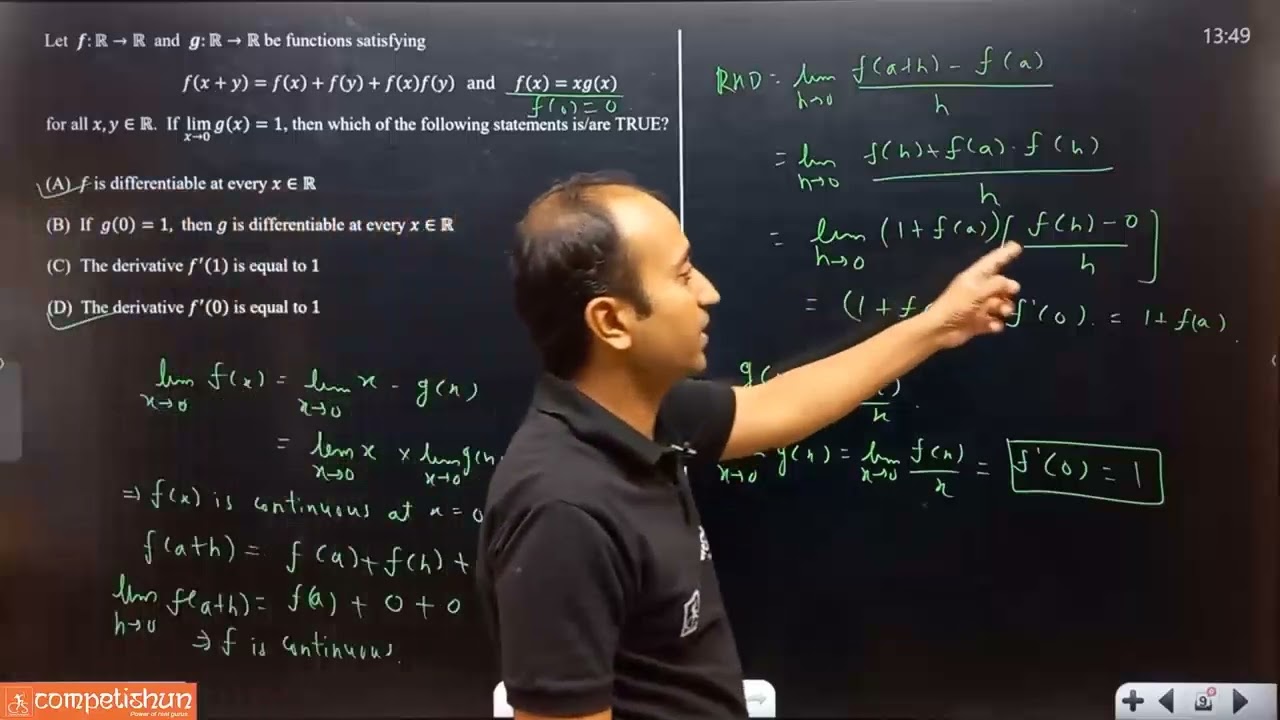
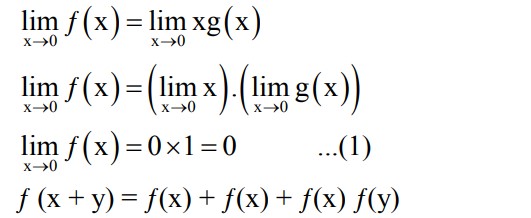
since Ζ’(x) = xg(x)

Now we check continuity of $f(\mathrm{x})$
at $x=a$
$ \begin{aligned} & \lim _{\mathrm{h} \rightarrow 0} f(\mathrm{a}+\mathrm{h})=f(\mathrm{a})+f(\mathrm{~b})+f(\mathrm{a})+f(\mathrm{~h}) \\ & \lim _{\mathrm{x} \rightarrow 0}(f(\mathrm{a})+f(\mathrm{~h})(1+f(\mathrm{a}))) \\ & \lim _{\mathrm{h} \rightarrow 0} f(\mathrm{a}+\mathrm{h})=f(\mathrm{a}) \end{aligned} $
$\therefore f(\mathrm{x})$ is continuous $\forall \mathrm{x} \in \mathrm{R}$
$ \begin{aligned} & \lim _{x \rightarrow 0} f(x)=f(0)=0 \quad\left(\lim _{x \rightarrow 0} f(x)=0\right) \\ & \therefore f(0)=0 \end{aligned} $
and $\lim _{x \rightarrow 0} \frac{f^{\prime}(x)}{1}=1$
$ \therefore f^{\prime}(0)=1 $
Now
$ f(\mathrm{x}+\mathrm{y})=f(\mathrm{x})+f(\mathrm{y})+f(\mathrm{x}) f(\mathrm{y}) $
using partial derivative (w.r.t. y)
$ \begin{aligned} & f^{\prime}(\mathrm{x}+\mathrm{y})+f^{\prime}(\mathrm{y})+f(\mathrm{x})+f^{\prime}(\mathrm{y}) \\ & \text { put } \mathrm{y}=0 \\ & f^{\prime}(\mathrm{x})=f^{\prime}(0)+f(\mathrm{x}) f^{\prime}(0) \\ & f^{\prime}(\mathrm{x})=1+f(\mathrm{x}) \\ & \int \frac{f^{\prime}(\mathrm{x})}{1+f(\mathrm{x})} \mathrm{d} \mathrm{x}=\int 1 \mathrm{dx} \\ & \ell \mathrm{n}|(1+f(\mathrm{x}))|=\mathrm{x}+\mathrm{C} \\ & f(0)=0 ; \mathrm{c}=0 \therefore|1+f(\mathrm{x})|=\mathrm{e}^{\mathrm{x}} \\ & 1+f(\mathrm{x})= \pm \mathrm{e}^{\mathrm{x}} \text { or } f(\mathrm{x})= \pm \mathrm{e}^{\mathrm{x}}-1 \end{aligned} $
Now $f(0)=0 \therefore f(\mathrm{x})=\mathrm{e}^{\mathrm{x}}-1$
$ \therefore f(\mathrm{x})=\mathrm{e}^{\mathrm{x}}-1 $
option (A) is correct and $f^{\prime}(\mathrm{x})=\mathrm{e}^{\mathrm{x}} f^{\prime}(0)=1$ option(D) is correct
$ \begin{aligned} & \mathrm{g}(\mathrm{x})=\frac{f(\mathrm{x})}{\mathrm{x}}=\left\{\begin{array}{ccc} \frac{\mathrm{e}^{\mathrm{x}}-1}{\mathrm{x}} & ; & \mathrm{x} \neq 0 \\ 1 & ; & \mathrm{x}=0 \end{array}\right\} \\ & \mathrm{g}^{\prime}(0+\mathrm{h})=\lim _{\mathrm{h} \rightarrow 0} \frac{\mathrm{~g}(0+\mathrm{h})-\mathrm{g}(0)}{\mathrm{h}} \\ & =\lim _{\mathrm{h} \rightarrow 0} \frac{\frac{\mathrm{e}^{\mathrm{h}}-1}{\mathrm{~h}}-1}{\mathrm{~h}}=\frac{1}{2} \end{aligned} $
option B is correct
Question Tags
JEE Advance
Mathematics
Easy
Start Preparing for JEE with Competishun
Video Solution
BY competishun
Video Solution
Watch Solution
Filters 0
JEE Main
JEE Advance
Easy
Medium
Hard
Showing 18 questions
Q JEE MAIN 20262026
Given below are two statements
Statement I: $\mathrm{H}_2 \mathrm{O}$ molecules move from the chamber 1 to chamber 2 .
Statement II:...
JEE MainChemistryMedium
View Solution→
QJEE MAIN 20212021
Which of the following molecules does not show stereo isomerism ?
JEE MainChemistryEasy
View Solution→
QJEE MAIN 2021 2021
Given below are two statements :
Statement-I : Ξ± and Ξ² forms of sulphur can change reversibly between themselves with...
JEE MainChemistryEasy
View Solution→
QJEE MAIN 20212021
Which one of the following statements is not true about enzymes ?
JEE MainChemistryEasy
View Solution→
Q JEE MAIN 20212021
The solubility product of $\mathrm{Pbl}_2$ is $8.0 \times 10^{-9}$. The solubility of lead iodide in 0.1 molar solution of lead...
JEE MainChemistryHard
View Solution→
QJEE MAIN 20222022
In Carius method of estimation of halogen. 0.45 g of an organic compound gave 0.36 g of AgBr. Find out...
JEE MainChemistryEasy
View Solution→
QJEE MAIN 20232023
The number of units, which are used to express concentration of solutions from the following is _______.
Mass percent,...
JEE MainChemistryEasy
View Solution→
QJEE MAIN 20222022
250 g solution of D-glucose in water contains 10.8% of carbon by weight. The molality of the solution is nearest...
JEE MainChemistryHard
View Solution→
QJEE MAIN 2019 2019
A compound ' $X$ ' on treatment with $\mathrm{Br}_2 / \mathrm{NaOH}$, provided $\mathrm{C}_3 \mathrm{H}_9 \mathrm{~N}$, which gives positive carbylamine test....
JEE MainChemistryMedium
View Solution→
QJEE MAIN 20232023
In the following reaction, 'A' is
JEE MainChemistryMedium
View Solution→
QJEE MAIN 20212021
Which one of the following reactions does not occur ?
JEE MainChemistryEasy
View Solution→
QJEE MAIN 2021 2021
The major products A and B formed in the following reaction sequence are :
JEE MainChemistryEasy
View Solution→
QJEE MAIN 2021 2021
Correct statement about the given chemical reaction is :
JEE MainChemistryEasy
View Solution→
QJEE MAIN 2021 2021
Carbylamine test is used to detect the presence of primary amino group in an organic compound. Which of the following...
JEE MainChemistryEasy
View Solution→
QJEE-MAIN 20202020
Three isomers A. B and C (mol. formula $\mathrm{C}_2 \mathrm{H}_7, \mathrm{~N}$ ) give the following results
JEE MainChemistryEasy
View Solution→
QJEE MAIN 20212021
In the chemical reactions given above A and B respectively are :
JEE MainChemistryEasy
View Solution→
QJEE MAIN 2019 2019
Benzene diazonium chloride on reaction with aniline in the presence of dilute hydrochloric acid gives :
JEE MainChemistryEasy
View Solution→
QJEE MAIN 20222022
Stability of $\alpha$ - Helix structure of proteins depends upon
JEE MainChemistryEasy
View Solution→