How to Solve JEE Main PYQs the Right Way: Chapter-Wise Strategy for Physics, Chemistry and Maths
JEE Main PYQ Strategy 2027 — Competishun
How to Solve JEE Main PYQs the Right Way: Chapter-Wise Strategy for Physics, Chemistry and Maths
Every JEE Main topper will tell you the same thing: previous year questions are the single most reliable guide to what the exam actually asks. Yet most students use PYQs the wrong way, solving them randomly at the end, treating them like just another question bank. Done properly, JEE Main PYQs do far more. They reveal high-weightage areas, expose your weak spots, and train you to recognise how each concept is tested.
This guide shows you how to solve JEE Main PYQs the right way, using a chapter-wise strategy for Physics, Chemistry and Maths. Follow it, and your previous year questions stop being revision filler and become your sharpest scoring tool for JEE Main 2027.
Why JEE Main PYQs Matter So Much
Before the how, understand the why. Previous year questions are not just practice, they are data about the exam itself.
| What PYQs Show You | Why It Helps |
|---|---|
| High-weightage chapters | You know where to spend more time |
| Repeated question patterns | Many concepts are tested again in new forms |
| Real difficulty level | You calibrate your preparation correctly |
| Your weak areas | Mistakes point to exactly what to fix |
| Time per question | You learn to manage speed and accuracy |
| PYQs tell you how JEE Main thinks. That is why chapter-wise previous year solved papers belong in every serious aspirant's routine. | |
The Wrong Way Most Students Use PYQs
If you recognise yourself here, this is exactly what to change.
- Saving them for the end: By the time you start, you have no time to fix weak areas
- Solving randomly: Mixing chapters too early hides which topics you are weak in
- Checking only the answer: Ignoring the detailed solution means you miss the method
- Not noting mistakes: The same error repeats in the actual exam
- Never revisiting: A solved PYQ you never review is a lesson wasted
The Right Way: Chapter-Wise PYQ Method (Step by Step)
Here is the exact routine to follow for every chapter in Physics, Chemistry and Maths.
Finish the Chapter
Complete the concept, formulae and basic practice for the chapter first.
Solve All PYQs of That Chapter
Attempt every previous year question from that chapter in one focused block.
Review Detailed Solutions
Study the full solution, not just the answer, to learn the approach.
Note Every Mistake
Maintain an error log of concepts and traps you got wrong.
Re-Practice Weak Topics
Go back to the concept, then re-solve the questions you missed.
Revisit Before Exam
In the final months, redo flagged PYQs and move to full papers.
The Book That Makes This Strategy Easy
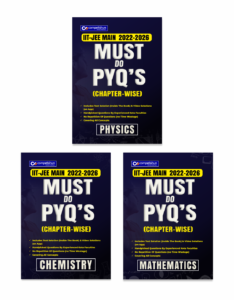
To solve PYQs chapter-wise, you need previous year questions already organised chapter-by-chapter with detailed solutions. That is exactly what the Competishun Must-Do PCM PYQ set is built for, covering 5 years (2022-2026) of JEE Main across Physics, Chemistry and Maths.
JEE Main Physics PYQ Strategy
Physics rewards conceptual clarity and application. PYQs here show you which formulae and concepts get tested repeatedly, and where students commonly slip.
- Concept first: Never attempt Physics PYQs before your concept and derivations are clear
- Focus on application: Physics questions test how you apply a concept, not just recall it
- Track numerical accuracy: Note where calculation or unit errors cost you marks
- Prioritise high-weightage chapters: Mechanics, Electrodynamics and Modern Physics carry strong weight
JEE Main Chemistry PYQ Strategy
Chemistry is the most scoring subject if you use PYQs well, because a large share of questions are direct or memory-based, especially in Inorganic and Physical Chemistry.
- Inorganic is PYQ gold: Many questions repeat directly from NCERT-based facts, PYQs reveal them
- Physical Chemistry: Practise the recurring numerical types until they are automatic
- Organic Chemistry: PYQs show which reactions and mechanisms are favourites
- Speed matters: Chemistry is where you save time for Physics and Maths
JEE Main Maths PYQ Strategy
Maths is about speed built on practice. PYQs train you to recognise the question type instantly and apply the fastest method, which is exactly what JEE Main rewards.
- Pattern recognition: PYQs teach you to spot the shortcut for each question type
- Time every set: Maths is where slow solving hurts your overall attempt
- High-weightage focus: Calculus, Coordinate Geometry and Algebra dominate the paper
- Redo the tough ones: Re-solving hard PYQs builds real speed and confidence
How Many Years of PYQs Should You Solve?
More is not always better, but too few leaves gaps. Here is the sensible range.
| Coverage | Best For |
|---|---|
| Last 5 Years (2022-2026) | Strong, focused coverage of current patterns |
| 6 Years, All Shifts | Maximum variety for serious top-rank aspirants |
| Chapter-Wise Format | Best for the chapter-wise method in this guide |
| Quality of analysis matters more than sheer volume. Five years solved and analysed well beats ten years rushed. | |
If you want the full Physics, Chemistry and Maths set in one comprehensive PCM volume, this option keeps everything together.
How to Analyse PYQs (Not Just Solve Them)
Solving is half the job. The real gains come from analysis. After each chapter's PYQs, ask yourself these questions.
- Which concepts repeated? Mark the topics that appear year after year
- Where did I lose marks? Concept gap, silly error, or time pressure
- Which question types are common? Build a mental library of recurring formats
- What is my accuracy per chapter? Rank chapters by how reliably you score
- What must I revise again? Turn weak chapters into a focused revision list
Common PYQ Mistakes to Avoid
- Starting PYQs too late: Begin chapter-wise, right after each chapter
- Only reading solutions: Always attempt first, then check
- Ignoring the pattern: Track what repeats, do not just chase answers
- Skipping analysis: An unanalysed PYQ barely helps
- No timed practice later: Move to full papers once chapters are solid
About Competishun
Competishun helps JEE and NEET aspirants with structured courses, chapter-wise PYQ books and All India Test Series, backed by faculty with 18 to 25 years of teaching experience. More than 2.2 million students follow the Competishun YouTube channel for free concept lectures and exam strategy.
Free JEE Concept Lectures
Follow Competishun for free Physics, Chemistry and Maths lectures and PYQ solutions.
Read These Next
A month-by-month plan to finish the syllabus and secure the January attempt.
The complete Class 11 PCM study material guide to build a strong JEE base.
The complete NIOS Class 12 eligibility guide for JEE and NEET droppers.
Frequently Asked Questions — JEE Main PYQ Strategy
Tags