JEE Main Most Repeated Questions 2027: Chapter-Wise Must-Do PYQs (Last 5 Years Analysis)
JEE Main Must-Do PYQs 2027 — Competishun
JEE Main Most Repeated Questions 2027: Chapter-Wise Must-Do PYQs (Last 5 Years Analysis)
Not every question in JEE Main is equally likely. When you study the last 5 years of papers, a clear truth emerges: certain topics and question types appear again and again. These are the most repeated questions, and the smartest aspirants make sure they can solve every one of them before exam day. These are your must-do PYQs.
This guide gives you a chapter-wise breakdown of the high-frequency areas in Physics, Chemistry and Maths based on recent JEE Main trends, and shows you how to turn most repeated questions into a real scoring advantage for JEE Main 2027.
Why Most Repeated Questions Matter
Repeated questions are not a coincidence. They reflect the concepts JEE Main considers core, so mastering them gives you the highest return on your study time.
| Benefit | Why It Helps You Score |
|---|---|
| Focus on high-yield topics | You practise what is most likely to be tested |
| Faster recognition | You solve familiar patterns quicker in the exam |
| Confidence on core concepts | You walk in sure of your strongest areas |
| Efficient revision | Must-do questions become your final-month checklist |
| Mastering the most repeated questions first is the fastest way to lock in a reliable base score before you push for higher. | |
Your Must-Do PYQ Question Bank
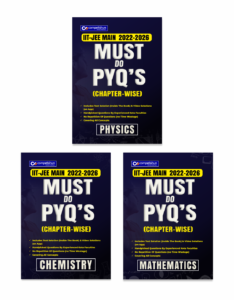
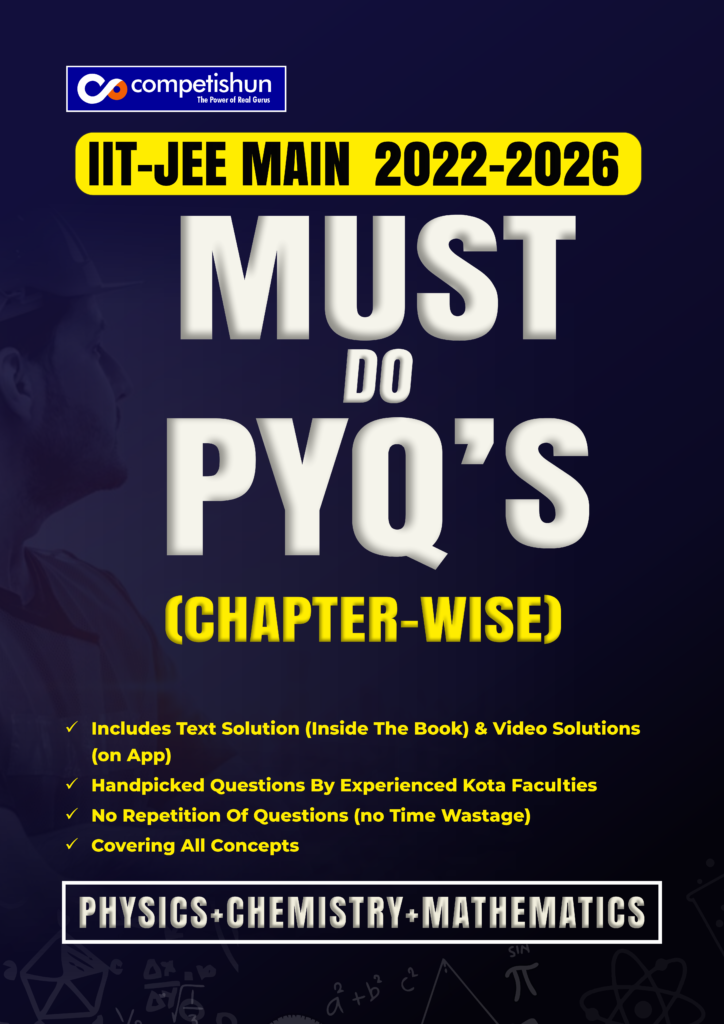
To master the most repeated questions, you need them already sorted chapter-wise with detailed solutions. The Competishun Must-Do PCM PYQ set does exactly that, covering 5 years (2022-2026) of JEE Main across Physics, Chemistry and Maths with the must-do questions highlighted.
Physics: Most Repeated Chapters and Question Types
In Physics, a handful of units consistently generate the highest number of questions. These are where your must-do practice should be heaviest.
| Chapter / Unit | Frequency Trend | Common Question Type |
|---|---|---|
| Mechanics (Kinematics, Laws of Motion, WPE) | High | Application-based numericals |
| Electrodynamics (Current, Magnetism, EMI) | High | Circuit and field problems |
| Modern Physics | High | Direct formula-based questions |
| Optics | Medium | Ray and wave optics numericals |
| Heat and Thermodynamics | Medium | Concept plus numerical mix |
| Frequency trends are indicative from recent papers, not a guarantee for 2027. Prepare all units, prioritise the high-frequency ones. | ||
Chemistry: Most Repeated Chapters and Question Types
Chemistry has the most direct, repeatable questions, especially in Inorganic and Physical Chemistry. This is the subject where must-do PYQs pay off fastest.
| Chapter / Unit | Frequency Trend | Common Question Type |
|---|---|---|
| Physical Chemistry (Mole, Equilibrium, Thermo) | High | Recurring numerical types |
| Inorganic Chemistry (Periodic, Bonding, Coordination) | High | Direct, NCERT-based questions |
| Organic Chemistry (GOC, Reactions) | High | Mechanism and reaction questions |
| Chemical Kinetics and Electrochemistry | Medium | Formula-based numericals |
| Biomolecules and Everyday Chemistry | Medium | Fact-based direct questions |
| Inorganic Chemistry in particular rewards must-do PYQ practice, since many questions repeat directly from NCERT-based facts. | ||
Maths: Most Repeated Chapters and Question Types
In Maths, a few heavyweight chapters carry a large share of the paper year after year. Must-do PYQs here train the speed and pattern recognition that decide your Maths score.
| Chapter / Unit | Frequency Trend | Common Question Type |
|---|---|---|
| Calculus (Limits, Differentiation, Integration) | High | Multi-step application problems |
| Coordinate Geometry | High | Conic and straight-line questions |
| Algebra (Quadratic, Sequences, Binomial) | High | Direct and formula-based |
| Vectors and 3D Geometry | Medium | Standard repeatable problems |
| Probability and Matrices | Medium | Concept plus calculation |
| Calculus and Coordinate Geometry are usually the biggest scorers, must-do PYQs from these chapters are non-negotiable. | ||
How to Use Most Repeated Questions the Right Way
Knowing the high-frequency areas is only useful if you act on them correctly. Follow this approach.
- Master must-do first: Solve every high-frequency question until it is automatic
- Learn the pattern, not the answer: Understand why a question type repeats
- Then cover the full syllabus: Repeated topics are the priority, not the limit
- Time your practice: Recognising a repeated question fast saves exam minutes
- Revise from must-do sets: In the last month, redo the highlighted PYQs
Want Everything in One Book?
If you prefer all three subjects in a single comprehensive volume with chapter-wise solved papers and must-do PYQs, this is the complete PCM option.
Mistakes to Avoid with Repeated Questions
- Skipping chapters: High-frequency does not mean low-frequency never appears
- Memorising answers: Learn the method so you can solve any variation
- Ignoring analysis: Note why each question repeats and where you slip
- Treating trends as guarantees: Weightage shifts every year
- No timed revision: Practise must-do sets under exam-like timing
About Competishun
Competishun helps JEE and NEET aspirants with structured courses, chapter-wise must-do PYQ books and an All India Test Series, backed by faculty with 18 to 25 years of teaching experience. More than 2.2 million students follow the Competishun YouTube channel for free concept lectures and PYQ solutions.
Free JEE Concept Lectures
Follow Competishun for free Physics, Chemistry and Maths lectures and PYQ solutions.
Read These Next
The complete chapter-wise method to use previous year questions effectively.
The subject-wise weightage breakdown to plan your JEE Main preparation.
A month-by-month plan to finish the syllabus and secure the January attempt.
Frequently Asked Questions — JEE Main Most Repeated Questions
Tags