JEE Main Hydrocarbons PYQs 2024, 2025 and 2026: All Questions with Solutions
JEE Main Hydrocarbons PYQs 2024, 2025 and 2026: All Questions with Solutions
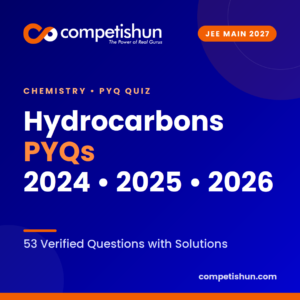
Verified JEE Main Hydrocarbons questions from 2024, 2025 and 2026, shift by shift. The 2024, 2025 and 2026 sets are interactive now: pick an option or enter a number and check instantly. Attempt timed, check the method only after answering, and log every miss by pattern.
How to use this quiz
1. Attempt one year timed, without looking at the method.
2. Click an option, or type a number and press Check, for instant right or wrong feedback.
3. Read the short method only after answering, then log the miss by pattern.
4. Rework your weak patterns the same day, then reattempt the year.
2024 Questions (15)
Among the following, total number of meta directing functional groups is (Integer based) -OCH3,-NO2,-CN,-CH3-NHCOCH3 -COR,-OH,-COOH,-Cl
3-Methylhex-2-ene on reaction with HBr in presence of peroxide forms an addition product (A). The number of possible stereoisomers for 'A' is
Consider the given reaction. The total number of oxygen atoms present per molecule of the product (P) is trans-But-2-ene reacts with (i) O3 (ii) Zn/H2O to give (P).

Identify product A and product B : Cyclohexene reacts with Cl2 under hv to give product A, and with Cl2 in CCl4 to give product B. The four options give (A, B) pairs: (A) A = 1,2-dichlorocyclohexane, B = 3,6-dichlorocyclohex-1-ene; (B) A = 3,6-dichlorocyclohex-1-ene, B = 3,6-dichlorocyclohex-1-ene; (C) A = 1,2-dichlorocyclohexane, B = 1,2-dichlorocyclohexane; (D) A = 3,6-dichlorocyclohex-1-ene, B = 1,2-dichlorocyclohexane. (A) = A, (B) = B, (C) = C, (D) = D.


2-chlorobutane +Cl2 → C4H8Cl2 (isomers) Total number of optically active isomers shown by C4H8Cl2, obtained in the above reaction is ____ .
Number of alkanes obtained on electrolysis of a mixture of CH3COONa and C2H5COONa is ______.
Number of isomeric products formed by monochlorination of 2-methylbutane in presence of sunlight is
Major product of the following reaction is - 1-Methylcyclopent-1-ene reacts with D-Cl to give the addition product. The four options are: (1) Cl and D on different carbons with D cis to Cl (anti-Markovnikov); (2) Cl and D on different carbons with D trans to Cl (anti-Markovnikov); (3) Cl and CH3 on the same carbon with D trans to Cl (Markovnikov); (4) Cl and CH3 on the same carbon with D cis to Cl (Markovnikov). (1) = A, (2) = B, (3) = C, (4) = D.


Identify major product ' P ' formed in the following reaction Benzene reacts with benzoyl chloride in the presence of anhydrous AlCl3 to give P (major product). The four options are: (1) (3-chlorocarbonylphenyl) phenyl ether (Ph-O-C6H4−COCl); (2) acetophenone (Ph-CO-CH3); (3) benzaldehyde (Ph-CHO); (4) benzophenone (Ph-CO-Ph). (1) = A, (2) = B, (3) = C, (4) = D.


In the given reactions identify A and B. H2 + A --Pd/C−→ cis-pent-2-ene (CH3−CH=CH-CH2CH3, cis); but-2-yne (CH3−C≡C-CH3) + H2 --Na/liq. NH3−→ B.

Identify major product " X " formed in the following reaction : Benzene reacts with CO and HCl in the presence of anhydrous AlCl3/CuCl to give X (major product). The four options are: (1) benzoyl chloride (Ph-COCl); (2) benzophenone (Ph-CO-Ph); (3) benzaldehyde (Ph-CHO); (4) benzyl chloride (Ph-CH2Cl). (1) = A, (2) = B, (3) = C, (4) = D.


The major product of the following reaction is P. Number of oxygen atoms present in product ' P ' is ______________ (nearest integer). But-2-yne (CH3−C≡C-CH3) reacts with (i) Na/liq. NH3 (ii) dilute KMnO4, 273 K to give P.

Identify the product A and product B in the following set of reactions. Propene (CH3−CH=CH2) reacts with H2O/H+ to give major product A, and with (BH3)2 followed by H2O2/OH− to give major product B.

What is the structure of C ? Benzene reacts with succinic anhydride and AlCl3 to give (A); (A) reacts with Zn-Hg/HCl to give (B); (B) reacts with conc. H2SO4 to give (C).


The number of correct reaction(s) among the following is (A) Benzene + benzoyl chloride, anhydrous AlCl3 gives diphenylmethane (Ph-CH2−Ph). (B) Benzoyl chloride + H2, Pd-BaSO4 gives benzoic acid (Ph-COOH). (C) Benzene + CO, HCl, anhydrous AlCl3/CuCl gives benzaldehyde (Ph-CHO). (D) Benzamide + H3O+, heat gives aniline (Ph-NH2).
UPO
Unique PYQs Only. Solve only what is new.
✓4,348 unique PYQs
✓Repeated questions grouped in clusters
PYQ Express
Every JEE Main PYQ in one place.
✓10,000+ PCM PYQs
✓Physics, Chemistry, Maths
2025 Questions (20)
The compound with molecular formula C6H6, which gives only one monobromo derivative and takes up four moles of hydrogen per mole for complete hydrogenation has ____ π electrons.
When sec-butyl cyclohexane reacts with bromine in the presence of sunlight, the major product is : The four options are: (1) Br on the ring carbon next to the sec-butyl group; (2) Br on the middle carbon of the sec-butyl chain (secondary); (3) Br on the carbon between the ring and the sec-butyl CH (secondary); (4) Br on the tertiary carbon of the sec-butyl group (the carbon attached to the ring). (1) = A, (2) = B, (3) = C, (4) = D.

Match List-I with List-II. List-I (Name of reaction): (A) Swarts reaction; (B) Sandmeyer's reaction; (C) Wurtz Fittig reaction; (D) Finkelstein reaction. List-II (Product obtainable): (I) Ethyl benzene; (II) Ethyl iodide; (III) Cyanobenzene; (IV) Ethyl fluoride. Choose the correct answer from the options given below:

Match List-I with List-II. List-I (Isomers of C10H14): (A), (B), (C), (D) are four fused bicyclic dienes (a six-membered ring fused to a five-membered ring, the methyl group in different positions). List-II (Ozonolysis product): (I), (II), (III), (IV) are four open-chain tetracarbonyl compounds (two aldehyde ends and two ketones, differing in the methyl position and the (CH2)3/(CH2)4 bridge). Choose the correct answer from the options given below:

Following are the four molecules "P", "Q", "R" and "S". Which one among the four molecules will react with H - Br(aq) at the fastest rate? The four molecules are: P = a six-membered ring with O at the top and the double bond at the bottom (not adjacent to O); Q = a six-membered ring with O at the top and the double bond on the right edge (adjacent to O, an enol ether); R = 1-methylcyclohex-1-ene; S = 1,2-dimethylcyclohex-1-ene.

The product (1) formed in the following reaction sequence is Propyne (CH3−C≡CH) reacts with (i) Hg2+, H2SO4 (ii) HCN (iii) H2/Ni to give product (A). The four options are: (A) CH3−CH2−CH(OH)-CH2−NH2 (1-aminobutan-2-ol); (B) CH3−C(NH2)(CH3)-CH2−OH (2-amino-2-methylpropan-1-ol); (C) CH3−CH2−CH(NH2)-CH2−OH (2-aminobutan-1-ol); (D) CH3−C(OH)(CH3)-CH2−NH2 (1-amino-2-methylpropan-2-ol). (A) = A, (B) = B, (C) = C, (D) = D.


Identify correct statement/s: (A) -OCH3 and -NHCOCH3 are activating group. (B) -CN and -OH are meta directing group. (C) -CN and -SO3H are meta directing group. (D) Activating groups act as ortho - and para directing groups. (E) Halides are activating groups. Choose the correct answer from the options given below :
A molecule ("P") on treatment with acid undergoes rearrangement and gives ("Q"). ("Q") on ozonolysis followed by reflux under alkaline condition gives ("R"). The structure of ("R") is given below. The structure of R is 1−(2-methylcyclopent-1-en-1-yl)ethan-1-one: a cyclopentene ring bearing a COCH3 group and a CH3 group on the two double-bond carbons. The four options are the candidate structures for P: (A) 1,2-dimethylcyclohex-1-ene; (B) 1−(prop-1-en-2-yl)cyclopentane (isopropenylcyclopentane); (C) 1-isopropylcyclopentan-1-ol; (D) 2-cyclobutylpropan-2-ol (a cyclobutane ring bearing a C(OH)(CH3)2 group). (A) = A, (B) = B, (C) = C, (D) = D.


The product B formed in the following reaction sequence is : 4-Methyl-(prop-1-en-1-yl)benzene (p-tolyl-CH=CH-CH3) reacts with HCl to give (A) (major), which reacts with AgCN to give (B) (major). The four options are: (1) p-tolyl-CH2−CH(NC)-CH3; (2) p-tolyl-CH(NC)-CH2−CH3; (3) p-tolyl-CH(CN)-CH3; (4) p-tolyl-CH2−CH(NC)-CH3 (the same compound as (1), drawn differently). (1) = A, (2) = B, (3) = C, (4) = D.


The total number of compounds from below when treated with hot KMnO4 giving benzoic acid is : The eight compounds are: toluene, ethylbenzene, isopropylbenzene (cumene), tert-butylbenzene, isobutylbenzene (Ph-CH2−CH(CH3)2), 2-phenylpropan-2-ol (Ph-C(OH)(CH3)2), n-propylbenzene and 4,4'-dimethylbiphenyl.

Identify product [A],[B] and [C] in the following reaction sequence. CH3-C ≡ CH Pd / C → H2[ A] (i) O3 → (ii) Zn, H2O[ B]+[C]
In the following substitution reaction : 2,3-Dibromonitrobenzene reacts with C2H5ONa in C2H5OH to give product P. The four options are: (A) 2-ethoxy-3-bromonitrobenzene (OC2H5 ortho to NO2); (B) 3-ethoxy-2-bromonitrobenzene (OC2H5 meta to NO2); (C) 2,3-dibromonitrobenzene with OC2H5 replacing NO2; (D) 2,3-diethoxynitrobenzene. (A) = A, (B) = B, (C) = C, (D) = D.


Given below are two statements : Statement (I) : On nitration of m-xylene with HNO3, H2SO4 followed by oxidation, 4-nitrobenzene-1,3dicarboxylic acid is obtained as the major product. Statement (II): -CH3 group is o/p-directing while -NO2 group is m-directing group. In the light of the above statements, choose the correct answer from the options given below:
An optically active alkyl halide C4H9Br[A] reacts with hot KOH dissolved in ethanol and forms alkene [B] as major product which reacts with bromine to give dibromide [C]. The compound [C] is converted into a gas [D] upon reacting with alcoholic NaNH2. During hydration 18 gram of water is added to 1 mole of gas [D] on warming with mercuric sulphate and dilute acid at 333 K to form compound [E]. The IUPAC name of compound [E] is :
Match List - I with List - II. Choose the correct answer from the options given below : List-I (Reaction): (A) 2 Ph-X + 2Na, dry ether gives biphenyl; (B) ArN2+X− with Cu/HCl gives ArCl + N2 + CuX; (C) C2H5Br + NaI, dry acetone gives C2H5I + NaBr; (D) (CH3)3C-OH with HCl/ZnCl2 gives (CH3)3C-Cl. List-II (Name of reaction): (I) Lucas reaction; (II) Finkelstein reaction; (III) Fittig reaction; (IV) Gatterman reaction.

Given below are two statements : Statement (I) : Neopentane forms only one monosubstituted derivative. Statement (II) : Melting point of neopentane is higher than n-pentane. In the light of the above statements, choose the most appropriate answer from the options given below :
Which compound would give 3-methyl-6-oxoheptanal upon ozonolysis? The four options are dimethylcyclohex-1-enes: (A) 1,3-dimethylcyclohex-1-ene; (B) 1,3-dimethylcyclohex-1-ene (the same compound as (A), drawn mirrored); (C) 1,2-dimethylcyclohex-1-ene; (D) 1,4-dimethylcyclohex-1-ene. (A) = A, (B) = B, (C) = C, (D) = D.

Consider the following molecule (X). The structure of X is The major product formed when the given molecule (X) is treated with HBr(1 eq) is : The structure of X is a fused tricyclic triene: three fused rings (two five-membered and one six-membered) sharing bonds, with three double bonds. The four options show the bromide at different positions of the tricyclic skeleton: (1) Br on a carbon of the left five-membered ring; (2) Br on the carbon at the bottom right of the skeleton (next to the ring junction); (3) Br on a carbon of the right six-membered ring; (4) Br on a carbon of the left five-membered ring. (1) = A, (2) = B, (3) = C, (4) = D.


Given below are two statements: Statement I: Ozonolysis followed by treatment with Zn,H2O of cis-2-butene gives ethanal. Statement II: The product obtained by ozonolysis followed by treatment with Zn,H2O of 3, 6-dimethyloct-4-ene has no chiral carbon atom. In the light of the above statements, choose the correct answer from the options given below
Statement (I): cis-1,2-dichloroethene is more polar than trans-1,2-dibromoethene. Statement (II): the boiling point of trans-1,4-dibromobut-2-ene is lower than that of cis-1,2-dibromoethene, but it is more polar than cis-1,2-dibromoethene.

JEE Mates
Online Mock Test Series.
✓50 online mock tests
✓Video solutions + analysis
UTS
Ultimate Test Series.
✓20 full mocks + 6 special tests
✓Projected percentile after every test
2026 Questions (18)
Identify A in the following reaction. A on hydrogenation (2H2/Pt) gives decalin (a bicyclic saturated hydrocarbon), and on oxidation (KMnO4, heat) gives cyclohexane-1,2-dicarboxylic acid plus oxalic acid. The four options are tetrahydronaphthalene isomers with two double bonds each: (1), (2) and (4) have one double bond in each ring, while (3) has both double bonds in the same ring (the other ring is saturated). (1) = A, (2) = B, (3) = C, (4) = D.


The cycloalkene ( X ) on bromination consumes one mole of bromine per mole of ( X ) and gives the product (Y) in which C: Br ratio is 3: 1. The percentage of bromine in the product (Y) is ____ %. (Nearest integer) (Given : molar mass in gmol−1 H: 1, C: 12, O: 16, Br: 80 )
Given below are two statements: Statement I: Benzene is nitrated to give nitrobenzene, which on further treatment with CH3COCl / AlCl3 will give Statement II: -NO2 group is a m-directing, and deactivating group. In the light of the above statements, choose the most appropriate answer from the options given below The structure shown is 3-nitroacetophenone: a benzene ring with a COCH3 group meta to a NO2 group. Statement I claims this is the product of nitrating benzene and then treating it with CH3COCl/AlCl3.

3, 3-Dimethyl-2-butanol cannot be prepared by : Choose the correct answer from the options given below : Five routes to 3,3-dimethyl-2-butanol: (A) (CH3)3C-CHO with MeMgBr in dry ether, then H3O+; (B) 3,3-dimethylbut-1-ene with H2O/H+; (C) 2,3,4,4-tetramethylpent-2-ene with (i) O3/Zn-H2O (ii) NaBH4/MeOH; (D) (CH3)3C-CO-CH3 with LiAlH4/H3O+; (E) (CH3)3C-C≡CH with H2O/Hg2+/H+.

Consider the following compounds Arrange these compounds in the increasing order of reactivity with nitrating mixture. The three compounds are: (a) chlorobenzene; (b) nitrobenzene; (c) anisole (methoxybenzene).

But-2-yne and hydrogen (one mole each) are separately treated with (i) Pd / C and (ii) Na / liq. NH3 to give the products X and Y respectively. Identify the incorrect statements. A. X and Y are stereoisomers. B. Dipole moment of X is zero. C. Boiling point of X is higher than Y . D. X and Y react with O3 / Zn+H2O to give different products. Choose the correct answer from the options given below: But-2-yne with H2 gives X with Pd/C and Y with Na/liq. NH3.

Ph-CH=CH2 (PhCOO)2 → HBr Product Consider the above reaction A. The reaction proceeds through a more stable radical intermediate. B. The role of peroxide is to generate H° (Hydrogen radical). C. During this reaction, benzene is formed as a byproduct. D. 1-Bromo-2-phenylethane is formed as the minor product. E. The same reaction in absence of peroxide proceeds via carbocation intermediate. Identify the correct statements. Choose the correct answer from the options given below:
Method used for separation of mixture of products ( B and C ) obtained in the following reaction is Benzene reacts with Br2/FeBr3 to give A; A reacts with conc. HNO3/conc. H2SO4 to give B + C.

The reactions which produce alcohol as the product are: A. CH4+O2 Mo2O3 → Δ B. 2 CH3CH3+3 O2 (CH3, COO)2Mn → Δ C. (CH3)3CH KMnO4 → D. 2 CH4+O2 Cu / 523 K / 100 am . → E. CH3-CH=CH-CH3 KMnO4 / H+ → Choose the correct answer from the options given below :
Identify the correct statements: The presence of -NO2 group in benzene ring A. activates the ring towards electrophilic substitutions. B. deactivates the ring towards electrophilic substitutions C. activates the ring towards nucleophilic substitutions. D. deactivates the ring towards nucleophilic substitutions. Choose the correct answer from the options given below :
For the given molecule, "x", the preferred site for the attack of the electrophile is : x is benzanilide (Ph-CO-NH-Ph): a benzoyl group joined through NH to a phenyl ring. The labelled sites are: r = para on the benzoyl ring, p = ortho on the benzoyl ring, s = ortho on the anilide ring, u = para on the anilide ring.

The compound (X) on (i) on heating in the presence of anhydrous AlCl3 and HCl gas gives 2,4-dimethyl pentane (ii) aromatization gives toulene and (iii) cyclisation gives methyl cyclohexane The correct name of compound (X) is :
For the following Friedel Craft’s alkylation reaction, which of the statements are correct? A. Major product is n -propyl benzene. B. iso-propyl carbocation intermediate is also generated. C. Multiple substitution is inevitable. D. Introducing electron-donating substituent on benzene will not produce any alkyl benzene. Choose the correct answer from the options given below: Benzene reacts with n-propyl chloride and anhydrous AlCl3 to give an alkylbenzene.

RMgI when treated with ice cold water liberated a gas which occupied 1.4 dm3 / g at STP. The gas produced is further reacted with iodine in presence of HIO3 to give compound (X). Compound (X) in presence of Na and dry ether produced compound (Y). Molar mass of compound (Y) is ____ gmol −1. (Nearest integer)
Given below are two statements: Statement I: Methane can be prepared by decarboxylation of sodium ethanoate, Kolbe's electrolysis of sodium acetate and reaction of CH3MgBr with water. Statement II: Methane cannot be prepared from unsaturated hydrocarbons and by Wurtz reaction. In the light of the above statements, choose the correct answer from the options given below
An alkane (Y) requires 8 moles of oxygen for complete combustion and on chlorination with Cl2 / h ν,(Y) gives only one monochlorinated product (Z). The total number of primary carbon atoms in ( Y ) is ____ .
An optically active alkyl bromide C4H9Br, reacts with ethanolic KOH to form major compound [A] which reacts with bromine to give compound [B]. Compound [B] reacts with ethanolic KOH and sodamide to give compound [C]. One molecule of water adds to compound [C] on warming with mercuric sulphate and dilute sulphuric acid at 333 K to form compound [D]. The functional group in compound D will be confirmed by :
The major product of which of the following reaction is not obtained by rearrangement reaction? The four reactions are: (1) benzene with n-propyl chloride and anhydrous AlCl3 gives isopropylbenzene; (2) tert-butyl alcohol with H3O+ gives isobutene; (3) n-hexane with anhydrous AlCl3/HCl gives 2-methylpentane; (4) neopentyl alcohol (2,2-dimethylpropan-1-ol) with H3O+ gives 2-methylbut-2-ene. (1) = A, (2) = B, (3) = C, (4) = D.

Chemistry PYQ Book
JEE Main 5 Years Chemistry PYQ Book 2022-2026.
✓Chapter-wise solved papers
✓Detailed solutions
JEE Advanced Online
Online Mock Test Series.
✓10 online mock tests
✓Video solutions + analysis
Frequently Asked Questions
Tags