JEE Main Wave Optics PYQs 2024, 2025 and 2026: All Questions with Solutions
JEE Main Wave Optics PYQs 2024, 2025 and 2026: All Questions with Solutions
Verified JEE Main Wave Optics questions from 2024, 2025 and 2026, shift by shift. The 2024, 2025 and 2026 sets are interactive now: pick an option or enter a number and check instantly. Attempt timed, check the method only after answering, and log every miss by pattern.
How to use this quiz
1. Attempt one year timed, without looking at the method.
2. Click an option, or type a number and press Check, for instant right or wrong feedback.
3. Read the short method only after answering, then log the miss by pattern.
4. Rework your weak patterns the same day, then reattempt the year.
2024 Questions (15)
A parallel beam of monochromatic light of wavelength 5000Å is incident normally on a single narrow slit of width 0.001 mm. The light is focused by convex lens on screen, placed on its focal plane. The first minima will be formed for the angle of diffraction of (degree)
When a polaroid sheet is rotated between two crossed polaroids then the transmitted light intensity will be maximum for a rotation of :
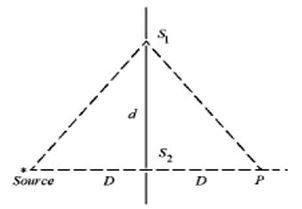
In a double slit experiment shown in figure, when light of wavelength 400 nm is used, dark fringe is observed at P . If D=0.2 m. the minimum distance between the slits S1 and S2 is mm . Source on the left on the axis; the slits plane is at distance D from the source, with S2 on the axis and S1 a distance d above it; point P is on the axis at distance D beyond the slits plane. Dashed lines join the source to S1 and S1 to P.
In a single slit diffraction pattern, a light of wavelength 6000 Å is used. The distance between the first and third minima in the diffraction pattern is found to be 3 mm when the screen in placed 50 cm away from slits. The width of the slit is ____ × 10−4 m.
In Young's double slit experiment, light from two identical sources are superimposing on a screen. The path difference between the two lights reaching at a point on the screen is 7 λ4. The ratio of intensity of fringe at this point with respect to the maximum intensity of the fringe is.
The diffraction pattern of a light of wavelength 400 nm diffracting from a slit of width 0.2 mm is focused on the focal plane of a convex lens of focal length 100cm. The width of the 1st secondary maxima will be :
A beam of unpolarised light of intensity I0 is passed through a polaroid A and then through another polaroid B which is oriented so that its principal plane makes an angle of 45∘ relative to that of A. The intensity of emergent light is :
Two waves of intensity ratio 1: 9 cross each other at a point. The resultant intensities at the point, when (a) Waves are incoherent is I1(b) Waves are coherent is I2 and differ in phase by 60°. If 1112=10x then x
A monochromatic light of wavelength 6000Å is incident on the single slit of width 0.01mm. If the diffraction pattern is formed at the focus of the convex lens of focal length 20" " cm, the linear width of the central maximum is :
In Young's double slit experiment, monochromatic light of wavelength 5000 Å is used. The slits are 1.0 mm apart and screen is placed at 1.0 m away from slits. The distance from the centre of the screen where intensity becomes half of the maximum intensity for the first time is × 10−6 m
A microwave of wavelength 2.0cm falls normally on a slit of width 4.0 cm. The angular spread of the central maxima of the diffraction pattern obtained on a screen 1.5m away from the slit, will be:
Two wavelengths λ1 and λ2 are used in Young's double slit experiment λ1=450 nm and λ2=650 nm. The minimum order of fringe produced by λ2 which overlaps with the fringe produced by λ1 is n . The value of n is
In Young's double slit experiment, carried out with light of wavelength 5000 Å , the distance between the slits is 0.3 mm and the screen is at 200 cm from the slits. The central maximum is at x=0 cm. The value of x for third maxima is.............mm
Which of the following phenomena does not explain by wave nature of light. (A) reflection (B) diffraction (C) photoelectric effect (D) interference (E) polarization Choose the most appropriate answer from the options given below :
A parallel beam of monochromatic light of wavelength 600nm passes through single slit of 0.4mm width. Angular divergence corresponding to second order minima would be × 10−3 rad
UPO
Unique PYQs Only. Solve only what is new.
✓4,348 unique PYQs
✓Repeated questions grouped in clusters
PYQ Express
Every JEE Main PYQ in one place.
✓10,000+ PCM PYQs
✓Physics, Chemistry, Maths
2025 Questions (17)
A transparent film of refractive index, 2.0 is coated on a glass slab of refractive index, 1.45. What is the minimum thickness of transparent film to be coated for the maximum transmission of Green light of wavelength 550 nm. [Assume that the light is incident nearly perpendicular to the glass surface.]
The width of one of the two slits in Young's double slit experiment is d while that of the other slit is x d. If the ratio of the maximum to the minimum intensity in the interference pattern on the screen is 9: 4 then what is the value of x ?
The Young's double slit interference experiment is performed using light consisting of 480 nm and 600 nm wavelengths to form interference patterns. The least number of the bright fringes of 480 nm light that are required for the first coincidence with the bright fringes formed by 600 mm light is
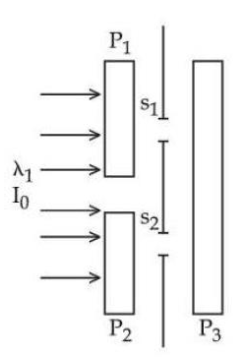
In a Young's double slit experiment, three polarizers are kept as shown in the figure. The transmission axes of P1 and P2 are orthogonal to each other. The polarizer P3 covers both the slits with its transmission axis at 45° to those of P1 and P2. An unpolarized light of wavelength λ and intensity I0 is incident on P1 and P2. The intensity at a point after P3 where the path difference between the light waves from s1 and s2 is λ3, is Polariser P1 covers the upper slit s1 and polariser P2 covers the lower slit s2; polariser P3 covers both slits. Unpolarised light of intensity I0 falls on P1 and P2.
Young's double slit interference apparatus is immersed in a liquid of refractive index 1.44. It has slit separation of 1.5 mm . The slits are illuminated by a parallel beam of light whose wavelength in air is 690 nm . The fringe-width on a screen placed behind the plane of slits at a distance of 0.72 m , will be:
A double slit interference experiment performed with a light of wavelength 600 nm forms an interference fringe pattern on a screen with 10th bright fringe having its centre at a distance of 10 mm from the central maximum. Distance of the centre of the same 10th bright fringe from the central maximum when the source of light is replaced by another source of wavelength 660 nm would be ____ mm.
A thin transparent film with refractive index 1.4 , is held on circular ring of radius 1.8 cm . The fluid in the film evaporates such that transmission through the film at wavelength 560 nm goes to a minimum every 12 seconds. Assuming that the film is flat on its two sides, the rate of evaporation is ____ π × 10−13 m3 / s.
Which of the following phenomena can not be explained by wave theory of light ?
If the measured angular separation between the second minimum to the left of the central maximum and the third minimum to the right of the central maximum is 30º in a single slit diffraction pattern recorded using 628 nm light, then the width of the slit is_______μ m.
A light wave is propagating with plane wave fronts of the type x + y + z = constant. The angle made by the direction of wave propagation with the x-axis is :
Two coherent monochromatic light beams of intensities 4I and 9I are superimposed. The difference between the maximum and minimum intensities in the resulting interference pattern is xI. The value of x is ______.
Width of one of the two slits in a Young's double slit interference experiment is half of the other slit. The ratio of the maximum to the minimum intensity in the interference pattern is :
Two monochromatic light beams have intensities in the ratio 1:9. An interference pattern is obtained by these beams. The ratio of the intensities of maximum to minimum is
In a Young's double slit experiment, the slits are separated by 0.2 mm. If the slits separation is increased to 0.4 mm, the percentage change of the fringe width is :
In a Young's double slit experiment, two slits are located 1.5 mm apart. The distance of screen from slits is 2 m and the wavelength of the source is 400 nm. If the 20 maxima of the double slit pattern are contained within the central maximum of the single slit diffraction pattern, then the width of each slit is x × 10−3 cm, where x-value is
Two plane polarized light waves combine at a certain point whose electric field components are E1 = E0 Sin ω t E2 = Eo Sin ( ω t + π 3 ) Find the amplitude of the resultant wave.
In a Young's double slit experiment, the source is white light. One of the slits is covered by red filter and another by a green filter. In this case
JEE Mates
Online Mock Test Series.
✓50 online mock tests
✓Video solutions + analysis
UTS
Ultimate Test Series.
✓20 full mocks + 6 special tests
✓Projected percentile after every test
2026 Questions (19)
In a Young's double slit experiment set up, the two slits are kept 0.4 mm apart and screen is placed at 1 m from slits. If a thin transparent sheet of thickness 20 μ m is introduced in front of one of the slits then center bright fringe shifts by 20 mm on the screen. The refractive index of transparent sheet is given by α10, where α is ____
Given below are two statements : Statement I: In a Young's double slit experiment, the angular separation of fringes will increase as the screen is moved away from the plane of the slits Statement II: In a Young's double slit experiment, the angular separation of fringes will increase when monochromatic source is replaced by another monochromatic source of higher wavelength In the light of the above statements, choose the correct answer from the options given below :
Which of the following are true for a single slit diffraction ? A. Width of central maxima increases with increase in wavelength keeping slit width constant. B. Width of central maxima increases with decrease in wavelength keeping slit width constant. C. Width of central maxima increases with decrease in slit width at constant wavelength. D. Width of central maxima increases with increase in slit width at constant wavelength. E. Brightness of central maxima increases for decrease in wavelength at constant slit width.
In two separate Young's double-slit experimental set-ups and two monochromatic light sources of different wavelengths are used to get fringes of equal width. The ratios of the slits separations and that of the wavelengths of light used are 2 : 1 and 1 : 2 respectively. The corresponding ratio of the distances between the slits and the respective screens (D1 / D2) is ____ .
When an unpolarized light falls at a particular angle on a glass plate (placed in air), it is observed that the reflected beam is linearly polarized. The angle of refracted beam with respect to the normal is ____ . (tan −1(1.52)=57.7°., refractive indices of air and glass are 1.00 and 1.52, respectively.)
An unpolarised light is incident at an interface of two dielectric media having refractive indices of 2 (incident medium) and 2 √(3) (medium) respectively. To satisfy the condition that reflected and refracted rays are perpendicular to each other, the angle of incidence is ____ .
In the Young's double slit experiment the intensity produced by each one of the individual slits is Io. The distance between two slits is 2 mm . The distance of screen from slits is 10 m . The wavelength of light is 6000A°. The intensity of light on the screen in front of one of the slits is ____
A point source is kept at the center of a spherically enclosed detector. If the volume of the detector increased by 8 times, the intensity will
Given below are two statements: Statement I : A plane wave after passing through prism remains as plane wave but passing through small pin hole may become spherical wave. Statement II: The curvature of a spherical wave emerging from a slit will increase for increasing slit width. In the light of the above statements, choose the correct answer from the options given below
In single slit diffraction pattern, the wavelength of light used is 628 nm and slit width is 0.2 mm , the angular width of central maximum is α × 10−2 degrees. The value of α is ____。
In a Young's double slit experiment, the intensity at some point on the screen is found to be 34 times of the maximum of the interference pattern. The path difference between the interfering waves at this point is λx where λ is wavelength of the incident light. The value of x is ____ . .
In a double slit experiment, when one of the slits is covered by a transparent mica sheet of refractive index 1.56 , the central fringe shifts to the position of 7th bright fringe, obtained with both slits uncovered. If the light source wavelength is 450 nm , the thickness of mica sheet is α × 10−9 m. The value of α is ____ .
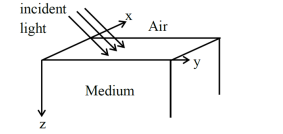
An unpolarized light is incident on the plane interface of air-dielectric medium shown in figure. If the incident angle is equal to Brewster angle, identify the expression representing reflected wave. Question figure: incident light rays fall on the horizontal air-medium interface; x and y axes lie in the interface plane and z points down into the medium. Options figure: the four options are (1) (Ei î + Ej ĵ)sin(kx - kz - ω t); (2) (Ei î + Ek k̂)sin(kx + ky - ω t); (3) (Ej ĵ + Ek k̂)sin(ky + kz - ω t); (4) (Ei î + Ej ĵ + Ek k̂)sin(kx + ky - kz - ω t). (1) = A, (2) = B, (3) = C, (4) = D.

In Young's double slit experiment, the fringe width of the interference pattern produced on the screen is 2.4 μ m. If the experiment is carried out in another medium having refractive index 1.2 , the fringe width will be ____ μ m.
The maximum intensity in a Young's double slit experiment is I0. Distance between the slits (d) is 5 λ, where λ is the wavelength of light used. The intensity of the fringe, exactly opposite to one of the slits on the screen, placed at D=10d is ____ -
An unpolarized light of intensity I0 passes through polarizer and then through a certain optically active solution and finally it goes to analyser. If the angle between analyser and polariser is 0° and intensity of light emerged from analyser is 38 I0, the angle of rotation of the light by the solution with respect to analyser is ____ degrees.
In interference experiment the path difference between two interfering waves at a point A on the screen is λ / 3, where λ is the wavelength of these waves, and at another point B the path difference is λ / 6. The ratio of intensities at points A and B is ____。
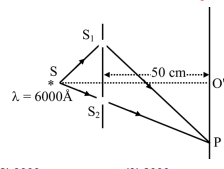
In a Young double slit experiment, the wavelength of incident light is 6000 A , the separation between slits S1 and S2 is 5 cm and the distance between slits plane and screen is 50 cm , as shown in the figure below. If the resultant intensity at P is equal to the intensity due to individual slits, the path difference between interfering waves is ____ A. YDSE diagram: source S on the left; slits S1 (above) and S2 (below) 5 cm apart; screen 50 cm from the slits; O' is the central point on the screen and P is a point below O' on the screen.
Some distant star is to be observed by some telescope of diameter of objective lens a, at an angular resolution of 3.0 × 10⁻⁷ radian. If the wavelength of light from the star reaching the telescope is 500 nm , the minimum diameter of the objective lens of the telescope is ____ cm. (nearest integer)
Physics PYQ Book
JEE Main 5 Years Physics PYQ Book 2022-2026.
✓Chapter-wise solved papers
✓Detailed solutions
JEE Advanced Online
Online Mock Test Series.
✓10 online mock tests
✓Video solutions + analysis
Frequently Asked Questions
Tags