JEE Main Geometrical Optics PYQs 2024, 2025 and 2026: All Questions with Solutions
JEE Main Geometrical Optics PYQs 2024, 2025 and 2026: All Questions with Solutions
Verified JEE Main Geometrical Optics questions from 2024, 2025 and 2026, shift by shift. The 2024, 2025 and 2026 sets are interactive now: pick an option or enter a number and check instantly. Attempt timed, check the method only after answering, and log every miss by pattern.
How to use this quiz
1. Attempt one year timed, without looking at the method.
2. Click an option, or type a number and press Check, for instant right or wrong feedback.
3. Read the short method only after answering, then log the miss by pattern.
4. Rework your weak patterns the same day, then reattempt the year.
2024 Questions (16)
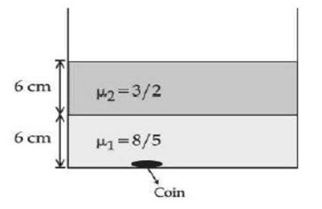
Two immiscible liquids of refractive indices 85 and 32 respectively are put in a beaker as shown in the figure. The height of each column is 6 cm . A coin is placed at the bottom of the beaker. For near normal vision, the apparent depth of the coin is α4 cm. The value of α is Beaker with two liquid layers, each 6 cm thick: lower layer μ1 = 8/5, upper layer μ2 = 3/2; coin at the bottom.
A convex lens of focal length 40 cm forms an image of an extended source of light on a photoelectric cell. A current I is produced. The lens is replaced by another convex lens having the same diameter but focal length 20 cm. The photoelectric current now is :
If the refractive index of the material of a prism is cot (A2), where A is the angle of prism then the angle of minimum deviation will be
A biconvex lens of refractive index 1.5 has a focal length of 20 cm in air. Its focal length when immersed in a liquid of refractive index 1.6 will be:
A convex mirror of radius of curvature 30 cm forms an image that is half the size of the object. The object distance is :
If the distance between object and its two times magnified virtual image produced by a curved mirror is 15 cm , the focal length of the mirror must be :
The distance between object and its two times magnified real image as produced by a convex lens is 45cm. The focal length of the lens used is cm.
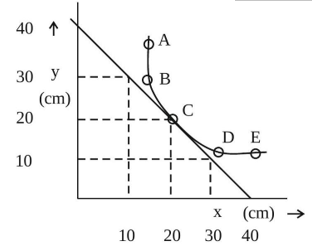
In an experiment to measure the focal length (f) of a convex lens, the magnitude of object distance (x) and the image distance (y) are measured with reference to the focal point of the lens. The y-x plot is shown in figure. The focal length of the lens is cm. y-x plot (x and y measured from the focal point of the lens); the curve passes through (20 cm, 20 cm).
The refractive index of a prism with apex angle A is cotA/2. The angle of minimum deviation is :
The distance between object and its 3 times magnified virtual image as produced by a convex lens is 20" " cm. The focal length of the lens used is cm.
An effective power of a combination of 5 identical convex lenses which are kept in contact along the principal axis is 25D. Focal length of each of the convex lens is :
In an experiment to measure focal length (f) of convex lens, the least counts of the measuring scales for the position of object (u) and for the position of image (v) are Δ u and Δ v, respectively. The error in the measurement of the focal length of the convex lens will be :
Light emerges out of a convex lens when a source of light kept at its focus. The shape of wavefront of the light is:
The refractive index of prism is μ=√(3) and the ratio of the angle of minimum deviation to the angle of prism is one. The value of angle of prism is
Critical angle of incidence for a pair of optical media is 45°.. The refractive indices of first and second media are in the ratio:
Given below are two statements: Statement (I): When an object is placed at the centre of curvature of a concave lens, image is formed at the centre of curvature of the lens on the other side. Statement (II): Concave lens always forms a virtual and erect image. In the light of the above statements, choose the correct answer from the options given below:
UPO
Unique PYQs Only. Solve only what is new.
✓4,348 unique PYQs
✓Repeated questions grouped in clusters
PYQ Express
Every JEE Main PYQ in one place.
✓10,000+ PCM PYQs
✓Physics, Chemistry, Maths
2025 Questions (39)
The driver sitting inside a parked car is watching vehicles approaching from behind with the help of his side view mirror, which is a convex mirror with radius of curvature R = 2m. Another car approaches him from behind with a uniform speed of 90 Km/hr. When the car is at a distance of 24 m from him, the magnitude of the acceleration of the image of the car in the side view mirror is 'a'. The value of 100 a is _____ m/s2.
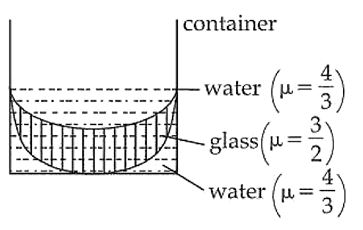
In the diagram given below, there are three lenses formed. Considering negligible thickness of each of them as compared to |R1| and |R2|, i.e., the radii of curvature for upper and lower surfaces of the glass lens, the power of the combination is Container with water (μ = 4/3) above and below a glass (μ = 3/2) meniscus lens; the glass lens has a concave upper surface (radius |R1|) and a convex lower surface (radius |R2|).
Given is a thin convex lens of glass (refractive index μ) and each side having radius of curvature R. One side is polished for complete reflection. At what distance from the lens, an object be placed on the optic axis so that the image gets formed on the object itself?
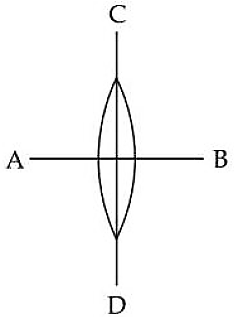
A symmetric thin biconvex lens is cut into four equal parts by two planes AB and CD as shown in figure. If the power of original lens is 4D then the power of a part of the divided lens is Symmetric thin biconvex lens cut into four equal parts by plane AB (through the principal axis) and plane CD (perpendicular to the axis through the centre).
What is the lateral shift of a ray refracted through a parallel-sided glass slab of thickness 'h' in terms of the angle of incidence 'i' and angle of refraction 'r', if the glass slab is placed in air medium?
Given a thin convex lens (refractive index μ2 ), kept in a liquid (refractive index μ1, μ1<μ2 ) having radii of curvatures |R1| and |R2|. Its second surface is silver polished. Where should an object be placed on the optic axis so that a real and inverted image is formed at the same place?
A spherical surface of radius of curvature R, separates air from glass (refractive index = 1.5). The centre of curvature is in the glass medium. A point object 'O' placed in air on the optic axis of the surface, so that its real image is formed at 'I' inside glass. The line OI intersects the spherical surface at P and PO = PI. The distance PO equals to
The refractive index of the material of a glass prism is √(3). The angle of minimum deviation is equal to the angle of the prism. What is the angle of the prism?
A thin plano convex lens made of glass of refractive index 1.5 is immersed in a liquid of refractive index 1.2. When the plane side of the lens is silver coated for complete reflection, the lens immersed in the liquid behaves like a concave mirror of focal length 0.2 m. The radius of curvature of the curved surface of the lens is
A plano-convex lens having radius of curvature of first surface 2 cm exhibits focal length of f1 in air. Another plano-convex lens with first surface radius of curvature 3 cm has focal length of f2 when it is immersed in a liquid of refractive index 1.2. If both the lenses are made of same glass of refractive index 1.5, the ratio of f1 and f2 will be
What is the relative decrease in focal length of a lens for an increase in optical power by 0.1 D from 2.5D ? ['D' stands for dioptre]
A photograph of a landscape is captured by a drone camera at a height of 18 km . The size of the camera film is 2 cm × 2 cm and the area of the landscape photographed is 400 km2. The focal length of the lens in the drone camera is:
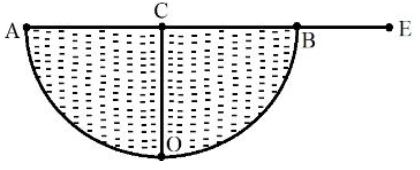
A hemispherical vessel is completely filled with a liquid of refractive index μ. A small coin is kept at the lowest point (O) of the vessel as shown in figure. The minimum value of the refractive index of the liquid so that a person can see the coin from point E (at the level of the vessel) is____. Hemispherical vessel filled with liquid (μ); coin at the lowest point O; E is a point at the level of the vessel rim, outside the vessel.
A thin prism P1 with angle 40 made of glass having refractive index 1.54, is combined with another thin prism P2 made of glass having refractive index 1.72 to get dispersion without deviation. The angle of the prism P2 in degrees is
A concave mirror produces an image of an object such that the distance between the object and image is 20 cm . If the magnification of the image is ' -3 ', then the magnitude of the radius of curvature of the mirror is :
In a long glass tube, mixture of two liquids A and B with refractive indices 1.3 and 1.4 respectively, forms a convex refractive meniscus towards A. If an object placed at 13 cm from the vertex of the meniscus in A forms an image with a magnification of ' -2 ' then the radius of curvature of meniscus is:
Two light beams fall on a transparent material block at point 1 and 2 with angle θ1 and θ2, respectively, as shown in figure. After refraction, the beams intersect at point 3 which is exactly on the interface at other end of the block. Given : the distance between 1 and 2, d = 4√3 cm and θ 1 = θ 2 = cos − 1( n22n1 ), where refractive index of the block n2> refractive index of the outside medium n1, then the thickness of the block is _______ cm . Two beams enter the top face at points 1 and 2, a distance d apart, at equal angles θ1 on opposite sides of the normal, and meet at point 3 on the bottom face directly below the midpoint of 1 and 2.
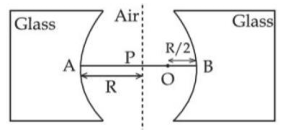
Two concave refracting surfaces of equal radii of curvature and refractive index 1.5 face each other in air as shown in figure. A point object O is placed midway, between P and B . The separation between the images of O, formed by each refracting surface is: Two concave refracting surfaces (glass, μ = 1.5) face each other in air, 2R apart; object O is midway between the midpoint P and the right surface B (OB = R/2, OA = 3R/2).
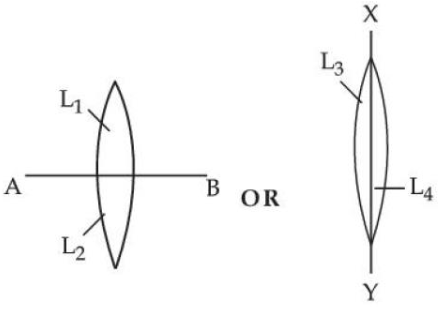
Two identical symmetric double convex lenses of focal length f are cut into two equal parts L1, L2 by A B plane and L3, L4 by X Y plane as shown in figure respectively. The ratio of focal lengths of lenses L1 and L3 is Two identical symmetric double convex lenses; one is cut by the horizontal plane AB (through the axis) into L1, L2; the other is cut by the vertical plane XY into L3, L4.
A convex lens made of glass (refractive index =1.5 ) has focal length 24 cm in air. When it is totally immersed in water (refractive index =1.33 ), its focal length changes to
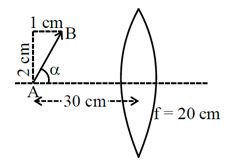
A slanted object AB is placed on one side of convex lens as shown in the diagram. The image is formed on the opposite side. Angle made by the image with principal axis is : Slanted object AB; A is on the axis 30 cm from the convex lens (f = 20 cm); B is 1 cm farther from the lens and 2 cm above the axis.
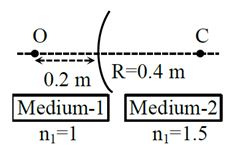
A spherical surface separates two media of refractive indices 1 and 1.5 as shown in figure. Distance of the image of an object 'O', is : (C is the center of curvature of the spherical surface and R is the radius of curvature) Spherical surface separates medium 1 (n1 = 1) from medium 2 (n2 = 1.5); object O is 0.2 m left of the surface; centre of curvature C is 0.4 m to the right (R = 0.4 m).
A ray of light suffers minimum deviation when incident on a prism having angle of the 64 prism equal to 60°. The refractive index of the prism material is √(2). The angle of incidence (in degrees) is ____
A bi-convex lens has radius of curvature of both the surfaces same as 1 / 6 cm. If this lens is required to be replaced by another convex lens having different radii of curvatures on both sides (R1 ≠ R2), without any change in lens power then possible combination of R1 and R2 is :
Two identical objects are placed in front of convex mirror and concave mirror having same radii of curvature of 12 cm , at same distance of 18 cm from the respective mirrors. The ratio of sizes of the images formed by convex mirror and by concave mirror is :
The radii of curvature for a thin convex lens are 10 cm and 15 cm respectively. The focal length of the lens is 12 cm. The refractive index of the lens material is
Consider following statements for refraction of light through prism, when angle of deviation is minimum. A. The refracted ray inside prism becomes parallel to the base. B. Larger angle prisms provide smaller angle of minimum deviation. C. Angle of incidence and angle of emergence becomes equal. D. There are always two sets of angle of incidence for which deviation will be same except at minimum deviation setting. E. Angle of refraction becomes double of prism angle. Choose the correct answer from the options given below:
Light from a point source in air falls on a spherical glass surface (refractive index, μ=1.5 and radius of curvature =50 cm ). The image is formed at a distance of 200 cm from the glass surface inside the glass. The magnitude of distance of the light source from the glass surface is ____ m.
Distance between object and its image (magnified by - 13) is 30 cm . The focal length of the mirror 74 used is ( x4 )cm, where magnitude of value of x is __________
When an object is placed 40 cm away from a spherical mirror an image of magnification 12 is produced. To obtain an image with magnification of 13, the object is to be moved :
A finite size object is placed normal to the principal axis at a distance of 30 cm from a convex mirror of focal length 30 cm. A plane mirror is now placed in such a way that the image produced by both the mirrors coincide with each other. The distance between the two mirrors is :
A container contains a liquid with refractive index of 1.2 up to a height of 60 cm and another liquid having refractive index 1.6 is added to height H above first liquid. If viewed from above, the apparent shift in the position of bottom of container is 40 cm. The value of H is ____cm . (Consider liquids are immiscible)
Two thin convex lenses of focal lengths 30 cm and 10 cm are placed coaxially, 10 cm apart. The power of this combination is:
A lens having refractive index 1.6 has focal length of 12 cm, when it is in air. Find the focal length of the lens when it is placed in water. (Take refractive index of water as 1.28)
A mirror is used to produce an image with magnification of 14. If the distance between object and its image is 40 cm , then the focal length of the mirror is
Given below are two statements : one is labelled as Assertion (A) and the other is labelled as Reason (R). Assertion (A) : Refractive index of glass is higher than that of air. Reason (R): Optical density of a medium is directly proportionate to its mass density which results in a proportionate refractive index. In the light of the above statements, choose the most appropriate answer from the options given below :
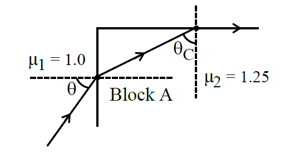
A transparent block A having refractive index μ=1.25 is surrounded by another medium of refractive index μ=1.0 as shown in figure. A light ray is incident on the flat face of the block with incident angle θ as shown in figure. What is the maximum value of θ for which light suffers total internal reflection at the top surface of the block? Rectangular block A (μ = 1.25) in air (μ = 1.0); the ray is incident on the flat vertical face at angle θ to the normal; the top surface is horizontal.
A concave-convex lens of refractive index 1.5 and the radii of curvature of its surfaces are 30 cm and 20 cm , respectively. The concave surface is upwards and is filled with a liquid of refractive index 1.3. The focal length of the liquid-glass combination will be
A convex lens of focal length 30 cm is placed in contact with a concave lens of focal length 20 cm. An object is placed at 20 cm to the left of this lens system. The distance of the image from the lens in cm is _________.
JEE Mates
Online Mock Test Series.
✓50 online mock tests
✓Video solutions + analysis
UTS
Ultimate Test Series.
✓20 full mocks + 6 special tests
✓Projected percentile after every test
2026 Questions (31)
In a microscope the objective is having focal length f0=2 cm and eye-piece is having focal length fe=4 cm. The tube length is 32 cm . The magnification produced by this microscope for normal adjustment is ____ .
A collimated beam of light of diameter 2 mm is propagating along x-axis. The beam is required to be expanded in a collimated beam of diameter 14 mm using a system of two convex lenses. If first lens has focal length 40 mm then the focal length of second lens is ____ mm.
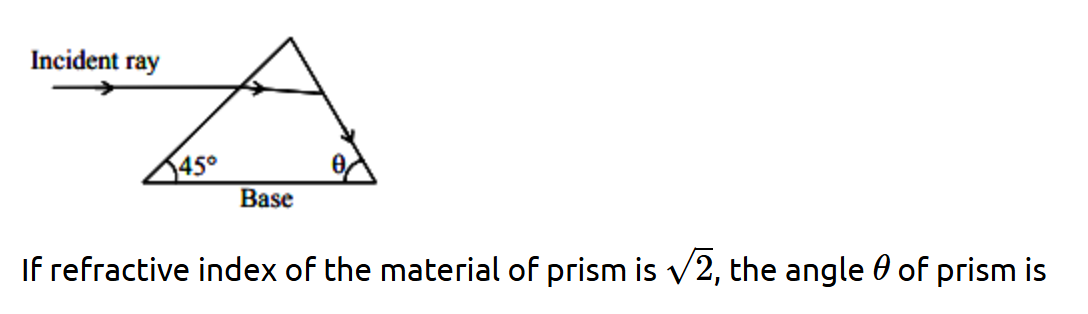
As shown in the diagram, when the incident ray is parallel to base of the prism, the emergent ray grazes along the second surface. Prism with base angles 45° (left) and θ (right); the incident ray is horizontal (parallel to the base) and the emergent ray grazes along the second surface. The figure also carries the question: "If refractive index of the material of prism is √(2), the angle θ of prism is ___."
parallel beam of light travelling in air (refractive index 1.0) is incident on a convex spherical glass surface of radius of curvature 50 cm . Refractive index of glass is 1.5 . The rays converge to a point at a distance xcm from the centre of the curvature of the spherical surface. The value of x is___________ cm .
Consider an equilateral prism (refractive index √(2) ). A ray of light is incident on its one surface at a certain angle i. If the emergent ray is found to graze along the other surface then the angle of refraction at the incident surface is close to ____ .
A thin convex lens of focal length 5 cm and a thin concave lens of focal length 4 cm are combined together (without any gap) and this combination has magnification m1 when an object is placed 10 cm before the convex lens. Keeping the positions of convex lens and object undisturbed a gap of 1 cm is introduced between the lenses by moving the concave lens away, which lead to a change in magnification of total lens system to m2. The value of |m1m2| is ____ .
In parallax method for the determination of focal length of a concave mirror, the object should always be placed :
The wavelength of light, while it is passing through water is 540 nm . The refractive index of water is 4 / 3. The wavelength of the same light when it is passing through a transparent medium having refractive index of 3 / 2 is ____ nm .
Consider light travelling from a medium A to medium B separated by a plane interface. If the light undergoes total internal reflection during its travel from medium A to B and the speed of light in media A and B are 2.4 × 10⁸ m / s and 2.7 × 10⁸ m / s, respectively, then the value of critical angle is :
A thin prism with angle 5° of refractive index 1.72 is combined with another prism of refractive index 1.9 to produce dispersion without deviation. The angle of second prism is ______.
The size of the images of an object, formed by a thin lens are equal when the object is placed at two different positions 8 cm and 24 cm from the lens. The focal length of the lens is _____ cm .
In a microscope of tube length 10 cm two convex lenses are arranged with focal length of 2 cm and 5 cm . Total magnification obtained with this system for normal adjustment is (5)k. The value of k is__________.
The exit surface of a prism with refractive index n is coated with a material having refractive index n2. When this prism is set for minimum angle of deviation, it exactly meets the condition of critical angle. The prism angle is ____
Distance between an object and three times magnified real image is 40 cm. The focal length of the mirror used is _____cm.
Five persons P1, P2, P3, P4 and P5 recorded object distance (u) and image distance (v) using same convex lens having power +5 D as (25,96),(30,62),(35,37),(45,35) and (50,32) respectively. Identify correct statement
A convex lens of refractive index 1.5 and focal length f=18 cm is immersed in water. The difference in focal lengths of the given lens when it is in water and in air is α × f. The value of α is ____ . (refractive index of water =4 / 3 )
The magnitudes of power of a biconvex lens (refractive index 1.5) and that of a plano-concave lens (refractive index =1.7 ) are same. If the curvature of planoconcave lens exactly matches with the curvature of back surface of the biconvex lens, then ratio of radius of curvature of front and back surface of the biconvex lens is ____
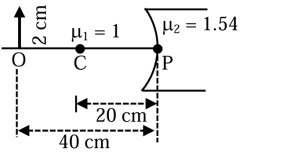
Refer the figure given below. m1 and m2 are refractive indices of air and lens material. The height of image will be _______ cm. Object O, 2 cm tall, is 40 cm left of a refracting surface; the centre of curvature C is 20 cm left of the surface vertex P; μ1 = 1 on the left, μ2 = 1.54 on the right.
For a thin symmetric prism made of glass (refractive index 1.5 ), the ratio of incident angle and minimum deviation will be ____ .
If sunlight is focused on a paper using convex lens, it starts burning the paper in shortest time when the lens is kept at 30 cm above the paper. If the radius of curvature of the lens is 60 cm then the refractive index of the lens material is α10. The value of α is ____ .
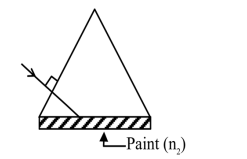
One side of an equilateral prism is painted by a transparent material of refractive index n2. The refractive index of prism is 1.6 . The minimum value of n2 required for total internal reflection from painted face is ____ . Equilateral prism; one side (the base) is painted with material of refractive index n2; the ray enters the left face at normal incidence.
A convex lens is made from glass material having refractive index of 1.4 with same radius of curvature on both sides. The ratio of its focal length and radius of curvature is ____ .
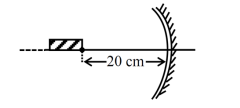
A rod of length 10 cm lies along the principle axis of a concave mirror of focal length 10 cm as shown in figure. The length of the image is _____ cm. Rod of length 10 cm lies along the principal axis; its near end is 20 cm from the concave mirror (f = 10 cm), so the rod spans 20 to 30 cm from the mirror.
A compound microscope is designed with two symmetric biconvex lenses. The objective lens is cut vertically, creating two identical plano-convex lenses. One of them is used in place of original objective lens. To retain same magnification keeping the object distance unchanged, the tube length has to be
An object A B is placed 15 cm on the left of a convex lens P of focal length 10 cm . Another convex lens Q is now placed 15 cm right of lens P. If the focal length of lens Q is 15 cm , the final image is ____ .
A thin convex lens and a thin concave lens are kept in contact and are co-axial. Which of the following statements is correct for this combination of two lenses?
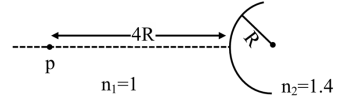
A spherical interface lens of radius R separates two media of refractive indices 1 and 1.4 respectively as shown in the figure below. A point source is placed at a distance of 4R in front of spherical interface. The magnitude of the magnification of point source image is _____ . Spherical refracting surface of radius R with its centre on the right; point source P is 4R to the left of the surface; n1 = 1 on the left, n2 = 1.4 on the right.
A concave mirror of focal length 10 cm forms an image which is double the size of object when the object is placed at two different positions. The distance between the two positions of the object is ____ cm .
Angle of minimum deviation is equal to the half of the angle of prism in an equilateral prism. The refractive index of the prism is _____.
Light ray incident along a vector A O(A O=2 î-3 ĵ) emerges out along vector O B(O B=C î-4 ĵ) as shown in the figure below. The value of C is ____ . The ray passes from air (refractive index 1) into glass (refractive index 1.5) across a horizontal plane interface; the normal to the interface is vertical.
A thin biconvex lens is prepared from the glass (μ=1.5) both curved surfaces of which have equal radii of 20 cm each. Left side surface of the lens is silvered from outside to make it reflecting. To have the position of image and object at the same place, the object should be placed, from the lens at a distance of ____ cm.
Physics PYQ Book
JEE Main 5 Years Physics PYQ Book 2022-2026.
✓Chapter-wise solved papers
✓Detailed solutions
JEE Advanced Online
Online Mock Test Series.
✓10 online mock tests
✓Video solutions + analysis
Frequently Asked Questions
Tags