JEE Main Coordination Compounds PYQs 2024, 2025 and 2026: All Questions with Solutions
JEE Main Coordination Compounds PYQs 2024, 2025 and 2026: All Questions with Solutions
Verified JEE Main Coordination Compounds questions from 2024, 2025 and 2026, shift by shift. The 2024, 2025 and 2026 sets are interactive now: pick an option or enter a number and check instantly. Attempt timed, check the method only after answering, and log every miss by pattern.
How to use this quiz
1. Attempt one year timed, without looking at the method.
2. Click an option, or type a number and press Check, for instant right or wrong feedback.
3. Read the short method only after answering, then log the miss by pattern.
4. Rework your weak patterns the same day, then reattempt the year.
2024 Questions (26)
Consider the following complex ions P = [FeF6]3-, Q = [V(H2O)6]2+, R = [Fe(H2O)6]2+. The correct order of the complex ions, according to their spin only magnetic moment values (in B.M.) is:
Which of the following electronic configuration would be associated with the highest magnetic moment?
The spin-only magnetic moment value of square planar complex [Pt(NH3)2Cl(NH2CH3)]Cl is ____ B.M. (nearest integer). (Given atomic number for Pt: 78, N: 7, Cl: 17, H: 1, C: 6)
Identify from the following species in which d2sp3 hybridization is shown by central atom:
In which one of the following metal carbonyls, CO forms a bridge between metal atoms?
The oxidation number of iron in the compound formed during brown ring test for NO3- ion is ____
A reagent which gives brilliant red precipitate with Nickel ions in basic medium is
The correct IUPAC name of K2MnO4 is
Choose the correct statements from the following: A. Ethane-1,2-diamine is a chelating ligand. B. Metallic aluminium is produced by electrolysis of aluminium oxide in presence of cryolite. C. Cyanide ion is used as a ligand for leaching of silver. D. Phosphine acts as a ligand in Wilkinson catalyst. E. The stability constants of Ca2+ and Mg2+ are similar to EDTA complexes.
Number of complexes which show optical isomerism among the following is ____: cis-[Cr(ox)2Cl2]3-, [Co(en)3]3+, cis-[Pt(en)2Cl2]2+, cis-[Co(en)2Cl2]+, trans-[Pt(en)2Cl2]2+, trans-[Cr(ox)2Cl2]3-
The coordination geometry around the manganese in decacarbonyldimanganese (0)
The 'Spin only' Magnetic moment for [Ni(NH3)6]2+ is ____ × 10-1 BM. (given = Atomic number of Ni: 28)
The correct statements from following are: A. The strength of anionic ligands can be explained by crystal field theory. B. Valence bond theory does not give a quantitative interpretation of kinetic stability of coordination compounds. C. The hybridization involved in formation of [Ni(CN)4]2- complex is dsp2. D. The number of possible isomer(s) of cis-[PtCl2(en)2]2+ is one. Choose the correct answer from the options given below:
Select the option with correct property / Select the correct option: [Ni species are in the options]
Match List I with List II. Figure: List-I (Complexion): A. [Cr(H2O)6]3+, B. [Fe(H2O)6]3+, C. [Ni(H2O)6]2+, D. [V(H2O)6]3+. List-II (Electronic Configuration): I. t2g2 eg0, II. t2g3 eg0, III. t2g3 eg2, IV. t2g6 eg2. Stem not solvable without the figure.

Which of the following complex is homoleptic?
Given below are two statements: Statement (I): A solution of [Ni(H2O)6]2+ is green in colour. Statement (II): A solution of [Ni(CN)4]2- is colourless. In the light of the above statements, choose the most appropriate answer from the options given below:
[Co(NH3)6]3+ and [CoF6]3- are respectively known as:
Number of ambidentate ligands among the following is ____: NO2-, SCN-, C2O4 2-, NH3, CN-, SO4 2-, H2O
Given below are two statements: one is labelled as Assertion (A) and the other is labelled as Reason (R). Assertion (A): The total number of geometrical isomers shown by [Co(en)2Cl2]+ complex ion is three. Reason (R): [Co(en)2Cl2]+ complex ion has an octahedral geometry. In the light of the above statements, choose the most appropriate answer from the options given below:
The correct order of ligands arranged in increasing field strength.
Consider the following complexes. (A) [CoCl(NH3)5]2+, (B) [Co(CN)6]3-, (C) [Co(NH3)5(H2O)]3+, (D) [Cu(H2O)6]2+. The correct order of A, B, C and D in terms of wavenumber of light absorbed is:
The 'spin only' magnetic moment value of MO4 2- is ____ BM. (Where M is a metal having least metallic radii among Sc, Ti, V, Cr, Mn and Zn). (Given atomic number: Sc = 21, Ti = 22, V = 23, Cr = 24, Mn = 25 and Zn = 30)
Number of complexes with even number of electrons in t2g orbitals is - [Fe(H2O)6]2+, [Co(H2O)6]2+, [Co(H2O)6]3+, [Cu(H2O)6]2+, [Cr(H2O)6]2+
An octahedral complex with the formula CoCl3.nNH3 upon reaction with excess of AgNO3 solution given 2 moles of AgCl. Consider the oxidation state of Co in the complex is 'x'. The value of 'x + n' is
The correct sequence of ligands in the order of decreasing field strength is
UPO
Unique PYQs Only. Solve only what is new.
✓4,348 unique PYQs
✓Repeated questions grouped in clusters
PYQ Express
Every JEE Main PYQ in one place.
✓10,000+ PCM PYQs
✓Physics, Chemistry, Maths
2025 Questions (39)
In which of the following complexes the CFSE, Δo, will be equal to zero?
From the magnetic behaviour of [NiCl4]2- (paramagnetic) and [Ni(CO)4] (diamagnetic), choose the correct geometry and oxidation state.
The complex of Ni2+ ion and dimethyl glyoxime contains ____ number of Hydrogen (H) atoms.
The correct order of the following complexes in terms of their crystal field stabilization energies is : [complexes are in the options]
Identify the homoleptic complex(es) that is/are low spin. (A) [Fe(CN)5NO]2-, (B) [CoF6]3-, (C) [Fe(CN)6]4-, (D) [Co(NH3)6]3+, (E) [Cr(H2O)6]2+. Choose the correct answer from the options given below:
The d-electronic configuration of an octahedral Co (II) complex having magnetic moment of 3.95 BM is
The correct set of ions (aqueous solution) with same colour from the following is:
The complex that shows Facial - Meridional isomerism is:
Identify the coordination complexes in which the central metal ion has d4 configuration. (A) [FeO4]2-, (B) [Mn(CN)6]3-, (C) [Fe(CN)6]3-, (D) Cr2(O-C-Me)4(H2O)2, (E) [NiF6]2-. Choose the correct answer from the options given below:
One mole of the octahedral complex compound Co(NH3)5Cl3 gives 3 moles of ions on dissolution in water. One mole of the same complex reacts with excess of AgNO3 solution to yield two moles of AgCl(s). The structure of the complex is:
Match List - I with List - II. List - I (Transition metal ion): (A) Ti3+, (B) V2+, (C) Ni2+, (D) Sc3+. List - II (Spin only magnetic moment (B.M.)): (I) 3.87, (II) 0.00, (III) 1.73, (IV) 2.84. Choose the correct answer from the options given below:
The conditions and consequence that favours the t2g3 eg1 configuration in a metal complex are :
The metal ion whose electronic configuration is not affected by the nature of the ligand and which gives a violet colour in non-luminous flame under hot condition in borax bead test is
Total number of molecules/species from following which will be paramagnetic is O2, O2+, O2-, NO, NO2, CO, K2[NiCl4], [Co(NH3)6]Cl3, K2[Ni(CN)4]
Match List - I with List - II. List - I (Complex): (A) [CoF6]3-, (B) [NiCl4]2-, (C) [Co(NH3)6]3+, (D) [Ni(CN)4]2-. List - II (Hybridisation of central metal ion): (I) d2sp3, (II) sp3, (III) sp3d2, (IV) dsp2. Choose the correct answer from the options given below:
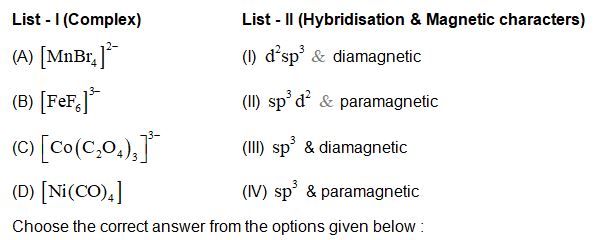
Match List - I with List - II. Figure: List-I (Complex): (A) [MnBr4]2-, (B) [FeF6]3-, (C) [Co(C2O4)3]3-, (D) [Ni(CO)4]. List-II (Hybridisation & Magnetic characters): (I) d2sp3 & diamagnetic, (II) sp3d2 & paramagnetic, (III) sp3 & diamagnetic, (IV) sp3 & paramagnetic. Stem not solvable without the figure.
The correct increasing order of stability of the complexes based on Δo value is : I. [Mn(CN)6]3-, II. [Co(CN)6]4-, III. [Fe(CN)6]4-, IV. [Fe(CN)6]3-
Consider the following low-spin complexes K3[Co(NO2)6], K4[Fe(CN)6], K3[Fe(CN)6], Cu2[Fe(CN)6] and Zn2[Fe(CN)6]. The sum of the spin-only magnetic moment values of complexes having yellow colour is ____ B.M. (answer in nearest integer)
The calculated spin-only magnetic moments of K3[Fe(OH)6] and K4[Fe(OH)6] respectively are :
Identify the homoleptic complexes with odd number of d electrons in the central metal : (A) [FeO4]2-, (B) [Fe(CN)6]3-, (C) [Fe(CN)5NO]2-, (D) [CoCl4]2-, (E) [Co(H2O)3F3]. Choose the correct answer from the options given below :
A transition metal (M) among Mn, Cr, Co and Fe has the highest standard electrode potential (M3+/M2+). It forms a metal complex of the type [M(CN)6]4-. The number of electrons present in the eg orbital of the complex is ____
Given below are two statements: Statement (I): In octahedral complexes, when Δo < P high spin complexes are formed. When Δo > P low spin complexes are formed. Statement (II): In tetrahedral complexes because of Δt < P, low spin complexes are rarely formed. In the light of the above statements, choose the most appropriate answer from the options given below:
The spin-only magnetic moment value of Mn+ ion formed among Ni, Zn, Mn and Cu that has the least enthalpy of atomisation is ____. (in nearest integer) Here n is equal to the number of diamagnetic complexes among K2[NiCl4], [Zn(H2O)6]Cl2, K3[Mn(CN)6] and [Cu(PPh3)3I]
The d-orbital electronic configuration of the complex among [Co(en)3]3+, [CoF6]3-, [Mn(H2O)6]2+ and [Zn(H2O)6]2+ that has the highest CFSE is :
The type of hybridization and the magnetic property of [MnCl6]3- are
The number of optical isomers exhibited by the iron complex (A) obtained from the following reaction is ____: FeCl3 + KOH + H2C2O4 -> A
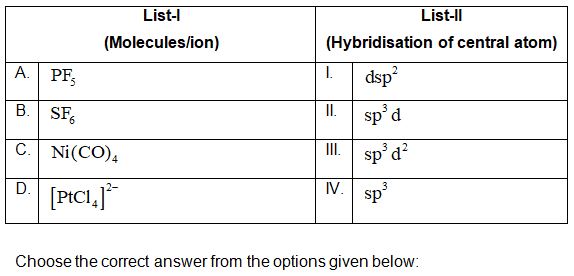
Match the LIST-I with LIST-II. Figure: List-I (Molecules/ion): (A) PF5, (B) SF6, (C) Ni(CO)4, (D) [PtCl4]2-. List-II (Hybridisation of central atom): (I) dsp2, (II) sp3d, (III) sp3d2, (IV) sp3. Stem not solvable without the figure (PF5/SF6 are hybridisation distractors).
The correct order of the complexes [Co(NH3)5(H2O)]3+ (A), [Co(NH3)6]3+ (B), [Co(CN)6]3- (C) and [CoCl(NH3)5]2+ (D) in terms of wavelength of light absorbed is
Identify the diamagnetic octahedral complex ions from below ; A. [Mn(CN)6]3-, B. [Co(NH3)6]3+, C. [Fe(CN)6]4-, D. [Co(H2O)3F3]. Choose the correct answer from the options given below:
Which one of the following complexes will have Δo = 0 and μ = 5.96 B.M?
Number of stereoisomers possible for the complexes, [CrCl3(py)3] and [CrCl2(ox)2]3- are respectively (py = pyridine, ox = oxalate)
A metal complex with a formula MCl4.3NH3 is involved in sp3d2 hybridisation. It upon reaction with excess of AgNO3 solution gives 'x' moles of AgCl. Consider 'x' is equal to the number of lone pairs of electron present in central atom of BrF5. Then the number of geometrical isomers exhibited by the complex is ____.
'X' is the number of electrons in t2g orbitals of the most stable complex ion among [Fe(NH3)6]3+, [FeCl6]3-, [Fe(C2O4)3]3- and [Fe(H2O)6]3+. The nature of oxide of vanadium of the type V2OX is :
An octahedral complex having molecular composition Co.5NH3.Cl2.SO4 has two isomers A and B. The solution of A gives a white precipitate with AgNO3 solution and the solution of B gives white precipitate with BaCl2 solution. The type of isomerism exhibited by the complex is.
The number of paramagnetic metal complex species among [Co(NH3)6]3+, [Co(C2O4)3]3-, [MnCl6]3-, [Mn(CN)6]3-, [CoF6]3-, [Fe(CN)6]3- and [FeF6]3- with same number of unpaired electrons is ____
'X' is the number of acidic oxides among VO2, V2O3, CrO3, V2O5 and Mn2O7. The primary valency of cobalt in [Co(H2NCH2CH2NH2)3]2(SO4)3 is Y. The value of X + Y is ____.
The number of species from the following that are involved in sp3d2 hybridization is [Co(NH3)6]3+, SF6, [CrF6]3-, [CoF6]3-, [Mn(CN)6]3- and [MnCl6]3-
Match the LIST-I with LIST-II. Figure: List-I (Complex/Species): (A) [Ni(CO)4], (B) [Ni(CN)4]2-, (C) [NiCl4]2-, (D) [MnBr4]2-. List-II (Shape & magnetic moment): (I) Tetrahedral, 2.8 BM, (II) Square planar, 0 BM, (III) Tetrahedral, 0 BM, (IV) Tetrahedral, 5.9 BM. Stem not solvable without the figure.

Given below are two statements: Statement I: A homoleptic octahedral complex, formed using monodentate ligands, will not show stereoisomerism. Statement II: cis- and trans-platin are heteroleptic complexes of Pd. In the light of the above statements, choose the correct answer from the options given below:
JEE Mates
Online Mock Test Series.
✓50 online mock tests
✓Video solutions + analysis
UTS
Ultimate Test Series.
✓20 full mocks + 6 special tests
✓Projected percentile after every test
2026 Questions (31)
Given below are two statements: Statement I: Among [Cu(NH3)4]2+, [Ni(en)3]2+, [Ni(NH3)6]2+ and [Mn(H2O)6]2+, [Mn(H2O)6]2+ has the maximum number of unpaired electrons. Statement II: The number of pairs among {[NiCl4]2-, [Ni(CO)4]}, {[NiCl4]2-, [Ni(CN)4]2-} and {[Ni(CO)4], [Ni(CN)4]2-} that contain only diamagnetic species is two. In the light of the above statements, choose the correct answer from the options given below:
Given below are two statements : Statement I : The number of species among SF4, NH4+, [NiCl4]2-, XeF4, [PtCl4]2-, SeF4 and [Ni(CN)4]2-, that have tetrahedral geometry is 3. Statement II: In the set [NO2, BeH2, BF3, AlCl3], all the molecules have incomplete octet around central atom. In the light of the above statements, choose the correct answer from the options given below:
Consider the transition metal ions Mn3+, Cr3+, Fe3+ and Co3+ and all form low spin octahedral complexes. The correct decreasing order of unpaired electrons in their respective d-orbitals of the complexes is
[Ni(PPh3)2Cl2] is a paramagnetic complex. Identify the INCORRECT statements about this complex. A. The complex exhibits geometrical isomerism. B. The complex is white in colour. C. The calculated spin-only magnetic moment of the complex is 2.84 BM. D. The calculated CFSE (Crystal Field Stabilization Energy) of Ni in this complex is -0.8 Δo. E. The geometrical arrangement of ligands in this complex is similar to that in Ni(CO)4. Choose the correct answer from the options given below.
The crystal field splitting energy of [Co(oxalate)3]3- complex is 'n' times that of the [Cr(oxalate)3]3- complex. Here 'n' is ____. (Assume Δo >> P)
The statements that are incorrect about the nickel(II) complex of dimethylglyoxime are : A. It is red in colour. B. It has a high solubility in water at pH = 9. C. The Ni ion has two unpaired d-electrons. D. The N - Ni - N bond angle is almost close to 90 degrees. E. The complex contains four five-membered metallacycles (metal containing rings). Choose the correct answer from the options given below:
Total number of unpaired electrons present in the central metal atoms/ions of [Ni(CO)4], [NiCl4]2-, [PtCl2(NH3)2], [Ni(CN)4]2- and [Pt(CN)4]2- is ____.
Identify the CORRECT set of details from the following: A. [Co(NH3)6]3+: Inner orbital complex; d2sp3 hybridized. B. [MnCl6]3-: Outer orbital complex; sp3d2 hybridized. C. [CoF6]3-: Outer orbital complex; d2sp3 hybridized. D. [FeF6]3-: Outer orbital complex; sp3d2 hybridized. E. [Ni(CN)4]2-: Inner orbital complex; sp3 hybridized. Choose the correct answer from the options given below:
Given below are two statements: Statement I: The number of paramagnetic species among [CoF6]3-, [TiF6]3-, V2O5 and [Fe(CN)6]3- is 3. Statement II: K4[Fe(CN)6] < K3[Fe(CN)6] < [Fe(H2O)6]SO4.H2O < [Fe(H2O)6]Cl3 is the correct order in terms of number of unpaired electron(s) present in the complexes. In the light of the above statements, choose the correct answer from the options given below
Consider a mixture 'X' which is made by dissolving 0.4 mol of [Co(NH3)5SO4]Br and 0.4 mol of [Co(NH3)5Br]SO4 in water to make 4 L of solution. When 2 L of mixture 'X' is allowed to react with excess of AgNO3, it forms precipitate 'Y'. The rest 2 L of mixture 'X' reacts with excess BaCl2 to form precipitate 'Z'. Which of the following statements is CORRECT?
Given below are two statements: Statement I: Hybridisation, shape and spin only magnetic moment of K3[Co(CO3)3] is sp3d2, octahedral and 4.9 BM respectively. Statement II: Geometry, hybridisation and spin only magnetic moment values (BM) of the ions [Ni(CN)4]2-, [MnBr4]2- and [CoF6]3- respectively are square planar, tetrahedral, octahedral; dsp2, sp3, sp3d2 and 0, 5.9, 4.9. In the light of the above statements, choose the correct answer from the options given below
The wavelength of light absorbed for the following complexes are in the order. Figure: (I) [Co(NH3)6]3+, (II) [Co(H2O)6]3+, (III) [Co(CN)6]3-, (IV) [Co(NH3)5(H2O)]3+, (V) [CoF6]3-. Stem not solvable without the figure.

X is the number of geometrical isomers exhibited by [Pt(NH3)(H2O)BrCl]. Y is the number of optically inactive isomer(s) exhibited by [CrCl2(ox)2]3-. Z is the number of geometrical isomers exhibited by [Co(NH3)3(NO2)3]. The value of X + Y + Z is ____.
The correct statement among the following is:
The number of isoelectronic species among Sc3+, Cr2+, Mn3+, Co3+ and Fe3+ is 'n'. If 'n' moles of AgCl is formed during the reaction of complex with formula CoCl3(en)2NH3 with excess of AgNO3 solution, then the number of electrons present in the t2g orbital of the complex is ____.
The correct increasing order of spin-only magnetic moment values of the complex ions [MnBr4]2- (A), [Cu(H2O)6]2+ (B), [Ni(CN)4]2- (C) and [Ni(H2O)6]2+ (D) is :
5.33 g of CrCl3.6H2O, which is a 1 : 3 electrolyte, is dissolved in water and is passed through a cation exchanger. The chloride ions in the eluted solution, on treatment with AgNO3 results in 8.61 g of AgCl. The ratio of moles of complex reacted and moles of AgCl formed is ____ × 10-2. (Nearest integer) [Molar mass in g mol-1: Cr : 52, Ag : 108, Cl : 35.5, H : 1, O : 16]
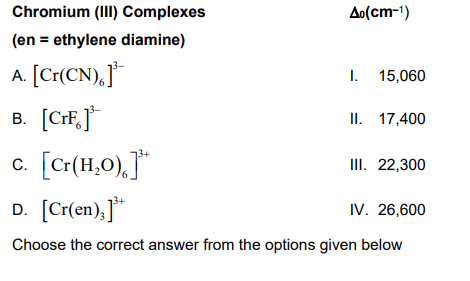
Match List I with List II. Figure: Chromium(III) Complexes (en = ethylene diamine): A. [Cr(CN)6]3-, B. [CrF6]3-, C. [Cr(H2O)6]3+, D. [Cr(en)3]3+; Δo (cm-1): I. 15,060, II. 17,400, III. 22,300, IV. 26,600. Stem not solvable without the figure.
Which of the following complexes will show coordination isomerism? A. [Ag(NH3)2][Ag(CN)2], B. [Co(NH3)6][Cr(CN)6], C. [Co(NH3)6][Co(CN)6], D. [Fe(NH3)6][Co(CN)6], E. [Co(NH3)6][Fe(CN)6]. Choose the correct answer from the options given below:
Given below are two statements: Statement I: Among Zn, Mn, Sc and Cu, the energy required to remove the third valence electron is highest for Zn and lowest for Sc. Statement II: The correct order of the following complexes in terms of CFSE is [Co(H2O)6]2+ < [Co(H2O)6]3+ < [Co(en)3]3+. In the light of the above statements, choose the correct answer from the options given below:
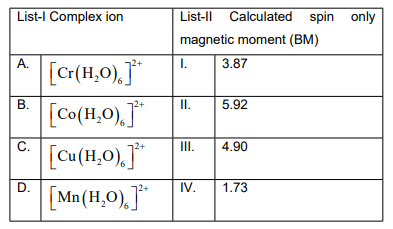
Match LIST-I with LIST-II. Figure: List-I (Complex ion): A. [Cr(H2O)6]2+, B. [Co(H2O)6]2+, C. [Cu(H2O)6]2+, D. [Mn(H2O)6]3+; List-II (Calculated spin only magnetic moment (BM)): I. 3.87, II. 5.92, III. 4.90, IV. 1.73. Stem not solvable without the figure.
Consider the metal complexes [Ni(en)3]2+ (A), [NiCl4]2- (B) and [Ni(NH3)6]2+ (C). Choose the CORRECT option by considering the number of unpaired electrons present in (A), (B) and (C) respectively and the order of frequency of absorption.
Given below are two statements: Statement I: Each electron in eg orbitals destabilizes the orbitals by +0.6 Δo and each electron in the t2g orbitals stabilizes the orbitals by -0.4 Δo in an octahedral field on the basis of crystal field theory. Statement II: All the d-orbitals of the transition metals have the same energy in their free atomic state but when a complex is formed the ligands destroy the degeneracy of these orbitals on the basis of crystal field theory. In the light of the above statements, choose the correct answer from the options given below
The correct statements about metal carbonyls are: A. The metal-carbon bonds in metal carbonyls possess both sigma and pi character. B. Due to synergic bonding interactions between metal and CO ligand, the metal-carbon bond becomes weak. C. The metal-carbon sigma bond is formed by the donation of lone pair of electrons on the carbonyl carbon into a vacant orbital of metal. D. The metal-carbon pi bond is formed by the donation of electrons from filled d-orbital of metal into vacant pi* orbital of CO. Choose the correct answer from the options given below:
The total number of unpaired electrons present in the d3, d4 (low spin), d5 (high spin), d6 (high spin) and d7 (low spin) octahedral complex systems is ____.
Identify the correct statements from the following: A. [Fe(C2O4)3]3- is the most stable complex among [Fe(OH)6]3-, [Fe(C2O4)3]3- and [Fe(SCN)6]3-. B. The stability of [Cu(NH3)4]2+ is greater than that of [Cu(en)2]2+. C. The hybridization of Fe in K4[Fe(CN)6] is d2sp3. D. [Fe(NO2)3Cl3]3- exhibits linkage isomerism. E. NO2- and SCN- ligands are NOT ambidentate ligands. Choose the correct answer from the options given below:
Given below are two statements: Statement I: Presence of large number of unpaired electrons in transition metal atoms results in higher enthalpies of their atomisation. Statement II: dxy = dxz = dyz < dx²−y² = dz² and dx²−y² = dz² < dxy = dxz = dyz are the d-orbital splittings in [Fe(H2O)6]3+ and [NiCl4]2- complex ions respectively. In the light of the above statements, choose the correct answer from the options given below
Which of the following are true about the energy of the given d-orbitals of a tetrahedral complex? A. dxy = dxz > dx²−y², B. dxy = dyz > dz², C. dx²−y² > dz² > dxz, D. dx²−y² = dz² < dxz. Choose the correct answer from the given below:
Match LIST-I with LIST-II. Figure: List-I (Electronic configuration of tetrahedral metal ion): A. d2, B. d4, C. d6, D. d8; List-II (Crystal Field Stabilization Energy (Δt)): I. -0.6, II. -0.8, III. -1.2, IV. -0.4. Stem not solvable without the figure.

An excess of AgNO3 is added to 100 mL of a 0.05 M solution of tetraaquadichloridochromium (III) chloride. The number of moles of AgCl precipitated will be ____ × 10-3. (Nearest integer)
Number of paramagnetic complexes among the following is ____. Figure: [MnBr4]2-, [NiCl4]2-, [Ni(CN)4]2-, [Ni(CO)4], [CoF6]3-, [Fe(CN)6]3-, [Mn(CN)6]3-, [Ti(CN)6]3-, [Cu(H2O)6]2+, [Co(C2O4)3]3-. Stem not solvable without the figure (list only in figure).

Chemistry PYQ Book
JEE Main 5 Years Chemistry PYQ Book 2022-2026.
✓Chapter-wise solved papers
✓Detailed solutions
JEE Advanced Online
Online Mock Test Series.
✓10 online mock tests
✓Video solutions + analysis
Frequently Asked Questions
Tags