JEE Main Chemistry PYQ Chapter Wise 2027: Physical, Organic & Inorganic
JEE Main PYQs · Competishun
JEE Main Chemistry PYQ Chapter Wise 2027: Physical, Organic & Inorganic
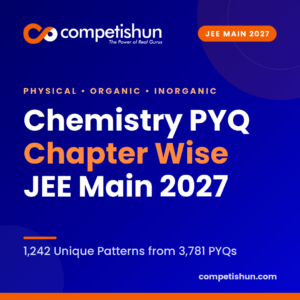
Solve Chemistry PYQs chapter by chapter, unique patterns first. From 2019 to 2026, JEE Main asked 3,781 Chemistry questions, but only 1,242 are unique patterns, about 33 percent, while 2,539 are repeats. Master the unique set of each chapter, ranked by Repeat Frequency, and practise the five verified 2024 to 2026 chapter sets below to start.
Chemistry is the most repeat-heavy subject in JEE Main, and that is good news. Of the 3,781 Chemistry questions asked from 2019 to 2026, only 1,242 are unique patterns. Learn those patterns chapter by chapter, and the rest of the paper starts to look familiar.
This guide is the Chemistry hub of the UPO series. It maps every standard Chemistry chapter across Physical, Organic and Inorganic, gives a practice approach for each, and uses only verified numbers: the UPO totals and five chapter question sets counted from this site for 2024 to 2026.
No per-chapter count is invented here. Where a count exists, it is named and linked. Where it does not, the guide says so, and gives you the method instead. That honesty is the point: a plan built on guessed numbers falls apart the first week you test it.
In this guide
Chemistry PYQ in Numbers: 3,781 Questions, 1,242 Unique Patterns
JEE Main Paper 1 asked 12,018 questions from 2019 to 2026. Only 4,348 of them are unique patterns, about 36 percent. The other 7,670 are repeats of those patterns, the same idea returning with new numbers, new compounds or a new story.
Swipe to see all four numbers
| Subject | Total PYQs (2019 to 2026) | Unique | Repeats | Unique Share |
|---|---|---|---|---|
| Physics | 4,369 | 1,527 | 2,842 | 35% |
| Chemistry | 3,781 | 1,242 | 2,539 | 33% |
| Mathematics | 3,868 | 1,579 | 2,289 | 41% |
| Total (PCM) | 12,018 | 4,348 | 7,670 | 36% |
| Full classification, JEE Main Paper 1, 2019 to 2026. | ||||
Swipe the table sideways to see all columns
Chemistry is the most repeat-heavy subject of the three. Its 3,781 questions compress into 1,242 unique patterns, only about 33 percent. Physics keeps 35 percent unique, and Maths keeps 41 percent. That gap is the whole point of this guide.
Chemistry split, 2019 to 2026. One in three Chemistry questions is a new pattern. Two in three are repeats.
Read the chart as a workload, not as trivia. Two out of every three Chemistry questions you meet are a repeat of a pattern you have already seen, if you studied the unique set first. The repeats are not extra work. They are revision, served by the exam itself.
Why Chapter-Wise PYQ Practice Wins for Chemistry
Year-wise practice feels complete, because you finish whole papers. It hides the one thing that matters: which chapter each question belongs to. You can solve ten papers and still not know whether your Mole Concept is strong and your Amines is weak.
Chapter-wise practice fixes that blind spot. Every question lands in its chapter, so your weak chapters show up within a week. You also meet the same pattern family several times in one sitting, which is how recognition forms.
- Patterns stay together: questions built on the same idea sit side by side, so the idea is easier to spot.
- Weak chapters surface fast: a low score in one chapter table tells you exactly where to go next.
- Revision is targeted: you revise one chapter at a time instead of re-solving whole papers.
- Repeats become visible: the same pattern returning with new numbers is obvious inside a chapter.
- Theory links to questions: you read the chapter, then solve its questions while the theory is fresh.
- Progress is measurable: chapter accuracy is a number you can track week by week.
Year-wise papers still have a place, and this guide uses them at the end, as timed tests. But the learning happens chapter by chapter. If you only have three months, spend them on chapters, not on papers.
One caution before the tables. This guide gives no invented per-chapter question counts. The only chapter counts used here are the five verified 2024 to 2026 sets listed later, counted from the site’s own quiz questions. Everything else is a practice approach, not a number.
Physical Chemistry: Five Chapters, One Method
Physical Chemistry rewards method over memory. Each chapter has a small set of formulas and a large set of variations, so the winning move is to solve the same formula in many forms until the form stops mattering.
| Chapter | What to master | Practice approach |
|---|---|---|
| Mole Concept | Mole, molarity, limiting reagent, stoichiometry | Solve numerically first, then check units every time |
| Thermodynamics | Enthalpy, entropy, Gibbs energy, Hess law | Write the sign and the unit before the number |
| Equilibrium | Kc and Kp, pH, buffers, solubility | Practise the ICE table until it is automatic |
| Electrochemistry | Nernst equation, cell EMF, conductance | Convert every cell diagram to a half-reaction pair |
| Chemical Kinetics | Rate laws, order, Arrhenius equation | Plot the data first, then pick the order |
| Standard JEE Main Physical Chemistry chapters, with a practice approach for each. | ||
Swipe the table sideways to see all columns
Mole Concept is the only Physical chapter with a verified 2024 to 2026 count on this site: 62 questions, published as a Mole Concept quiz with solutions. Start there if your basics are shaky, because every other Physical chapter borrows its arithmetic.
Thermodynamics and Equilibrium are the two chapters where sign errors cost the most marks. Keep a one-page error log for them, and re-solve every missed question after three days, not the same evening.
- Formula sheet first: write every formula of the chapter from memory before you solve a single question.
- Units in every line: a missing unit is usually a wrong setup, and the setup is the question.
- Timed sets of ten: ten questions in fifteen minutes builds the speed the paper demands.
Electrochemistry and Kinetics are smaller chapters, so finish them in short bursts between bigger chapters. A small chapter done well is worth more than a big chapter left half done.
Organic Chemistry: Learn Reactions as Families
Organic Chemistry looks huge because it lists many reactions. It shrinks fast when you group them into families. One mechanism explains a whole family, and the exam mostly asks the same family with a different starting compound.
| Chapter | Core idea | Practice approach |
|---|---|---|
| General Organic Chemistry | Inductive and resonance effects, intermediates | Name the intermediate before you pick the product |
| Hydrocarbons | Alkanes, alkenes, alkynes, aromatic substitution | Draw every mechanism with arrows, never from memory alone |
| Haloalkanes and Haloarenes | SN1, SN2, elimination | Decide the mechanism first, then the product |
| Alcohols, Phenols and Ethers | Acidity, dehydration, Williamson synthesis | Compare acidities in a table, not in your head |
| Aldehydes and Ketones | Nucleophilic addition, oxidation, reduction | List the reagent with the product it gives |
| Amines | Basicity, diazotisation, named reactions | Rank basicity with reasons, then solve |
| Biomolecules | Carbohydrates, proteins, vitamins | Learn structures as diagrams, then test yourself |
| Standard JEE Main Organic Chemistry chapters, with a practice approach for each. | ||
Swipe the table sideways to see all columns
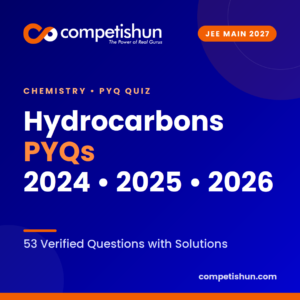
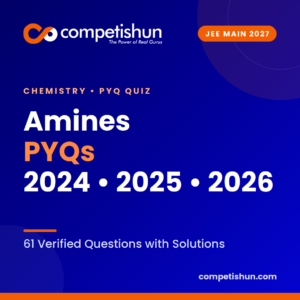
Two Organic chapters carry verified 2024 to 2026 counts on this site: Amines with 61 questions and Hydrocarbons with 53, each published as a quiz with solutions. They are good first targets, because their counts are real and their solutions are checked.
General Organic Chemistry is the chapter that pays for all the others. If you cannot name the intermediate, you will guess the product. Spend the first week here, even if it feels slow, because it makes every later chapter faster.
- One family at a time: finish all questions of one reaction family before starting the next.
- Reagent notebook: one line per reagent: what it does, and what it never does.
- Name reactions by mechanism: a name you cannot explain is a mark you will lose under pressure.
Biomolecules is the most memory-heavy chapter in Organic Chemistry. Use short daily recall, ten minutes a day, instead of one long session. Memory chapters fade fastest, so revisit them in every revision cycle.
Inorganic Chemistry: Facts That Repeat, Logic That Stays
Inorganic Chemistry mixes facts with logic. The periodic table gives you the logic, and NCERT gives you the facts. Read NCERT first, then solve, because most Inorganic questions test a line you have read, not a trick you must invent.
| Chapter | What to master | Practice approach |
|---|---|---|
| Periodic Table and Periodicity | Trends across periods and groups | Explain each trend with shielding and size |
| Chemical Bonding | Hybridisation, VSEPR, molecular orbital theory | Draw the shape before you name it |
| Coordination Compounds | IUPAC names, isomerism, crystal field theory | Practise naming daily, five compounds a day |
| p-Block Elements | Group trends, oxoacids, anomalous behaviour | One table per group, filled from memory |
| d-Block and f-Block Elements | Oxidation states, colour, magnetic moment | Link each property to its electronic configuration |
| Standard JEE Main Inorganic Chemistry chapters, with a practice approach for each. | ||
Swipe the table sideways to see all columns
Two Inorganic chapters carry verified 2024 to 2026 counts on this site: Coordination Compounds with 96 questions, the largest verified Chemistry set, and Chemical Bonding with 65. Both are published as quizzes with solutions.
Coordination Compounds is the highest-value Inorganic chapter by that count, and it rewards steady naming practice. Five compounds a day, named from structure and drawn from name, builds the skill in a month.
- NCERT line by line: read the chapter, then underline every fact that could become a question.
- Tables from memory: rebuild each group table without the book, then check it.
- Exceptions list: keep one page of exceptions, and read it every Sunday.
Chemical Bonding is the chapter that connects all three branches, because hybridisation and shape appear in Organic questions too. A strong Bonding chapter quietly lifts your Organic score as well.
Five Verified Chapter Counts: 2024 to 2026 Questions on This Site
Everything so far used only the verified totals. This section adds the only per-chapter figures this guide claims: five chapter question sets counted from the site’s own quizzes for JEE Main 2024 to 2026, each with solutions.
Verified questions asked in JEE Main 2024 to 2026, counted from the site’s own chapter quizzes. Bar widths are scaled to the largest set, 96.
| Chapter | Branch | Questions (2024 to 2026) | Practice |
|---|---|---|---|
| Coordination Compounds | Inorganic | 96 | Coordination Compounds quiz |
| Chemical Bonding | Inorganic | 65 | Chemical Bonding quiz |
| Mole Concept | Physical | 62 | Mole Concept quiz |
| Amines | Organic | 61 | Amines quiz |
| Hydrocarbons | Organic | 53 | PYQ Express chapter set |
| Five verified chapter sets. No other chapter count is claimed in this guide. | |||
Swipe the table sideways to see all columns
Together these five sets hold 337 verified questions. That is a solid first block of chapter practice, and every question in it has a checked solution. Start with the chapter you are weakest in, not the biggest one.
No other chapter count appears in this guide, because no other chapter has been counted the same way yet. A count without a count method is a guess, and guesses do not belong in a plan you will trust for months.
The 5-Step Method for Every Chemistry Chapter
One method works for all three branches, because the differences sit in the content, not in the steps. Learn the chapter, rank its patterns, check the concept, mark the must-do set, then practise it timed.
Run every chapter through the same five steps
Learn the chapter first
Read the theory until every core idea can be stated in one line. No solving before theory.
List the patterns by Repeat Frequency
Open the cluster list. The highest frequency patterns are the important set of the chapter.
Rank firstCheck the concept under each pattern
Name the concept in one line, without the numbers. If you cannot name it, you have not identified it.
Concept checkMark the must-do set
Star the top patterns. These are the questions to master first. The rest wait their turn.
Practise timed, then revisit
Solve the marked set against the clock, then re-solve the misses after a week.
Practise loopUPO for JEE Main 2027
2019 to 2026 · Physics, Chemistry and Maths
All 12,018 JEE Main PYQs analysed and clustered: solve the 4,348 unique questions first, ranked by Repeat Frequency, with every repeat one tap away in its cluster and written, express and detailed solutions for each question.
PYQ Express
Video + Text Solutions · Chapter and Topic-wise
JEE Main PYQs sorted chapter-wise and topic-wise, with express video solutions for fast methods, detailed video solutions and step-by-step text solutions.
Two habits make the method work. First, name each pattern in one line before moving on. Second, time the must-do set, because a pattern recognised slowly is not yet an exam mark.
Repeat Frequency is the ranking behind step two. Across 12,018 questions, only 4,348 patterns are unique, and each carries a count of how often it returned. The highest counts go first, in every chapter.
Mistakes to Avoid in Chemistry PYQ Practice
- Solving year-wise only: whole papers hide weak chapters. Mix chapter sets with timed papers, never papers alone.
- Memorising answers: a changed number defeats a memorised answer. Learn the method behind each pattern.
- Skipping NCERT for Inorganic: most Inorganic questions test a line from NCERT. Read it before you solve.
- Ignoring sign and unit errors: in Physical Chemistry the setup is the question. Log every sign error and re-solve it.
- Reading Organic without drawing: mechanisms learned by reading alone fail under pressure. Draw every arrow.
- Trusting invented chapter counts: exact counts without a count method are guesses. Use only verified totals and the five sets above.
- Leaving revision to the end: Chemistry facts fade fast. Revisit each chapter on a fixed cycle, not when you feel like it.
- Practising without a timer: untimed accuracy is not exam accuracy. Time every set once the method is clear.
If your practice already holds one of these mistakes, do not start over. Change the next session: pick a chapter, run the five steps, and time the must-do set. Questions already solved are not wasted, they handed you the attempts to analyse.
The costliest mistake is the quietest one: solving many questions without ever naming the pattern. Ten questions from ten patterns teach less than ten questions from one pattern, solved until the pattern is obvious.
Your 4-Week Chemistry PYQ Plan
Four weeks is enough to cover the five verified sets and the chapter method, if each week has one job. The plan below assumes two hours a day for Chemistry PYQs, and it scales: halve the daily questions if you have one hour, and stretch each week to ten days.
| Week | Focus | What to finish |
|---|---|---|
| Week 1 | Physical Chemistry | Mole Concept set (62 questions) plus Thermodynamics theory and one timed set |
| Week 2 | Inorganic Chemistry | Coordination Compounds set (96 questions) plus Chemical Bonding set (65 questions) |
| Week 3 | Organic Chemistry | Amines set (61 questions) plus Hydrocarbons set (53 questions) plus GOC theory |
| Week 4 | Revision and papers | Re-solve every miss timed, then two full Chemistry sections from past papers |
| Four weeks, five verified sets, 337 questions. | ||
Swipe the table sideways to see all columns
Week 2 is the heaviest, because it holds 161 questions across two chapters. Split it across seven days, about 23 questions a day, and keep the timed sets short so the volume does not turn into rushed guessing.
After four weeks, the method is yours. Repeat it chapter by chapter across the remaining chapters in the tables above, and let the Repeat Frequency ranking set the order inside each one.
Start With the Unique Chemistry Patterns
Solve the 1,242 unique Chemistry patterns first, ranked by Repeat Frequency, with every repeat inside its cluster and written, express and detailed solutions on one screen.
About Competishun
Competishun is an online JEE and NEET coaching platform with programs for Class 11, Class 12 and droppers, PYQ courses and books, study material and an All India Test Series, taught by experienced senior faculty. More than 2.2 million students follow the Competishun YouTube channel for free concept lectures and PYQ solutions.
Chemistry PYQ Chapter Wise for JEE Main 2027
Follow Competishun for daily PYQ solutions, concept lectures and JEE Main 2027 updates.
Read These Next
Clusters, Repeat Frequency and three solution formats, explained on the UPO page.
Every JEE Main PYQ from 2019 to 2026, sorted chapter-wise and topic-wise, with text and video solutions.
The repeat data behind this guide: 4,348 unique patterns, clusters and Repeat Frequency.
Frequently Asked Questions
Tags