JEE Main PYQ Analysis: What 12,018 PYQs from 2019 to 2026 Actually Show
JEE Main PYQ Analysis · Competishun
JEE Main PYQ Analysis: What 12,018 PYQs from 2019 to 2026 Actually Show
ANALYSIS SESSION BY
Mohit Tyagi Sir (MT Sir)
Mathematics Faculty · JEE Main Guidance
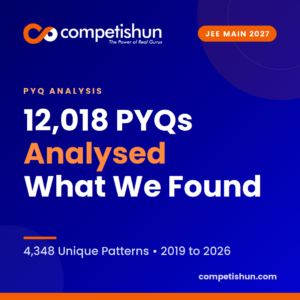
PYQ analysis of 12,018 JEE Main questions from 2019 to 2026 finds 4,348 unique patterns and 7,670 repeats. Similar questions are grouped into clusters, one representative question is kept for each pattern, and the repeats stay inside the cluster. Read the data by pattern and by Repeat Frequency, not by year alone, and give new patterns the practice time that repeated patterns do not need.
A long list of previous year questions looks impressive, but a list alone does not teach you anything. The useful question is different: how much of that list is actually new, and how much is the same idea returning in a new dress? That is the question this PYQ analysis answers, and the answer changes how practice should be planned.
When 12,018 JEE Main PYQs from 2019 to 2026 are put side by side and compared, a clear shape appears. A large part of the set is repetition. A much smaller part is genuinely new. The job of a serious aspirant is not to march through the whole list in order. It is to recognise the new part, understand it well, and stop spending the best hours of the day on questions that teach nothing new.
This blog explains the analysis in plain terms: how the grouping was done, what the subject numbers show, how to read Repeat Frequency, what a similar question family looks like, and where students misread the data. It is an analysis findings blog. It does not repeat the product explainer, and it does not repeat a step by step solving plan. Its purpose is simpler: help you read the evidence before you decide what to practise.
In this guide
How the PYQ Analysis Was Done
Analysis starts with a decision about what counts as the same question. Two questions are not the same only when every word matches. They are similar when they test the same concept, use the same kind of working, and differ mainly in numbers, data, or a small twist. That working definition matters, because it is the rule that decides whether a question is new or repeated.
Once that rule is set, the work follows a simple order. First, all 12,018 questions from 2019 to 2026 are collected across Physics, Chemistry, and Mathematics. Then, questions that are similar in concept and working are grouped together. Each group is called a cluster. Finally, one representative question is taken from each cluster, and every question that has no similar partner is also kept. Together, those representative questions and those standalone questions form the unique set.
The key detail is what happens to the rest. The remaining similar questions are not thrown away. They stay inside their own cluster, labelled CL1, CL2, and so on, so that a student who wants to see every version of a pattern can open that cluster and find them. The unique set is therefore a shorter practice list, not a censored record. Nothing in the original set is hidden. It is organised.
That structure also explains why the word unique needs care. Unique here does not mean rare, and it does not mean important in itself. It means one pattern, counted once. A unique pattern may have appeared many times in different forms, or it may have appeared only once. The next section shows how to tell those two cases apart, and why that difference matters more than the raw count.
What the Numbers Actually Show
The headline numbers are easy to quote and easy to misunderstand, so read them slowly. Out of 12,018 questions, 4,348 are unique patterns and 7,670 are repeats. In other words, about 36 percent of the set is new pattern, and about 64 percent is repetition of a pattern already present. A student who solves the full set in order therefore spends most of the time on ideas already met, unless the practice is organised by pattern first.
| Subject | Total PYQs | Unique patterns | What the share means |
|---|---|---|---|
| Physics | 4,369 | 1,527 | About 35 percent of Physics questions are unique patterns |
| Chemistry | 3,781 | 1,242 | About 33 percent of Chemistry questions are unique patterns |
| Mathematics | 3,868 | 1,579 | About 41 percent of Mathematics questions are unique patterns |
| Total: 12,018 PYQs from 2019 to 2026, of which 4,348 are unique patterns and 7,670 are repeats. | |||
Mathematics shows the highest unique share among the three subjects, while Chemistry shows the lowest. That does not mean Mathematics is harder, or Chemistry is easier. It means the rate at which new patterns appear differs by subject, and a single practice rule for all three subjects would miss that difference. A subject with more repetition rewards pattern recognition sooner, because the same idea returns often. A subject with more unique patterns rewards wider exposure, because new ideas keep appearing.
There is a second reading of the same table that students often miss. The repeats are not waste. They are evidence. When a pattern returns again and again, that return tells you something about the habits of the paper: which ideas examiners return to, which forms they prefer, and which small changes they use to make an old idea look new. The analysis turns that evidence into a number, Repeat Frequency, which is the subject of the next section.
How to Read Repeat Frequency
Repeat Frequency, written as RF, answers a simple question: how often has a similar pattern appeared? Questions in the unique set are listed with the highest Repeat Frequency first, and then in decreasing order. That order is not a ranking of difficulty. It is a ranking of return. A pattern at the top has come back in several forms. A pattern further down has come back less often, and a pattern with a Repeat Frequency of one has appeared in only one form so far.
| What you see | What it means | How to read it |
|---|---|---|
| High Repeat Frequency, listed first | The same pattern has returned in several similar questions | Understand the core idea deeply, because the paper returns to it |
| Middle Repeat Frequency | The pattern has returned, but less often | Learn the idea and note the variations that have appeared |
| Repeat Frequency of one | Only one form of this pattern has appeared so far | Do not skip it, but do not treat it as a returning favourite either |
| Repeat Frequency describes the past. It does not predict the next paper, and it does not promise that a pattern will return again. | ||
That last warning is important, because students often turn a frequency list into a prediction list. A high Repeat Frequency pattern is a good reason to study an idea well. It is not a guarantee that the same pattern will appear again, and it is not a reason to ignore everything else. Papers change, examiners vary the form, and a pattern that was common can be replaced by a new twist. Frequency helps you choose where to start. It does not choose the paper for you.
The order also helps with time. When time is short, starting from the top of the list means starting with patterns that have the strongest record of return. When time is comfortable, the full list matters, because the lower part contains the patterns that widen exposure. In both cases, the list is a guide to order, not a permission to skip. A student who only studies the top of the list has studied the most repeated patterns, not the whole subject.
One Similar Question Family, Explained
Abstract rules become clear with one concrete family. Take a point and a line. One question may ask for the foot of the perpendicular from the point to the line. Another may ask for the length of that perpendicular. A third may ask for the image of the point in the line. The numbers change, the wording changes, and the final ask changes, but the core working is the same family of ideas: the direction of the line, the perpendicular condition, and the relation between the point, its foot, and its image.
A student who solves all three in a row learns the family well on the first question, and then mainly repeats the same working on the next two. The second and third questions add familiarity, but they add little new understanding. That is the cost hidden inside a long question list: repetition feels like progress, because the hand keeps moving and answers keep coming, while the mind is mainly rehearsing a skill already learned.
The cluster view changes that experience. Study one representative question from the family properly, understand why the foot, the length, and the image are connected, and then glance at the other versions in the cluster to see how the twist changes. If a twist is genuinely new, study it. If it is only a change of numbers, move on. The time saved is not small talk. It is the time that can go to a pattern never met before, which is exactly where a paper can surprise a student.
This family also shows why solving many similar questions in a row wastes productive time in a subtler way. It builds speed on one family, but it narrows exposure. A paper does not ask one family again and again. It asks many families, each once or twice. Exposure across families matters more than speed inside one family, because speed inside one family cannot help with a family never seen.
Two Tools for the Same Analysis
The analysis is useful only if a student can actually use it while practising. Two tools carry the same data in different forms, and the difference between them is about how much time and depth a student needs on a given day.
UPO: Unique PYQs Only
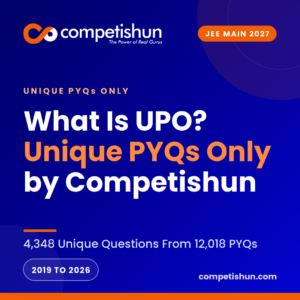
UPO organises the analysed set into clusters and a unique set, with Repeat Frequency, full clusters, and written plus video solutions on the same screen. Use it to study patterns in order, check clusters when needed, and see how often a pattern has returned.
PYQ Express
PYQ Express gives chapter-wise previous year questions with video solutions, so a student can practise a chapter in order and then return to the cluster view to check which patterns in that chapter repeat most often.
Neither tool replaces understanding. A cluster list without understanding is just a shorter list. The value comes from the habit of asking, for each question, which pattern it belongs to and whether that pattern is new to you. That habit is the real product of PYQ analysis, and it transfers to new questions in a way that memorised solutions do not.
Three Ways to Study One Question
The same question can be studied at three depths, and the right depth depends on how well the pattern is already known. The analysis keeps all three on the same screen, so a student does not have to hunt for a different resource when a question is unclear.
| Solution type | What it gives | When it helps most |
|---|---|---|
| Written solution | The full working in text, step by step | When you want to read at your own pace and recheck a step |
| Express Video solution | A short video of about 1 minute, explaining what the question asks and the solving map | When you want quick exposure to a pattern without a full solution |
| Detailed Video solution | A fuller video explanation of the question | When a question still feels unclear after the short version |
| Use the shortest version that gives understanding. Move to a longer version only when the idea is still unclear. | ||
The Express Video idea deserves a note, because it is often misunderstood. It is not a shortcut to skip understanding. It explains what the question is asking and how the solution should be approached, rather than working through every step at length. For a pattern already partly known, that map is enough to restore the idea. For a pattern that is new or confusing, the detailed version is the honest choice, even though it takes longer.
That choice is itself a study skill. Students who always choose the longest solution for every question run out of time. Students who always choose the shortest version for every question often miss the step where they actually get stuck. The analysis helps here too: a high Repeat Frequency pattern that still feels unclear deserves the detailed version, while a familiar pattern can be refreshed with the short version. Time is saved by matching depth to need, not by always choosing the shortest option.
The Last 5 Years Trap
One of the most common practice plans sounds sensible at first: solve only the last 5 years, because recent papers matter most. The analysis shows why that plan is incomplete, even though it feels modern. The last 5 years set is larger than the unique set, so it feels bigger and safer, but it does not cover the full period. Unique patterns from 2019 to 2021 are missing from it, and those patterns are still part of the subject, even if they have not appeared recently.
There are two mistakes hidden in that plan. The first is a coverage mistake: a larger set is not the same as a complete set. A set can be large because it contains many repeats, while still missing patterns from earlier years. The second is a recency mistake: recent does not mean representative. A pattern that appeared in an earlier year can return in a new form, and a student who never met it will meet it for the first time in the exam hall, which is the worst place to meet a new idea.
The unique set avoids both mistakes by design, not by luck. It is smaller than the last 5 years set, but it is drawn from the full 2019 to 2026 period. That means it includes earlier patterns as well as recent ones, and it counts each pattern once. A student who covers the unique set has therefore seen a wider range of ideas in less time, which is the opposite of what a long, repetitive list offers.
How to Read the Findings Honestly
Data is useful only when its limits are stated as clearly as its findings. This analysis describes 12,018 questions from 2019 to 2026. It does not describe a future paper, and it does not rank chapters, because chapter specific counts from the analysis are not part of the verified findings used here. Any claim that a particular chapter will dominate the next paper would go beyond what this data can support, and this blog does not make that claim.
There are three honest ways to use the findings. First, use them to order practice: start with patterns that have returned often, then widen to patterns seen only once, so that both familiarity and exposure grow. Second, use them to save time: when a cluster question teaches nothing new, move to a new pattern instead of repeating the same working. Third, use them to check understanding: if a high Repeat Frequency pattern still feels shaky, that is a signal to study the idea again, not to solve ten more versions of it.
There are also three misreadings to avoid. Do not treat a high Repeat Frequency as a promise. Do not treat a low Repeat Frequency as unimportant, because a new pattern can appear without warning. And do not treat the unique count as a finish line: covering 4,348 patterns is not the same as understanding them, and understanding comes from the work done on each pattern, not from ticking it off a list.
Read the analysis in four steps
Count patterns, not questions
Ask how many new patterns a session added, not how many questions were finished.
Coverage over countCheck the cluster
Open the cluster when a pattern feels familiar, and see how it has varied.
Variation over repetitionFollow Repeat Frequency
Start with patterns that have returned often, then widen to the rest.
Order over guessingWhen those three habits become routine, PYQ analysis stops being a set of impressive numbers and becomes a practical filter: what is new, what repeats, and what deserves the next hour. That filter is the real finding of the 12,018 question analysis, and it is available to any student willing to practise by pattern instead of by count.
Read the Patterns, Then Practise Them
Start with the unique patterns from 2019 to 2026, check clusters when a pattern returns, and use Repeat Frequency to order your practice.
About Competishun
Competishun is an online coaching platform for JEE preparation, with courses, test series, study material, and PYQ practice for students preparing for JEE Main and JEE Advanced. Its PYQ tools organise previous year questions by chapter and by pattern, with written and video solutions, so that students can practise with structure instead of only with volume.
Free JEE PYQ Solutions and Lectures
Follow Competishun for PYQ solutions, concept lectures, and JEE Main 2027 updates.
Read These Next
How the unique PYQ system works, what clusters mean, and how Repeat Frequency is organised.
A personalised PYQ plan by syllabus situation and time left, built around unique questions.
Chapter-wise guidance for solving Physics, Chemistry, and Mathematics PYQs in the right order.
Frequently Asked Questions
Tags
About the Teacher

Mohit Tyagi Sir, popularly known as MT Sir, is a Mathematics teacher known for clear concept teaching and direct, honest exam guidance for JEE aspirants. In this analysis session, he explains what the comparison of 12,018 previous year questions actually shows, how similar questions were grouped, and how students should read that evidence before planning practice.
Watch: 12,018 JEE Main PYQs Analysed
Watch Mohit Tyagi Sir explain the findings from the 12,018 question analysis, how the grouping works, and how to read Repeat Frequency.

Video: Mohit Tyagi Sir on YouTube