What is UPO by Competishun? Unique PYQs Only for JEE Main 2027
JEE Main PYQs · Competishun
What Is UPO by Competishun? Unique PYQs Only for JEE Main 2027
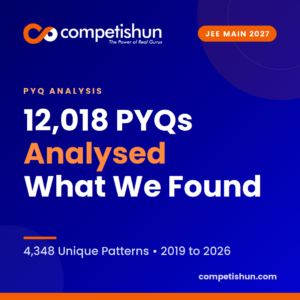
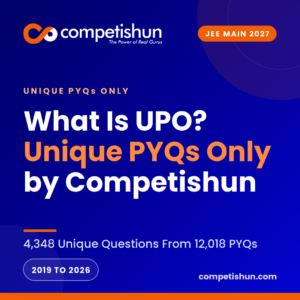
UPO means Unique PYQs Only, Competishun’s smarter way to practise JEE Main previous year questions. Between 2019 and 2026, JEE Main Paper 1 asked 12,018 questions, but only 4,348 of them are actually unique patterns; the other 7,670 are repeats. UPO groups similar questions into clusters, gives you one representative question per cluster, and ranks every cluster by Repeat Frequency, so you solve the unique question first and open its repeats only when you need them. This guide explains what UPO is, how it works, and how to use it for JEE Main 2027.
Every JEE Main aspirant hears the same advice: solve PYQs. What nobody tells you is that solving PYQs the usual way, one paper after another from 2019 to 2026, means solving 12,018 questions, and roughly two out of three of them are something you have already solved before: in a different year, a different shift, or with different numbers.
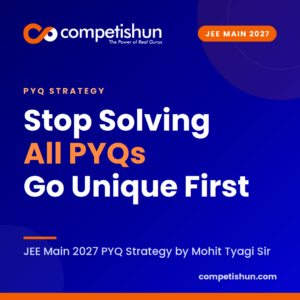
UPO, short for Unique PYQs Only, is Competishun’s answer to that problem. Instead of handing you 12,018 questions in year order, it classifies the entire 2019 to 2026 pool into 4,348 unique questions, each with its repeat questions grouped behind it in a cluster. You solve the unique question first. The repeats stay available inside the cluster, so nothing is hidden from you, but your time goes to new patterns first.
This guide explains what UPO is in plain language, the numbers behind it, how clusters and Repeat Frequency work, how UPO compares with solving every PYQ, who it suits best, and how to fit it into a JEE Main 2027 plan.
In this guide
What Is UPO? Unique PYQs Only, Explained Simply
UPO stands for Unique PYQs Only. It is a practice system for JEE Main Paper 1 previous year questions from 2019 to 2026, built by Competishun and available on the Competishun app and website under Digital Book, then Unique PYQs Only (UPO). It is not another PYQ book and not another set of papers. It is the same 8-year question pool, classified so that you practise patterns instead of counting questions.
The core idea fits in one line: every question pattern appears once, as the question you solve, and every time that pattern repeated in the exam sits behind it in the same cluster. Similar questions are grouped together, one representative question stands for the cluster, and the repeated versions stay available inside it, labelled CL1, CL2 and so on, whenever you want them.
UPO for JEE Main 2027
2019–2026 · Physics, Chemistry & Maths
All 12,018 JEE Main PYQs analysed and clustered: solve the 4,348 unique questions first, ranked by Repeat Frequency, with every repeat one tap away in its cluster and written, express and detailed solutions for each question.
The Numbers Behind UPO: 12,018 PYQs, 4,348 Unique Questions
Swipe to see all four numbers
Between 2019 and 2026, JEE Main Paper 1 was held across many shifts, and the total question pool grew to 12,018. When every question is compared with every other, a clear structure appears: 4,348 questions are genuinely distinct patterns, and 7,670 are repeats: the same concept, the same model, often the same solution path with new numbers, a new diagram or a new story.
| Subject | Total PYQs (2019 to 2026) | Unique | Repeats | Unique Share |
|---|---|---|---|---|
| Physics | 4,369 | 1,527 | 2,842 | 35% |
| Chemistry | 3,781 | 1,242 | 2,539 | 33% |
| Mathematics | 3,868 | 1,579 | 2,289 | 41% |
| Total (PCM) | 12,018 | 4,348 | 7,670 | 36% |
| Counts from the full classification of JEE Main Paper 1 questions, 2019 to 2026, all shifts. | ||||
Swipe the table sideways to see all columns
Unique share by subject, from the full 2019 to 2026 classification. Chemistry repeats the most; Mathematics varies the most.
Read the subject split carefully, because it changes your strategy per subject. Chemistry is the most repetitive subject: only a third of its questions are unique, which means Chemistry PYQ practice converges fast, and NCERT-line questions recur almost verbatim. Mathematics is the least repetitive: 41 percent unique means Maths rewards a wide model library, not a narrow set of memorised questions. Physics sits between the two.
One chapter proves the whole thesis. Electrostatics contains about 223 raw PYQs in the 2019 to 2026 pool. Classified properly, they compress to roughly 80 unique patterns. A student who masters those 80 patterns and recognises them on sight has effectively prepared for 223 questions. That compression ratio, about 2.8 to 1, is typical of the heavy Physics chapters.
How UPO Works: Clusters, Repeat Frequency and Solutions
UPO works in three parts that fit together: clusters, Repeat Frequency, and solutions on the same screen. Understand these three and you understand the product.
The five-step UPO loop
Open a chapter
Pick a chapter or topic. Its unique questions are listed first, ready to solve.
Solve the unique question
One representative question per cluster, starting with the most repeated patterns.
The core stepOpen the cluster when needed
For every unique question you missed or found slow, solve its repeats immediately. This is where a pattern becomes permanent.
Where marks are madeCheck the solution on the same screen
Written, Express Video and Detailed Video solutions sit with the question. No hunting across PDFs or videos.
Repeat by RF, not by year
Work clusters from highest Repeat Frequency to lowest, so the most examined patterns get mastered first.
- Repeat Frequency (RF): how many times a similar question pattern has appeared in JEE Main. In practice, the patterns the exam asks most often sit at the top of the list, and the rarer ones come after them.
- Clusters: groups of similar questions. You solve the representative unique question first; every repeated version stays inside the cluster for practice whenever you want it.
- Three solution types: written solutions, Express Video solutions and Detailed Video solutions, all on the same screen as the question.
- Where to find it: on the Competishun app and website under Digital Book, then Unique PYQs Only (UPO), chapter-wise and topic-wise, in Practice and Test mode.
One honest note, straight from UPO’s own guidance: if you are already doing a Must-Do PYQ set, finish what you have started. Use UPO for the remaining chapters, then do one quick UPO cycle for revision. Switching halfway through a set you are already solving well helps nobody.
UPO vs Solving All 12,018 PYQs: What Actually Changes
UPO and the full pool contain the same questions. The difference is purely the order and the structure around them. This table makes that difference concrete.
| Solving all PYQs in year order | Solving with UPO | |
|---|---|---|
| Order of solving | Year by year, paper by paper | Unique questions first, repeats on demand |
| What you cover | All 12,018 questions, repeats included | All 4,348 unique patterns, repeats inside clusters |
| Where new patterns come | Spread across the whole pool | Front-loaded: new patterns come first |
| Revision material | Re-solved papers | High-RF clusters plus your error log |
| Biggest risk | Running out of weeks before finishing | Skipping cluster practice and losing speed |
| Qualitative comparison. Question counts are from the 2019 to 2026 classification; the rest is method, not measurement. | ||
Swipe the table sideways to see all columns
None of this replaces full-paper practice. Papers train stamina, section order and time allocation, and they matter enormously in the final phase. The sequence is the point: UPO during the syllabus to build pattern mastery, full papers later to test it under exam conditions.
UPO for JEE Main 2027
2019–2026 · Physics, Chemistry & Maths
All 12,018 JEE Main PYQs analysed and clustered: solve the 4,348 unique questions first, ranked by Repeat Frequency, with every repeat one tap away in its cluster and written, express and detailed solutions for each question.
PYQ Express
Video + Text Solutions · Chapter & Topic-wise
JEE Main PYQs sorted chapter-wise and topic-wise, with express video solutions for fast methods, detailed video solutions and step-by-step text solutions.
Who Should Use UPO (and Who Should Not)
- Students starting PYQ practice now: the cleanest start available: unique first from day one, with repeats waiting in clusters.
- Students short on time: the unique bank is the highest-yield slice of the pool. If weeks are limited, this is where they should land.
- Droppers and repeaters: you already know many patterns from your last attempt. UPO stops you re-solving them and points you at what is actually new to you.
- Students who finished a Must-Do set: use UPO for the remaining chapters, then one quick UPO cycle for revision, exactly as the product itself suggests.
- Students who only love full papers: keep papers for the final phase. UPO is the practice bank underneath the papers, not a replacement for them.
And the honest exception: if you enjoy solving every paper end-to-end and you genuinely have the months to spare, the full pool still works. UPO is for students who want the same coverage with less repetition, not for students who want repetition itself.
How to Fit UPO Into Your JEE Main 2027 Plan
The four-step weekly UPO routine
Learn the chapter
Theory, formulas and textbook examples until the basics are solid. UPO before this step measures ignorance, not skill.
Solve its unique bank
The chapter’s unique questions, highest RF first, at exam pace.
The core stepCluster the misses
Every question you missed or found slow: open its cluster and solve the repeats the same day.
Where marks are madeReview the error log weekly
Wrong questions and slow clusters go into the log with a revisit date. The log is your final revision bank.
- Solving repeats before the unique parent: destroys the ordering UPO is built on. Unique first, always.
- Skipping clusters entirely: repeats are your speed training. A pattern you never timed is a pattern you do not own yet.
- Only reading solutions: recognition feels like mastery until the exam changes the numbers. Every question gets an honest timed attempt first.
- Treating UPO as a book to finish: it is a bank to work through chapter by chapter, not a novel to complete. Coverage of patterns matters, not page count.
Start with the chapter you are studying this week, not with 2019 Paper 1. UPO rewards the student who pairs it with the syllabus, chapter by chapter, and punishes the student who treats it as a separate mountain to climb. Explore it on the UPO page, and pair it with the year-count guide and the chapter-wise method linked below.
Explore UPO for JEE Main 2027
Solve the 4,348 unique JEE Main PYQs first, ranked by Repeat Frequency, with every repeat inside its cluster and written, express and detailed solutions on the same screen.
About Competishun
Competishun is an online JEE and NEET coaching platform with programs for Class 11, Class 12 and droppers, PYQ courses and books, study material and an All India Test Series, taught by experienced senior faculty. More than 2.2 million students follow the Competishun YouTube channel for free concept lectures and PYQ solutions.
What Is UPO? Unique PYQs Only for JEE Main
Follow Competishun for daily PYQ solutions, concept lectures and JEE Main 2027 updates.
Read These Next
The year-count question, answered with the same data.
Why chapter-wise order beats year-wise solving.
The full chapter-wise strategy for Physics, Chemistry and Maths.
Frequently Asked Questions
Tags