JEE Main Chemical Kinetics PYQs 2024, 2025 and 2026: All Questions with Solutions
JEE Main Chemical Kinetics PYQs 2024, 2025 and 2026: All Questions with Solutions
Verified JEE Main Chemical Kinetics questions from 2024, 2025 and 2026, shift by shift. The 2024, 2025 and 2026 sets are interactive now: pick an option or enter a number and check instantly. Attempt timed, check the method only after answering, and log every miss by pattern.
How to use this quiz
1. Attempt one year timed, without looking at the method.
2. Click an option, or type a number and press Check, for instant right or wrong feedback.
3. Read the short method only after answering, then log the miss by pattern.
4. Rework your weak patterns the same day, then reattempt the year.
2024 Questions (14)
Consider the following data for the given reaction 2 HI(g) → H2( g)+I2( g) The order of the reaction is [HI] 0.005, 0.01, 0.02 mol L−1; rate 7.5 × 10⁻⁴, 3.0 × 10⁻³, 1.2 × 10⁻² mol L−1 s−1.

Time required for completion of 99.9 % of a First order reaction is times of half life (t1 / 2) of the reaction.
The half-life of radioisotopic bromine - 82 is 36 hours. The fraction which remains after one day is × 10−2. (Given antilog 0.2006=1.587 )
For a reaction taking place in three steps at same temperature, overall rate constant K=K1 K2K3. If Ea1, Ea2 and Ea3 are 40, 50 and 60 kJ/mol respectively, the overall Ea is _____ kJ/mol.
The rate of first order reaction is 0.04 mol L−1 s−1 at 10 minutes and 0.03 mol L−1 s−1 at 20 minutes after initiation. Half life of the reaction is ____ minutes. (Given log 2=0.3010, log 3=0.4771 )
NO2 required for a reaction is produced by decomposition of N2O5 in CCl4 as by equation 2 N2O5( g) → 4 NO2( g)+O2( g) The initial concentration of N2O5 is 3 mol L−1 and it is 2.75 mol L−1 after 30 minutes. The rate of formation of NO2 is x × 10−3 mol L−1 min−1, value of x is ____ .
r=k[A] for a reaction, 50 % of A is decomposed in 120 minutes. The time taken for 90 % decomposition of A is ____ minutes.
The ratio of 14 C 12 C in a piece of wood is 18 part that of atmosphere. If half life of 14 C is 5730 years, the age of wood sample is ____ years
The following data were obtained during the first order thermal decomposition of a gas A at constant volume: A(g) → 2B(g) + C(g). At 0 s the total pressure is 0.1 atm; at 115 s it is 0.28 atm. The rate constant is _____ × 10−2 s−1 (nearest integer).

During Kinetic study of reaction 2 A+B→C+D, the following results were obtained : Based on above data, overall order of the reaction is Table: run I, [A] 0.1 M, [B] 0.1 M, initial rate of formation of D 6.0 × 10⁻³; run II, 0.3 M, 0.2 M, 7.2 × 10⁻²; run III, 0.3 M, 0.4 M, 2.88 × 10⁻¹; run IV, 0.4 M, 0.1 M, 2.40 × 10⁻².

Time required for 99.9% completion of a first order reaction is time the time required for completion of 90% reaction.(nearest integer).
Consider the following reaction A+B→C The time taken for A to become 1 / 4th of its initial concentration is twice the time taken to become 1/2 of the same. Also, when the change of concentration of B is plotted against time, the resulting graph gives a straight line with a negative slope and a positive intercept on the concentration axis. The overall order of the reaction is
Given below are two statements : Statement I : The rate law for the reaction A+B→C is rate (r)=k[A]2 [" " B]. When the concentration of both A and B is doubled, the reaction rate is increased " x " times. Statement II : The figure is showing "the variation in concentration against time plot" for a " y " order reaction. The value of x+y is ______. Concentration of R against time is a straight line falling from [R0], with -k = slope.

Consider the following transformation involving first order elementary reaction in each step at constant temperature as shown below. A+B ⇌ Step 1 Step 3 C Step 2 → P Some details of the above reaction are listed below. If the overall rate constant of the above transformation ( k ) is given as k=k1 k2k3 and the overall activation energy (Ea) is 400 kJ mol−1, then the value of Ea3 is _____ kJmol−1 (nearest integer) Table: step 1, rate constant k1, activation energy 300 kJ mol−1; step 2, k2, 200 kJ mol−1; step 3, k3, Ea3.

UPO
Unique PYQs Only. Solve only what is new.
✓4,348 unique PYQs
✓Repeated questions grouped in clusters
PYQ Express
Every JEE Main PYQ in one place.
✓10,000+ PCM PYQs
✓Physics, Chemistry, Maths
2025 Questions (25)
A → B The molecule A changes into its isomeric form B by following a first order kinetics at a temperature of 1000 K. If the energy barrier with respect to reactant energy for such isomeric transformation is 191.48kjmol−1 and the frequency factor is 1020 , the time required for 50% of the molecules of A to become B is _______ picoseconds (nearest integer).[ R = 8.314 J K − 1 mol − 1 ]
Which of the following statement is not true for radioactive decay?
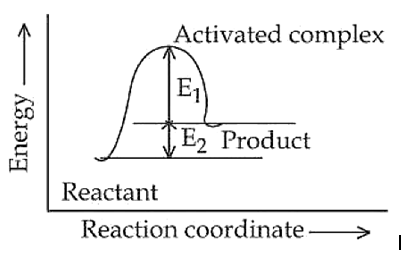
Consider the given figure and choose the correct option : Energy against reaction coordinate: the reactant is at the lowest level, the product is higher than the reactant, and the activated complex is at the top. E1 is the drop from the activated complex to the product level and E2 is the rise from the reactant to the product level.
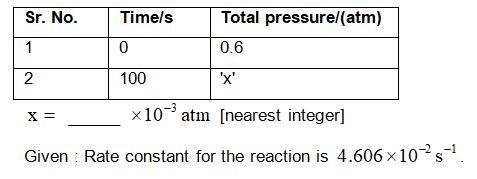
For the thermal decomposition of N2O5( g) at constant volume, the following table can be formed, for the reaction mentioned below. 2 N2O5( g)→ 2 N2O4( g)+O2( g) 2N2O5(g) → 2N2O4(g) + O2(g). At 0 s the total pressure is 0.6 atm; at 100 s it is x. x = _____ × 10−3 atm (nearest integer). Rate constant k = 4.606 × 10⁻² s−1.
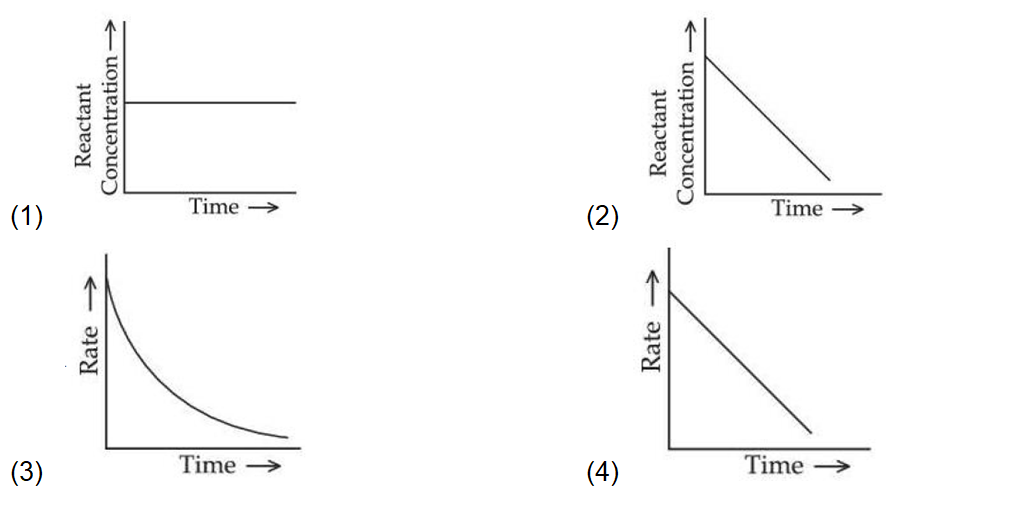
Which of the following graphs most appropriately represents a zero order reaction? (1) Reactant concentration against time is a horizontal line. (2) Reactant concentration against time is a straight line falling to zero. (3) Rate against time is an exponential decay. (4) Rate against time is a straight line falling to zero.
Consider a complex reaction taking place in three steps with rate constants k1, k2 and k3 respectively. The overall rate constant k is given by the expression k=√(k1 k3k2). If the activation energies of the three steps are 60,30 and 10 kJ mol−1 respectively, then the overall energy of activation in kJmol−1 is ____ . (Nearest integer)
Given below are two statements : In the light of the above statements, choose the correct answer from the options given below: Statement (I): a plot of t1/2 against [R]0 is a horizontal line, and it is valid for first order reaction. Statement (II): a plot of log([R]/[R]0) against time is a straight line with slope k/2.303, and it is valid for first order reaction.

For a given reaction R → P,t1/2 is related to [A]0 as given in table. Given: log 2 = 0.30 Which of the following is true? A. The order of the reaction is 1/2. B. If [A]0 is 1 M , then t1/2 is 200√(10) min C. The order of the reaction changes to 1 if the concentration of reactant changes from 0.100 M to 0.500 M. D. t1/2 is 800 min for [A]0 = 1.6M Choose the correct answer from the options given below: Table: [A]0 0.100 mol L−1, t1/2 200 min; [A]0 0.025 mol L−1, t1/2 100 min.

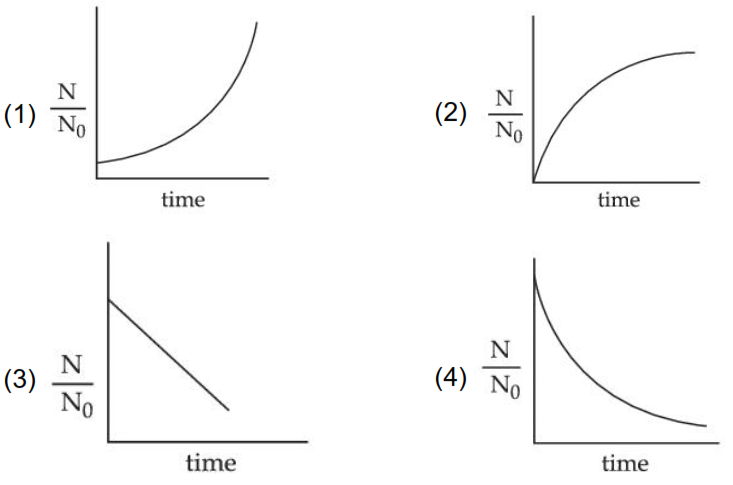
For bacterial growth in a cell culture, growth law is very similar to the law of radioactive decay. Which of the following graphs is most suitable to represent bacterial colony growth ? Where N - Number of Bacteria at any time, N0 - Initial number of Bacteria. (1) N/N0 against time is an exponential rise. (2) N/N0 against time rises and levels off. (3) N/N0 against time is a straight-line fall. (4) N/N0 against time is an exponential fall.
Consider an elementary reaction A(g)+B(g) → C(g)+D(g) If the volume of reaction mixture is suddenly reduced to 13 of its initial volume, the reaction rate will become ' X ' times of the original reaction rate. The value of X is :
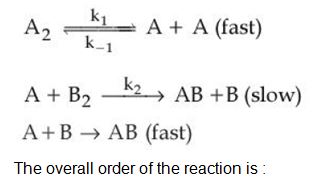
The reaction A2 + B2 → 2AB follows the mechanism A2 ⇌ A + A (fast); A + B2 → AB + B (slow); A + B → AB (fast). The overall order of the reaction is:
Drug X becomes ineffective after 50 % decomposition. The original concentration of drug in a bottle was 16 mg / mL which becomes 4 mg / mL in 12 months. The expiry time of the drug in months is ____ . Assume that the decomposition of the drug follows first order kinetics.
For the reaction A → products The concentration of A at 10 minutes is _____ × 10−3molL−1 (nearest integer). The reaction was started with 2.5molL−1 of A. t1/2 in min against [A]0 in mol L−1 is a straight line through the origin with slope 76.92 (appropriate units).

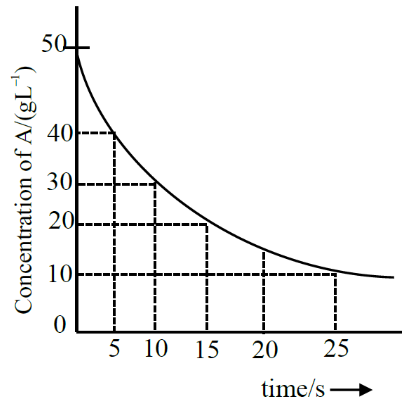
For the reaction A → B the following graph was obtained. The time required (in seconds) for the concentration of A to reduce to 2.5 g L−1 (if the initial concentration of A was 50 g L−1 ) is (Nearest integer) Given : log 2=0.3010 Concentration of A in g L−1 against time in s: 50 at 0 s, 40 at 5 s, 30 at 10 s, 20 at 15 s, 10 at 25 s.
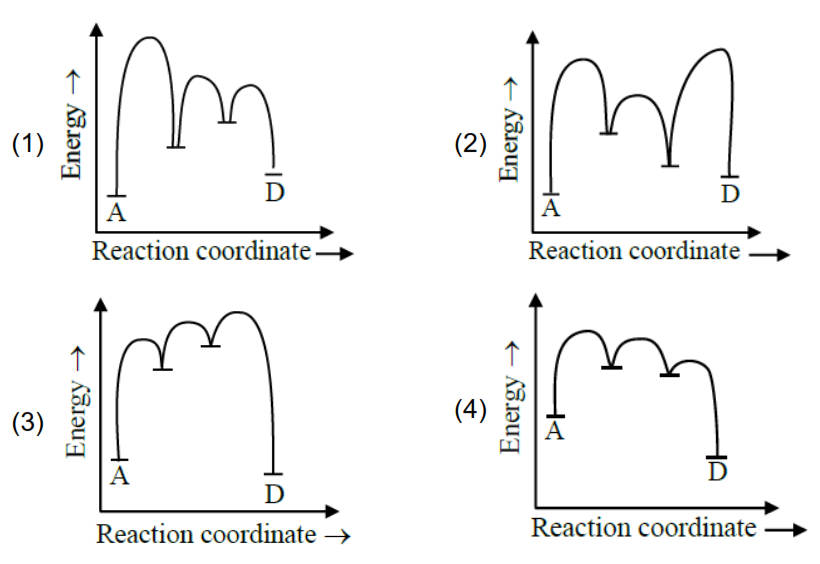
Reactant A converts to product D through the given mechanism (with the net evolution of heat) : A → B slow; Δ H=+ve B → C fast; Δ H=-v e C → D fast; Δ H=-v e Which of the following represents the above reaction mechanism? Four energy profiles (1)-(4) of A against reaction coordinate to D, each with three peaks. (1) B is above A, C is below B but above A, D is above A. (2) B is above A, C is below A, D is at the level of A. (3) B is above A, C is above B, D is well below A. (4) B is above A, C is below B but above A, D is well below A, and the first peak is the tallest.
In a reaction A + B → C, initial concentrations of A and B are related as [A]0 = 8[B]0. The half lives of A and B are 10 min and 40 min , respectively. If they start to disappear at the same time, both following first order kinetics, after how much time will the concentration of both the reactants be same?
Consider the following statements related to temperature dependence of rate constants. Identify the correct statements. A. The Arrhenius equation holds true only for an elementary homogenous reaction. B. The unit of A is same as that of k in Arrhenius equation. C. At a given temperature, a low activation energy means a fast reaction. D. A and Ea as used in Arrhenius equation depend on temperature. E. When and Ea become interdependent. Choose the correct answer from the options given below:
For A2+B2 ⇌ 2 AB Ea for forward and backward reaction are 180 and 200 kJ mol − 1 respectively If catalyst lowers Ea for both reaction by 100 kJ mol − 1. Which of the following statement is correct?
Rate law for a reaction between A and B is given by r = k[ A]n[ B]m If concentration of A is doubled and concentration of B is halved from their initial value, the ratio of new rate of reaction to the initial rate of reaction ( r2r1 ) is
Half life of zero order reaction A → product is 1 hour, when initial concentration of reactant is 2.0 molL−1. The time required to decrease concentration of A from 0.50 to 0.25 molL−1 is :
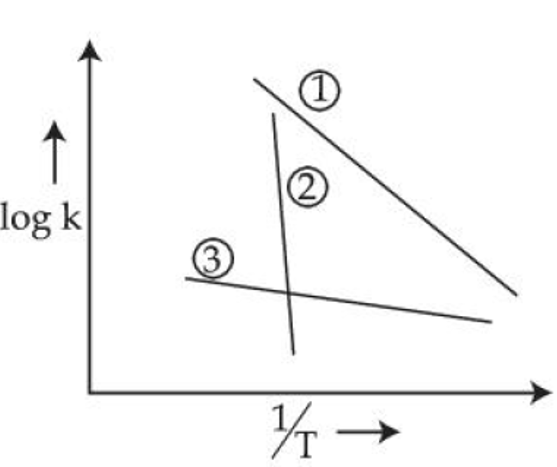
Consider the following plots of log of rate constant k(log k) vs 1T for three different reactions. The correct order of activation energies of these reactions is : log k against 1/T for three reactions: line 2 is the steepest, line 1 is next, and line 3 is the flattest.
Reaction A(g) → 2 B( g) + C(g) is a first order reaction. It was started with pure A Which of the following option is incorrect? Pressure of the system at time t: at 10 min, 160 mm Hg; at infinity, 240 mm Hg.

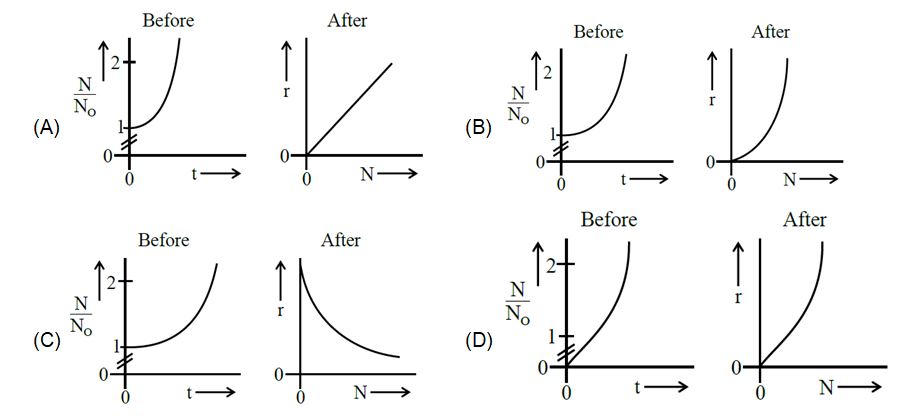
A person's wound was exposed to some bacteria and then bacterial growth started to happen at the same place. The wound was later treated with some antibacterial medicine and the rate of bacterial decay(r) was found to be proportional with the square of the existing number of bacteria at any instance. Which of the following set of graphs correctly represents the 'before' and 'after' situation of the application of the medicine? [Given: N = No. of bacteria, t = time, bacterial growth follows 1st order kinetics.] Four sets (A)-(D), each with a Before graph of N/N0 against t and an After graph of r against N. (A) Before: exponential rise from 1; After: r against N is a straight line. (B) Before: exponential rise from 1; After: r against N is a parabola through the origin. (C) Before: exponential rise from 1; After: r against N falls. (D) Before: exponential rise from 0; After: r against N is a parabola through the origin.
A(g) → B(g)+C(g) is a first order reaction. The reaction was started with reactant A only. Which of the following expression is correct for rate constant k ? Time: T and infinity; pressure of the system: Pt at time T and Pinfinity at infinity.

In a first order decomposition reaction, the time taken for the decomposition of reactant to one fourth and one eighth of its initial concentration are t1 and t2( s) , respectively. The ratio t1 / t2 will be:
JEE Mates
Online Mock Test Series.
✓50 online mock tests
✓Video solutions + analysis
UTS
Ultimate Test Series.
✓20 full mocks + 6 special tests
✓Projected percentile after every test
2026 Questions (25)
Pre-exponential factors of two different reactions of same order are identical. Let activation energy of first reaction exceeds the activation energy of second reaction by 20 kJ mol−1. If k1 and k2 are the rate constants of first and second reaction respectively at 300 K , then ln k2k1 will be ____ (nearest integer) [R=8.3 JK−1 mol−1]
Decomposition of A is a first order reaction at T(K) and is given by A(g) → B(g)+C(g). In a closed 1 L vessel, 1 bar A(g) is allowed to decompose at T(K). After 100 minutes, the total pressure was 1.5 bar. What is the rate constant (. in .min −1) of the reaction? (log 2=0.3)
A → product (First order reaction). Three sets of experiment were performed for a reaction under similar experimental conditions: Run 1 ⇒ 100 mL of 10 M solution of reactant A Run 2 ⇒ 200 mL of 10 M solution of reactant A Run 3 ⇒ 100 mL of 10 M solution of reactant A+100 mL of H2O added. The correct variation of rate of reaction is
Consider A k1 → B and C k2 → D are two reactions. If the rate constant (k1) of the A → B reaction can be expressed by the following equation log 10k=14.34-1.5 × 10⁴ T / K and activation energy of C → D reaction (E a2) is 15 th of the A → B reaction (E a1), then the value of (E a2) is __ kJmol−1. (Nearest Integer)
For the thermal decomposition of reaction AB(g), the following is constructed. The half life of the reaction is ' x ' min. x= ____ min. (Nearest integer) [AB] in M against time in s is a straight line: 0.6 M at 0 s, 0.55 M at 100 s, 0.5 M at 200 s.

Observe the following reactions at T(K). I. A → products. II. 5 Br−(aq)+BrO3−(aq)+6 H+(aq) → 3 Br2(aq)+3 H2O(l) Both the reactions are started at 10.00 am . The rates of these reactions at 10.10 am are same. The value of -Δ[Br−]Δ t at 10.10 am is 2 × 10⁻⁴ mol L−1 min−1. The concentration of A at 10.10 am is 10−2 molL−1. What is the first order rate constant (in min −1 ) of reaction I ?
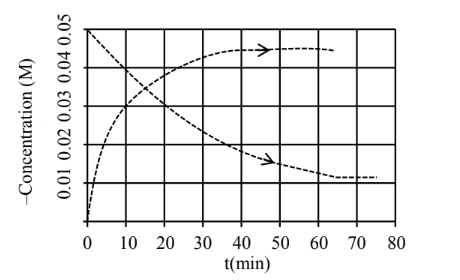
Given above is the concentration vs time plot for a dissociation reaction : A → nB Based on the data of the initial phase of the reaction (initial 10 min ), the value of n is ____ . Concentration in M against time in min: [A] falls from 0.05 M and [B] rises from 0; at 10 min [A] is 0.04 M and [B] is 0.03 M.
At 27° C in presence of a catalyst, activation energy of a reaction is lowered by 10 kJ mol−1. The logarithm of ratio of k (catalysed) k (uncatalysed) is.... (Consider that the frequency factor for both the reactions is same)
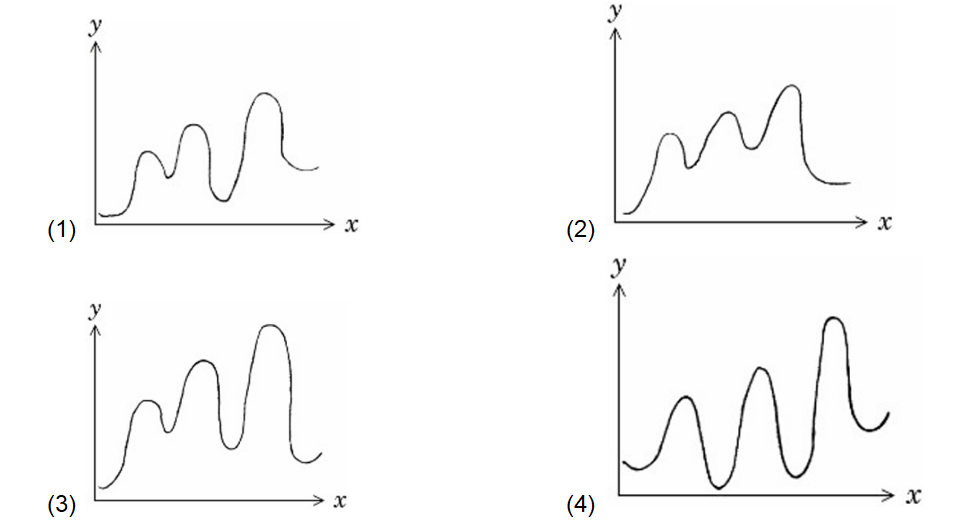
A → D is an endothermic reaction occurring in three steps (elementary). (i) A → B Δ Hi=+ve (ii) B → C Δ Hi i=-ve (iii) C → D Δ Hi i i=-ve Which of the following graphs between potential energy ( y-axis) vs reaction coordinate ( x -axis) correctly represents the reaction profile of A → D ? Four potential energy (y) against reaction coordinate (x) profiles (1)-(4), each with three peaks. (1) The second valley falls to the level of A. (2) The second valley is higher than the first valley. (3) The levels fall steadily: B is the highest, C is lower but still above A, and D is the lowest but still above A. (4) The valleys dip below the level of A.
The half-life of 65 Zn is 245 days. After x days, 75 % of original activity remained. The value of x in days is ... (Nearest integer) (Given: log 3=0.4771 and log 2=0.3010 )
An organic compound undergoes first order decomposition. The time taken for decomposition to (18)th and (110)th of its initial concentration are t1 / 8 and t1 / 10 respectively. What is the value of t1 / 8t1 / 10 × 10 ? (log 2=0.3)
A → B (first reaction) C → D (second reaction) Consider the above two first-order reactions. The rate constant for first reaction at 500 K is double of the same at 300 K . At 500 K, 50 % of the reaction becomes complete in 2 hour. The activation energy of the second reaction is half of that of first reaction. If the rate constant at 500 K of the second reaction becomes double of the rate constant of first reaction at the same temperature; then rate constant for the second reaction at 300 K is ____ × 10−1 hour −1 (Nearest integer).
For reaction A → P, rate constant k=1.5 × 10³ s−1 at 27° C If activation energy for the above reaction is 60 kJ mol−1, then the temperature (in ° C ) at which rate constant, k=4.5 × 10³ s−1 is ____ . (Nearest integer) Given : log 2=0.30, log 3=0.48, R=8.3 J K−1 mol−1, ln 10=2.3
t100 % is the time required for the 100 % completion of the reaction while t1 / 2 is the time required for 50 % of the reaction to be completed. Which of the following option correctly represents the relation between t100 % and t1 / 2 for zero and first order reactions respectively?
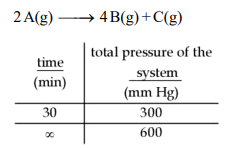
Consider the following gas phase reaction being carried out in a closed vessel at 25° C. The pressure of C(g) at 30 minutes time interval would be ____ mm Hg. (Nearest integer) 2A(g) → 4B(g) + C(g). Total pressure of the system: 300 mm Hg at 30 min, 600 mm Hg at infinity.
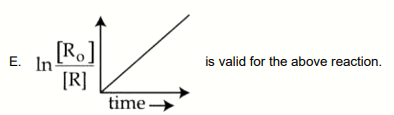
Consider the reaction aX → bY, for which the rate constant at 30° C is 1 × 10⁻³ mol−1 Ls−1. Which of the following statements are true? A. When concentration of ' X′ ' is increased to four times, the rate of reaction becomes 16 times. B. The reaction is a second order reaction. C. The half-life period is independent of the concentration of X. D. Decomposition of N2O5 is an example of the above reaction. Choose the correct answer from the options given below : E. A plot of ln([R0]/[R]) against time is a straight line, and it is valid for the above reaction.
Consider the first order reaction R → P. The fraction of molecules decomposed in the given first order reaction can be expressed as
For a first order reaction A → B x= ____ min. (Nearest integer) Time in min against [A] in M: at 0 min, 0.6500 M; at x min, 0.0650 M; at 20 min, 0.00065 M.

Consider the given graph showing variation of reactant concentration with time. Three different reactions were started with identical initial concentration of reactants. Which of the following statement is correct?
If the half life of a first order reaction is 6.93 minutes then the time required for completion of 99 % of the reaction will be ____ minutes. (Given : log 2=0.3010 )
First order gas phase reaction A → B+C pi= initial pressure of gas A, pt= total pressure of the reaction mixture at time t
For a reaction A → P at TK , the half life (t1 / 2) is plotted as a function of initial concentration [A]0 of A as given below. The value of x in the given figure is ____ s (Nearest integer) t1/2 in s against [A]0 in mol L−1 is a straight line through the origin: t1/2 is 240 s at [A]0 = 4 × 10⁻³ mol L−1, and x at [A]0 = 1.5 × 10⁻³ mol L−1.

Sucrose hydrolyses in acidic medium into glucose and fructose by first order rate law with t1 / 2=3 hour. The percentage of sucrose remaining after 6 hours is ____ . (Nearest integer) (Given : log 2=0.3010 and log 3=0.4771 )
Decomposition of a hydrocarbon follows the equation k=(5.5 × 10¹¹ s−1) e−28000 K T. The activation energy of reaction is ____ kJmol−1. (Nearest Integer) Given : R=8.3 JK−1 mol−1
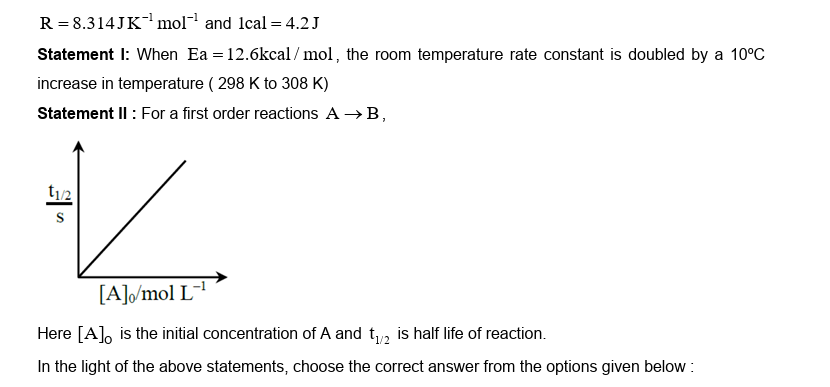
Given below are two statements : R = 8.314 J K−1 mol−1 and 1 cal = 4.2 J. Statement I: When Ea = 12.6 kcal/mol, the room temperature rate constant is doubled by a 10 degree C increase in temperature (298 K to 308 K). Statement II: For a first order reaction A → B, a plot of t1/2 in s against [A]0 in mol L−1 is a straight line through the origin. Here [A]0 is the initial concentration of A and t1/2 is the half life of the reaction.
Chemistry PYQ Book
JEE Main 5 Years Chemistry PYQ Book 2022-2026.
✓Chapter-wise solved papers
✓Detailed solutions
JEE Advanced Online
Online Mock Test Series.
✓10 online mock tests
✓Video solutions + analysis
Frequently Asked Questions
Tags