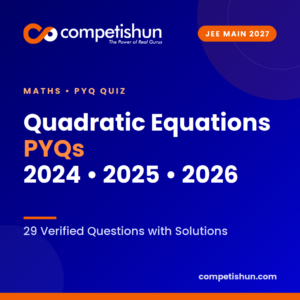
JEE Main Quadratic Equations PYQs 2024, 2025 and 2026: All Questions with Solutions
By CompetishunNov 26, 202612 min read
JEE Main Quadratic Equations PYQs 2024, 2025 and 2026: All Questions with Solutions
Verified JEE Main Quadratic Equations questions from 2024, 2025 and 2026, shift by shift. The 2024, 2025 and 2026 sets are interactive now: pick an option or enter a number and check instantly. Attempt timed, check the method only after answering, and log every miss by pattern.
Score: 0 correct out of 0 attempted ( interactive questions)
How to use this quiz
1. Attempt one year timed, without looking at the method.
2. Click an option, or type a number and press Check, for instant right or wrong feedback.
3. Read the short method only after answering, then log the miss by pattern.
4. Rework your weak patterns the same day, then reattempt the year.
2024 Questions (11)
Q129 Jan 2024, Shift 1
Let α,β be the roots of the equation x2-x+2=0 with Im(α)>Im(β). Then α6+α4+β4-5α2 is equal to
Answer: 13. Method: Since α2=α-2, α4=2-3α and α6=5α+2; also β4=2-3β. So the expression is (5α+2)+(2-3α)+(2-3β)-5(α-2)=16-3(α+β)=13.
Q230 Jan 2024, Shift 1
Let α, β ∈ N be roots of equation x2-70 x+λ=0, where λ2, λ3 ∉ N. If λ assumes the minimum possible value, then (√(α-1)+√(β-1))(λ+35)|α-β| is equal to :
Answer: 60. Method: Here α+β=70 and αβ=λ. The smallest λ=α(70-α) with α∈ N that is odd and not divisible by 3 is 325 (at α=5, β=65). Then (√(4)+√(64))(325+35)60=10·36060=60.
Q331 Jan 2024, Shift 2
The number of solutions, of the equation esin x-2 e−sin x=2 is
Correct option: D. Method: Put t=esin x>0. Then t-2/t=2, i.e. t2-2t-2=0, giving t=1+√(3). So sin x=ln(1+√(3))>1, which is impossible. Hence there are 0 solutions.
Q431 Jan 2024
Let a,b,c be the length of three sides of a triangle satisfying the condition (a2+b2)x2-2b(a+c)x+(b2+c2)=0. If the set of all possible values of x is the interval (α,β), then 12(α2+β2) is equal to
Answer: 36. Method: The equation is (ax-b)2+(bx-c)2=0, so x=b/a and ac=b2. The triangle inequalities give (√(5)-1)/2<b/a<(√(5)+1)/2, so (α,β)=((√(5)-1)/2,(√(5)+1)/2). Then α2+β2=3, and 12(α2+β2)=36.
Q51 Feb 2024, Shift 1
Let S={x∈ R:(√(3)+√(2))x+(√(3)-√(2))x=10}. Then the number of elements in S is:
Correct option: C. Method: Since (√(3)-√(2))=1/(√(3)+√(2)), put t=(√(3)+√(2))x>0. Then t+1/t=10, i.e. t2-10t+1=0, giving two positive values of t and hence two values of x. So S has 2 elements.
Q61 Feb 2024, Shift 2
Let α and β be the roots of the equation px2+qx-r=0, where p ≠ 0. If p, q and r be the consecutive terms of a non-constant G.P and 1α+1β=34, then the value of (α-β)2 is :
Correct option: A. Method: Write p=A, q=AR, r=AR2. Dividing by p, x2+Rx-R2=0, so α+β=-R and αβ=-R2. From 1α+1β=34, 1R=34, so R=4/3. Then (α-β)2=5R2=80/9.
Q74 Apr 2024, Shift 1
If 2 and 6 are the roots of the equation ax2+bx+1=0, then the quadratic equation, whose roots are 12 a+b and 16 a+b, is :
Correct option: D. Method: From the sum and product of the roots, 8=-b/a and 12=1/a, so a=1/12 and b=-2/3. Then 2a+b=-1/2 and 6a+b=-1/6, so the new roots are -2 and -6. The equation is x2+8x+12=0.
Q84 Apr 2024, Shift 1
Let the sum of the maximum and the minimum values of the function f(x)=2 x2-3 x+82 x2+3 x+8 be mn, where gcd(m, n)=1. Then m+n is equal to :
Correct option: D. Method: Put y=f(x). Then (2y-2)x2+(3y+3)x+(8y-8)=0 has a real solution, so its discriminant 9(y+1)2-64(y-1)2≥0, i.e. 55y2-146y+55≤0. The extreme values are 5/11 and 11/5, whose sum is 146/55. Hence m+n=201.
Q96 Apr 2024, Shift 1
Let, α, β be the distinct roots of the equation x2-(t2-5 t+6) x+1=0, t ∈ R and an=αn+βn Then the minimum value of a2023+a2025a2024 is ____ .
Correct option: C. Method: The recurrence an+2=(α+β)an+1-αβ an with α+β=t2-5t+6 and αβ=1 gives a2023+a2025a2024=t2-5t+6=(t-5/2)2-1/4. Its minimum value is -1/4.
Q109 Apr 2024, Shift 1
Let α,β be the roots of the equation x2+2√(2)x-1=0. The quadratic equation, whose roots are α4+β4 and 110(α6+β6), is:
Correct option: C. Method: Here α+β=-2√(2) and αβ=-1. So α2+β2=10 and α4+β4=98. Also α3+β3=-22√(2), so α6+β6=970 and 110(α6+β6)=97. The equation is x2-195x+9506=0.
Q119 Apr 2024, Shift 2
Let α, β ; α>β, be the roots of the equation x2-√(2) x-√(3)=0. Let Pn=αn-βn, n ∈ N. Then (11 √(3)- 10 √(2)) P10+(11 √(2)+10) P11-11 P12 is equal to :
Correct option: B. Method: From α2=√(2)α+√(3), Pn+2=√(2)Pn+1+√(3)Pn. Using P12=√(2)P11+√(3)P10, the expression becomes 10(P11-√(2)P10)=10√(3)P9.
Let αθ and βθ be the distinct roots of 2 x2+(cos θ) x-1=0, θ ∈(0,2 π). If m and M are the minimum and the maximum values of αθ4+βθ4, then 16(M+m) equals :
Correct option: D. Method: Here α+β=-cosθ/2 and αβ=-1/2. So α2+β2=cos2θ/4+1 and α4+β4=(cos2θ/4+1)2-1/2. As cos2θ ranges over [0,1], the minimum is 1/2 and the maximum is 17/16. Hence 16(M+m)=16·25/16=25.
Q223 Jan 2025, Shift 1
If the equation a(b - c)x2 + b(c - a)x + c(a - b) = 0 has equal roots, where a + c = 15 and b = 365, a2 + c2 is equal to
Answer: 117. Method: x=1 is a root, since the coefficients add to 0. Equal roots means both roots are 1, so the product of the roots is 1: c(a-b)a(b-c)=1, giving 2ac=b(a+c). With b=36/5 and a+c=15, ac=54. Hence a2+c2=(a+c)2-2ac=225-108=117.
Q323 Jan 2025, Shift 2
Let α, β be the roots of the equation x2-ax-b=0 with Im(α)<Im(β). Let Pn=αn-βn. If P3=-5 √(7) i, P4=-3 √(7) i, P5=11 √(7) i and P6=45 √(7) i, then |α4+β4| is equal to ____ .
Answer: 31. Method: Since α,β satisfy x2=ax+b, Pn+2=aPn+1+bPn. From P5 and P6: -3a-5b=11 and 11a-3b=45, giving a=3, b=-4. Then α+β=3 and αβ=4, so α2+β2=1 and α4+β4=1-2·16=-31. Hence |α4+β4|=31.
Q424 Jan 2025, Shift 1
The product of all the rational roots of the equation ( x2 - 9x + 11 )2 - (x - 4)(x - 5) = 3, is equal to
Correct option: C. Method: Put t=x2-9x+11. Then (x-4)(x-5)=x2-9x+20=t+9, so the equation is t2-(t+9)=3, i.e. t2-t-12=0, giving t=4 or t=-3. For t=4, x2-9x+7=0 has irrational roots. For t=-3, x2-9x+14=0, giving x=2 or 7. The product of the rational roots is 14.
Q528 Jan 2025, Shift 2
If α+i β and γ+i δ are the roots of x2-(3-2 i) x-(2 i-2)=0, i=√(-1), then α γ+β δ is equal to :
Correct option: B. Method: The roots are 1 and 2-2i. So, up to order, α=2, β=-2, γ=1, δ=0, and αγ+βδ=2.
Q629 Jan 2025, Shift 1
The number of solutions of the equation ( 9x - 9√(x) + 2 )( 2x - 7√(x) + 3 ) = 0 is :
Correct option: A. Method: Put t=1/√(x)>0. The first factor is 9t2-9t+2=0, giving t=1/3 or 2/3. The second factor is 2t2-7t+3=0, giving t=1/2 or 3. So x=9, 9/4, 4 or 1/9: 4 solutions.
Q729 Jan 2025, Shift 2
If the set of all a∈R, for which the equation 2x2+(a-5)x+15=3a has no real root, is the interval (α,β), and X={x∈ Z:α<x<β}, then Σx∈ Xx2 is equal to:
Correct option: B. Method: The discriminant is (a-5)2-8(15-3a)=a2+14a-95=(a-5)(a+19)<0, so a∈(-19,5). Hence X={-18,-17,…,4} and Σx∈ Xx2=Σk=118k2+Σk=14k2=2109+30=2139.
Q82 Apr 2025, Shift 1
Let Pn = α n + β n,n ∈ N . If P10 = 123,P9 = 76,P8 = 47 and P1 = 1, then the quadratic equation having roots 1α and 1β is :
Correct option: D. Method: P1=α+β=1. The recurrence Pn+2=(α+β)Pn+1-αβ Pn with P10=123, P9=76, P8=47 gives 123=76-47αβ, so αβ=-1. The equation with roots 1/α and 1/β has sum -1 and product -1, i.e. x2+x-1=0.
Q92 Apr 2025, Shift 2
If the set of all a ∈ R-{1}, for which the roots of the equation (1-a) x2+2(a-3) x+9=0 are positive is (-∞,-α] ∪[β, γ), then 2 α+β+γ is equal to ____
Answer: 7. Method: The discriminant is 4(a-3)2-36(1-a)=4a(a+3)≥0, so a≤-3 or a≥0. The product of the roots is 9/(1-a)>0, so a<1, and the sum 2(a-3)/(a-1)>0 holds for a<1. Hence the set is (-∞,-3]∪[0,1), so α=3, β=0, γ=1 and 2α+β+γ=7.
Q103 Apr 2025, Shift 1
Let α and β be the roots of x2+√(3)x-16=0, and γ and δ be the roots of x2+3x-1=0. If Pn=αn+βn and Qn=γn+δn, then P25+√(3)P242P23+Q25-Q23Q24 is equal to
Correct option: D. Method: From α2=-√(3)α+16, Pn+2=-√(3)Pn+1+16Pn, so P25+√(3)P24=16P23 and the first term is 8. From γ2=-3γ+1, Qn+2=-3Qn+1+Qn, so Q25-Q23=-3Q24 and the second term is -3. The sum is 5.
Q114 Apr 2025, Shift 1
Consider the equation x2 + 4x - n = 0, where n ∈ [20,100] is a natural number. Then the number of all distinct values of n, for which the given equation has integral roots, is equal to
Correct option: B. Method: The roots are -2±√(4+n), so 4+n must be a perfect square. With n∈[20,100], 4+n is 25,36,49,64,81 or 100, giving 6 values of n.
Q127 Apr 2025, Shift 1
Let the set of all values of p∈ ℝ, for which both the roots of the equation x2 - (p + 2)x + (2p + 9) = 0 are negative real numbers, be the interval (α ,β ]. Then β-2α is equal to
Correct option: C. Method: For both roots negative and real, the discriminant (p+2)2-4(2p+9)=(p-8)(p+4) must be ≥0, the sum p+2<0 and the product 2p+9>0. So -9/2<p≤-4, i.e. (α,β]=(-9/2,-4]. Hence β-2α=-4+9=5.
Let α and β be the roots of the equation x2+2 a x+(3 a+10)=0 such that α<1<β. Then the set of all possible values of a is :
Correct option: D. Method: f(x)=x2+2ax+(3a+10) opens upwards, so α<1<β exactly when f(1)<0. f(1)=1+2a+3a+10=5a+11<0 gives a<-11/5. The discriminant is 4a2-4(3a+10)=4(a-5)(a+2), which is positive for a<-11/5, so the roots are real and distinct there. Hence the set is (-∞,-11/5).
Q222 Jan 2026, Shift 2
Let α, β be the roots of the quadratic equation 12x2-20x+3λ=0, λ∈ Z. If 12≤|β-α|≤32, then the sum of all possible values of λ is:
Correct option: B. Method: For 12x2-20x+3λ=0, β-α=√(400-144λ)/12. The condition 12≤|β-α|≤32 gives 6≤√(400-144λ)≤18, so 36≤400-144λ≤324, i.e. 1936≤λ≤9136. With λ∈ Z, λ=1 or 2, whose sum is 3.
Q323 Jan 2026, Shift 1
If α and β(α<β) are the roots of the equation (-2+√(3))(|√(x)-3|)+(x-6 √(x))+(9-2 √(3))=0, x ≥ 0, then √(βα)+√(α β) is equal to :
Correct option: C. Method: Put t=√(x)≥0. Then x-6√(x)=t2-6t, so the equation is (t-3)2+(-2+√(3))|t-3|-2√(3)=0. With u=|t-3|≥0, u2+(-2+√(3))u-2√(3)=0, giving u=2 (the other root -√(3) is rejected). So |t-3|=2, t=1 or 5, and x=1 or 25. Hence α=1, β=25, and √(β/α)+√(αβ)=5+5=10.
Q424 Jan 2026, Shift 2
The smallest positive integral value of a, for which all the roots of x4-a x2+9=0 are real and distinct, is equal to
Correct option: D. Method: Put y=x2. Then y2-ay+9=0 must have two distinct positive roots, so the discriminant a2-36>0 and the sum of roots a>0. Hence a>6, and the smallest positive integral value is 7.
Q528 Jan 2026, Shift 1
If α, β, where α<β, are the roots of the equation λ x2-(λ+3) x+3=0 such that 1α-1β=13, then the sum of all possible values of λ is
Correct option: A. Method: Here α+β=(λ+3)/λ and αβ=3/λ. So (β-α)2=(α+β)2-4αβ=(λ-3)2/λ2, giving β-α=|λ-3|/|λ|. The condition 1α-1β=13 is β-ααβ=13, so |λ-3|·λ|λ|=1. This needs λ>0 and |λ-3|=1, so λ=2 or 4. Their sum is 6.
Q66 Apr 2026, Shift 2
Consider the quadratic equation (n2-2 n+2) x2-3 x+(n2-2 n+2)2=0, n ∈ R. Let α be the minimum value of the product of its roots and β be the maximum value of the sum of its roots. Then the sum of the first six terms of the G.P., whose first term is α and the common ratio is αβ, is :
Correct option: C. Method: Put m=n2-2n+2=(n-1)2+1≥1. The product of the roots is m2/m=m, so α=1 (at n=1). The sum of the roots is 3/m, so β=3 (at m=1). The G.P. has first term 1 and common ratio 1/3, so the sum of its first six terms is 1-(1/3)61-1/3=364243.
Pick an option for a multiple choice question, or type your answer for a numerical question and press Check. A correct choice turns green, a wrong choice turns red and the correct option turns green, and the short method appears below. Once answered, a card locks until you press Reset.
How many Quadratic Equations questions are in this quiz, and from which years?
29 verified JEE Main Quadratic Equations questions: 11 from 2024, 12 from 2025 and 6 from 2026, each in shift order.
How should I use this quiz for revision?
Attempt one year timed, without looking at the method. After checking, note every miss by pattern, such as roots of quadratic equations, nature of roots, or sum and product of roots, and rework that pattern the same day.
Do the questions cover both the January and April sessions?
Yes. The 2026 set covers both the January and April sessions, and the 2024 and 2025 sets cover their January and April sessions too.
Are these real JEE Main questions?
Yes. Every question here is a verified JEE Main Quadratic Equations question from 2024, 2025 or 2026, shown with its exam date and shift wherever the shift is printed on the question page.
Tags
JEE Main 2027Quadratic Equations PYQJEE Main MathsPYQ AnalysisRepeat FrequencyUPO Unique PYQsRoots of Quadratic EquationNature of RootsSum and Product of RootsJEE Main Preparation
Hello 👋 Welcome to Competishun – India’s most trusted platform for JEE & NEET preparation. Need help with JEE / NEET courses, fees, batches, test series or free study material? Chat with us now 👇