JEE Main Statistics PYQs 2024, 2025 and 2026: All Questions with Solutions
By CompetishunNov 24, 202616 min read
JEE Main Statistics PYQs 2024, 2025 and 2026: All Questions with Solutions
Verified JEE Main Statistics questions from 2024, 2025 and 2026, shift by shift. The 2024, 2025 and 2026 sets are interactive now: pick an option or enter a number and check instantly. Attempt timed, check the method only after answering, and log every miss by pattern.
Score: 0 correct out of 0 attempted ( interactive questions)
How to use this quiz
1. Attempt one year timed, without looking at the method.
2. Click an option, or type a number and press Check, for instant right or wrong feedback.
3. Read the short method only after answering, then log the miss by pattern.
4. Rework your weak patterns the same day, then reattempt the year.
2024 Questions (13)
Q127 Jan 2024, Shift 1
Let a1, a2, … . . a10 be 10 observations such that Σk=110 ak=50 and Σ∀ k<j ak · aj=1100. Then the standard deviation of a1, a2, …, a10 is equal to:
Correct option: B. Method: Squaring the sum, (Σ ak)2=Σ ak2+2Σk<jakaj, so 2500=Σ ak2+2200 and Σ ak2=300. The variance is 300/10-(50/10)2=30-25=5, so the standard deviation is √(5).
Q229 Jan 2024, Shift 1
If the mean and variance of the data 65,68,58,44, 48, 45, 60, α,β,60 where α>β are 56 and 66.2 respectively, then α2+β2 is equal to
Answer: 6344. Method: The known numbers sum to 448, and the mean is 56, so α+β=112. Their squares sum to 25678, and E(X2)=66.2+562=3202.2, so the total sum of squares is 32022. Hence α2+β2=32022-25678=6344.
Q329 Jan 2024, Shift 2
The mean and standard deviation of 15 observations were found to be 12 and 3 respectively. On rechecking it was found that an observation was read as 10 in place of 12 . If μ and σ2 denote the mean and variance of the correct observations respectively, then 15(μ+μ2+σ2) is equal to
Answer: 2521. Method: The wrong sum is 180 and the wrong sum of squares is 15(9+144)=2295. Correcting 10 to 12, the sum is 182, so μ=182/15, and the sum of squares is 2295-100+144=2339. Then σ2=2339/15-(182/15)2=1961/225. Hence 15(μ+μ2+σ2)=182+(33124+1961)/15=182+2339=2521.
Q429 Jan 2024, Shift 2
If the mean and variance of five observations are 245 and 19425 respectively and the mean of first four observations is 72, then the variance of the first four observations in equal to
Correct option: C. Method: The sum of all five observations is 24 and the mean of the first four is 7/2, so their sum is 14 and x5=10. The total sum of squares is 5(194/25+576/25)=154, so the first four have sum of squares 154-100=54. Their variance is 54/4-(7/2)2=5/4.
Q530 Jan 2024
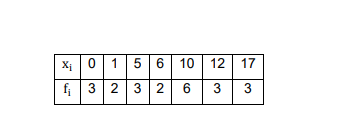
The variance σ2 of the data in the table below (xi: 0, 1, 5, 6, 10, 12, 17 with frequencies fi: 3, 2, 3, 2, 6, 3, 3) is equal to:
Answer: 29. Method: The total frequency is 22, Σ fixi=176 and Σ fixi2=2048. The mean is 176/22=8, and the variance is σ2=2048/22-82=320/11, about 29.09. The nearest integer, the recorded answer, is 29.
Q630 Jan 2024
Let M denote the median of the following frequency distribution: classes 0-4, 4-8, 8-12, 12-16, 16-20 with frequencies 3, 9, 10, 8, 6. Then 20M is equal to:
Correct option: D. Method: The total frequency is 36, so the median is the value at cumulative frequency 18, which lies in the class 8-12. The median is M=8+(18-12)10 · 4=10.4, so 20M=208.
Q731 Jan 2024, Shift 2
Let the mean and the variance of 6 observation a, b, 68,44,48,60 be 55 and 194 , respectively if a>b, then a+3 b is
Correct option: C. Method: The sum is 220+a+b=330, so a+b=110. The sum of squares is 12464+a2+b2, and E(X2)=194+552=3219, so a2+b2=6850. Then ab=2625, and with a>b, a=75, b=35. Hence a+3b=75+105=180.
Q81 Feb 2024, Shift 2
Consider 10 observations x1, x2, …, x10 such that Σi=110(xi-α)=2 and Σi=110(xi-β)2=40, where α, β are positive integers. Let the mean and the variance of the observations be 65 and 8425 respectively. Then βα is equal to:
Correct option: A. Method: Σ(xi-α)=12-10α=2, so α=1. The mean is 6/5 and the variance is 84/25, so Σ xi2=10(84/25+36/25)=48. From Σ(xi-β)2=48-24β+10β2=40, we get 5β2-12β+4=0, so β=2 (a positive integer). Hence β/α=2.
Q94 Apr 2024, Shift 1
Let a,b∈R. Let the mean and the variance of 6 observations -3,4,7,-6,a,b be 2 and 23 , respectively. The mean deviation about the mean of these 6 observations is :
Correct option: A. Method: The sum is 2+a+b=12, so a+b=10. The sum of squares is 110+a2+b2, and E(X2)=23+4=27, so a2+b2=52. Then ab=24, giving {a,b}={6,4}. The mean deviation about the mean 2 is (5+2+5+8+4+2)/6=26/6=13/3.
Q105 Apr 2024, Shift 1
From a lot of 10 items, which include 3 defective items, a sample of 5 items is drawn at random. Let the random variable X denote the number of defective items in the sample. If the variance of X is σ2, then 96 σ2 is equal to
Answer: 56. Method: For a hypergeometric variable with N=10, K=3 defective and n=5 drawn, the variance is σ2=n · KN · (1-KN) · N-nN-1=5 · 310 · 710 · 59=7/12. Hence 96σ2=96 · 7/12=56.
Q116 Apr 2024, Shift 1
The mean and standard deviation of 20 observations are found to be 10 and 2, respectively. On rechecking, it was found that an observation by mistake was taken as 8 instead of 12. The correct standard deviation is _____.
Correct option: C. Method: The wrong sum is 200 and the wrong sum of squares is 20(4+100)=2080. Correcting 8 to 12, the sum is 204 and the sum of squares is 2080-64+144=2160. The variance is 2160/20-(204/20)2=108-104.04=3.96, so the correct standard deviation is √(3.96).
Q129 Apr 2024, Shift 1
The frequency distribution of the age of students in a class of 40 students is given below: ages 15, 16, 17, 18, 19, 20 with numbers of students 5, 8, 5, 12, x, y. If the mean deviation about the median is 1.25, then 4x+5y is equal to:
Correct option: B. Method: The total is 40, so 30+x+y=40 and x+y=10. The 20th and 21st values are both 18, so the median is 18. The mean deviation about the median is 140(5 · 3+8 · 2+5 · 1+12 · 0+x · 1+y · 2)=36+x+2y40=1.25, so x+2y=14. With x+y=10 this gives x=6, y=4, and 4x+5y=24+20=44.
Q139 Apr 2024, Shift 2
If the variance of the frequency distribution (x = c, 2c, 3c, 4c, 5c, 6c with frequencies f = 2, 1, 1, 1, 1, 1) is 160, then the value of c ∈ N is
Correct option: C. Method: The total frequency is 7. The mean is (2c+2c+3c+4c+5c+6c)/7=22c/7 and E(X2)=(2c2+4c2+9c2+16c2+25c2+36c2)/7=92c2/7. The variance is 92c2/7-484c2/49=160c2/49. Setting this equal to 160 gives c2=49, so c=7 (with c ∈ N).
Marks obtained by all the students of class 12 are presented in a frequency distribution with classes of equal width. Let the median of this grouped data be 14 with median class interval 12-18 and median class frequency 12. If the number of students whose marks are less than 12 is 18, then the total number of students is
Correct option: A. Method: For the median class 12-18, the median is 12+(N/2-18)12 · 6=14. So (N/2-18)/12=1/3, giving N/2=22 and N=44.
Q224 Jan 2025, Shift 1
For a statistical data x1,x2, … ,x10 of 10 values, a student obtained the mean as 5.5 and Σi = 110 xi2 = 371. He later found that he had noted two values in the data incorrectly as 4 and 5, instead of the correct values 6 and 8, respectively. The variance of the corrected data is
Correct option: B. Method: The wrong sum is 55 and the wrong sum of squares is 371. Correcting 4 and 5 to 6 and 8, the correct sum is 55-9+14=60 and the correct sum of squares is 371-16-25+36+64=430. The variance is 430/10-(60/10)2=43-36=7.
Q328 Jan 2025, Shift 1
Three defective oranges are accidentally mixed with seven good ones and on looking at them, it is not possible to differentiate between them. Two oranges are drawn at random from the lot. If x denotes the number of defective oranges, then the variance of x is
Correct option: A. Method: For X, the number of defective oranges in 2 draws, P(X=0)=21/45, P(X=1)=21/45 and P(X=2)=3/45. So E(X)=3/5 and E(X2)=7/15+4/15=11/15. The variance is 11/15-(3/5)2=28/75.
Q429 Jan 2025, Shift 1
Let x1,x2, … .,x10 be ten observations such that Σi = 110 ( xi - 2 ) = 30,Σi = 110 ( xi - β )2 = 98,β > 2, and their variance is 45. If μ and σ 2 are respectively the mean and the variance of 2( x1 - 1 ) + 4β , 2( x2 - 1 ) + 4β , … .,2( x10 - 1 ) + 4β , then β μ σ 2 is equal to :
Correct option: D. Method: Σ(xi-2)=30 gives Σ xi=50, so the mean is 5. The variance is 4/5, so Σ xi2=10(4/5+25)=258. From Σ(xi-β)2=258-100β+10β2=98, we get β2-10β+16=0, so β=8 (since β>2). For 2(xi-1)+4β, the mean is μ=2(5-1)+32=40 and the variance is σ2=4 · 4/5=16/5. Hence βμ/σ2=8 · 40/(16/5)=100.
Q52 Apr 2025, Shift 2
If the mean and the variance of 6, 4, a, 8, b, 12,10,13 are 9 and 9.25 respectively, then a + b + ab is equal to
Correct option: C. Method: The sum is 53+a+b=72, so a+b=19. The sum of squares is 529+a2+b2, and E(X2)=81+9.25=90.25, so a2+b2=193. Then ab=((a+b)2-(a2+b2))/2=84, and a+b+ab=19+84=103.
Q63 Apr 2025, Shift 2
Let the Mean and Variance of five observations x1=1, x2=3, x3=a, x4=7 and x5=b, a>b, be 5 and 10 respectively. Then the Variance of the observations n+xn, n=1,2, …, 5 is
Correct option: C. Method: The sum is 11+a+b=25, so a+b=14. The sum of squares is 59+a2+b2, and E(X2)=25+10=35, so a2+b2=116. Then ab=40, and with a>b, a=10, b=4. The new observations n+xn are 2, 5, 13, 11, 9, with mean 8 and sum of squares 400, so their variance is 400/5-64=16.
Q74 Apr 2025, Shift 2
Let the mean and the standard deviation of the observation 2,3,3,4,5,7, a, b be 4 and √(2) respectively. Then the mean deviation about the mode of these observations is:
Correct option: D. Method: The sum is 24+a+b=32, so a+b=8. The sum of squares is 112+a2+b2, and E(X2)=16+2=18, so a2+b2=32. Then ab=16, giving a=b=4. The data is 2, 3, 3, 4, 4, 4, 5, 7, whose mode is 4. The mean deviation about the mode is (2+1+1+0+0+0+1+3)/8=1.
Q87 Apr 2025, Shift 1
The mean and standard deviation of 100 observations are 40 and 5.1, respectively. By mistake one observation is taken as 50 instead of 40. If the correct mean and the correct standard deviation are μ and σ respectively, then 10(μ +σ) is equal to
Correct option: C. Method: The wrong sum is 4000 and the wrong sum of squares is 100(5.12+402)=162601. Correcting 50 to 40, the correct sum is 3990, so μ=39.9, and the correct sum of squares is 162601-2500+1600=161701. The variance is 161701/100-39.92=25, so σ=5. Hence 10(μ+σ)=10(39.9+5)=449.
Let the mean and variance of 7 observations 2,4,10, x, 12,14, y, x>y, be 8 and 16 respectively. Two numbers are chosen from {1,2,3, x-4, y, 5} one after another without replacement, then the probability, that the smaller number among the two chosen numbers is less than 4 , is :
Correct option: B. Method: The sum of the observations is 2+4+10+x+12+14+y=42+x+y, and the mean is 8, so x+y=14. The sum of squares is 4+16+100+x2+144+196=460+x2+y2, and E(X2)=16+64=80, so x2+y2=100. Then xy=((x+y)2-(x2+y2))/2=48, and with x>y this gives x=8, y=6. The set is {1,2,3,4,5,6}. P(smaller ≥ 4) = (3 · 2)/(6 · 5)=1/5, so the required probability is 1-1/5=4/5.
Q222 Jan 2026, Shift 2
If the mean deviation about the median of the numbers k, 2 k, 3 k, … …, 1000 k is 500 , then k2 is equal to :
Correct option: A. Method: The median of k,2k,…,1000k is (500k+501k)/2=500.5k. The mean deviation about the median is 2k1000Σj=1500(500.5-j)=2k1000(500 · 500.5-500 · 501/2)=250k. Setting 250k=500 gives k=2, so k2=4.
Q323 Jan 2026, Shift 1
Let the mean and variance of 8 numbers -10,-7,-1, x, y, 9,2,16 be 72 and 2934, respectively. Then the mean of 4 numbers x, y, x+y+1,|x-y| is:
Correct option: A. Method: The sum is 9+x+y=8 · 7/2=28, so x+y=19. The sum of squares is 491+x2+y2, and E(X2)=293/4+49/4=342/4, so x2+y2=193. Then xy=((x+y)2-(x2+y2))/2=84, giving {x,y}={7,12}. The mean of x, y, x+y+1, |x-y| is (7+12+20+5)/4=11.
Q423 Jan 2026, Shift 2
If the mean and the variance of the data (classes 4-8, 8-12, 12-16, 16-20 with frequencies 3, λ, 4, 7) are μ and 19 respectively, then the value of λ+μ is
Correct option: D. Method: With class marks 6, 10, 14, 18, the total frequency is 14+λ, Σ fx=200+10λ and Σ fx2=3160+100λ. So μ=(200+10λ)/(14+λ) and the variance is (3160+100λ)/(14+λ)-μ2=19. Solving gives λ=6, hence μ=13 and λ+μ=19.
Q524 Jan 2026, Shift 1
The mean and variance of a data of 10 observations are 10 and 2 , respectively. If an observations α in this data is replaced by β, then the mean and variance become 10.1 and 1.99 , respectively. Then α+β equals
Correct option: D. Method: The sum is 100 and the sum of squares is 10 · (2+100)=1020. After replacing α by β, the sum is 101 and the sum of squares is 10 · (1.99+102.01)=1040. So β-α=1 and β2-α2=20, giving α+β=20.
Q628 Jan 2026, Shift 1
The mean and variance of 10 observations are 9 and 34.2 , respectively. If 8 of these observations are 2,3,5,10,11,13,15,21, then the mean deviation about the median of all the 10 observations is
Correct option: A. Method: The 8 known observations sum to 80 and their squares sum to 1094. The total sum is 90 and E(X2)=34.2+81=115.2, so the total sum of squares is 1152. The other two observations sum to 10 and their squares sum to 58, so they are 3 and 7. Sorted, the data is 2, 3, 3, 5, 7, 10, 11, 13, 15, 21, with median 8.5. The mean deviation about the median is (6.5+5.5+5.5+3.5+1.5+1.5+2.5+4.5+6.5+12.5)/10=5.
Q72 Apr 2026, Shift 1
If the mean of the data in the table below (classes 5-10, 10-15, 15-20, 20-25, 25-30, 30-35 with frequencies 2, k, 28, 54, k+1, 5) is 21, then k is one of the roots of the equation:
Correct option: C. Method: With class marks 7.5, 12.5, 17.5, 22.5, 27.5, 32.5, the total frequency is 90+2k and Σ fx=1910+40k. The mean is (1910+40k)/(90+2k)=21, giving 1910+40k=1890+42k, so k=10. Checking the options, 2 · 102-19 · 10-10=0, so 10 is a root of 2x2-19x-10=0.
Q82 Apr 2026, Shift 2
The mean and variance of n observations are 8 and 16, respectively. If the sum of the first (n-1) observations is 48 and the sum of squares of the first (n-1) observations is 496, then the value of n is:
Correct option: D. Method: Let the last observation be t. Then 8n=48+t, so t=8n-48. Also E(X2)=16+64=80, so the total sum of squares is 80n=496+t2. Substituting t gives (8n-48)2=80n-496, i.e. 4n2-53n+175=0, so (n-7)(4n-25)=0 and n=7.
Q94 Apr 2026, Shift 1
Suppose that the mean and median of the non-negative numbers 21,8,17, a, 51,103, b, 13,67,(a>b), are 40 and 21 , respectively. If the mean deviation about the median is 26 , then 2 a is equal to:
Correct option: D. Method: The known numbers sum to 280, and the mean is 40, so a+b=80. The median is 21, so one of a, b is below 21 and the other above it. The mean deviation about the median is 26, so Σ|x-21|=234. The known numbers contribute 183, hence a-b=51. With a+b=80 this gives a=65.5, so 2a=131.
Q104 Apr 2026, Shift 2
For 10 observations x1, x2, …, x10, if Σi=110(xi+2)2=180 and Σi=110(xi-1)2=90, then their standard deviation is:
Correct option: D. Method: Expanding, Σ xi2+4Σ xi+40=180 and Σ xi2-2Σ xi+10=90. Subtracting gives 6Σ xi=90, so Σ xi=10 and the mean is 1. Then Σ xi2=100, so the variance is 100/10-1=9 and the standard deviation is 3.
Q115 Apr 2026, Shift 1
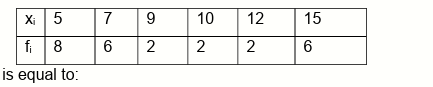
The mean deviation about the mean for the data in the table below (xi: 5, 7, 9, 10, 12, 15 with frequencies fi: 8, 6, 2, 2, 2, 6) is equal to:
Correct option: C. Method: The total frequency is 26 and Σ fixi=234, so the mean is 9. The mean deviation about the mean is 126(8 · 4+6 · 2+2 · 0+2 · 1+2 · 3+6 · 6)=88/26=44/13.
Q125 Apr 2026, Shift 2
A variable X takes values 0,0,2,6,12,20, …, n(n-1) with frequencies n C0, n C1, n C2, n C3, n C4, n C5, …, n Cn, respectively. If the mean of this data is 60 , then its median is :
Correct option: A. Method: The values are j(j-1) for j=0,…,n with frequencies nCj. The mean is 12nΣj=0nnCj j(j-1)=n(n-1)/4. Setting this equal to 60 gives n(n-1)=240, so n=16. The total frequency is 216=65536, and the cumulative frequencies up to j=7 and j=8 are 26333 and 39203, so the middle values both lie in the j=8 group, whose value is 8 · 7=56. Hence the median is 56.
Q136 Apr 2026, Shift 1
A data consists of 20 observations x1, x2, …, x20. If Σi=120(xi+5)2=2500 and Σi=120(xi-5)2=100, then the ratio of mean to standard deviation of this data is:
Correct option: B. Method: Expanding, Σ xi2+10Σ xi+500=2500 and Σ xi2-10Σ xi+500=100. Subtracting gives 20Σ xi=2400, so the mean is 6. Adding gives Σ xi2=800, so the variance is 800/20-36=4 and the standard deviation is 2. The ratio of mean to standard deviation is 6:2=3:1.
Q146 Apr 2026, Shift 2
Let the mean and the variance of seven observations 2,4, α, 8, β, 12,14, α<β, be 8 and 16 respectively. Then the quadratic equation whose roots are 3 α+2 and 2 β+1 is :
Correct option: B. Method: The sum is 40+α+β=56, so α+β=16. The sum of squares is 424+α2+β2, and E(X2)=16+64=80, so α2+β2=136. Then αβ=((α+β)2-(α2+β2))/2=60. With α<β, α=6 and β=10. The roots are 3α+2=20 and 2β+1=21, so the equation is x2-41x+420=0.
Pick an option for a multiple choice question, or type your answer for a numerical question and press Check. A correct choice turns green, a wrong choice turns red and the correct option turns green, and the short method appears below. Once answered, a card locks until you press Reset.
How many Statistics questions are in this quiz, and from which years?
35 verified JEE Main Statistics questions: 13 from 2024, 8 from 2025 and 14 from 2026, each in shift order.
How should I use this quiz for revision?
Attempt one year timed, without looking at the method. After checking, note every miss by pattern, such as mean, variance, median, or standard deviation, and rework that pattern the same day.
Do the questions cover both the January and April sessions?
Yes. The 2026 set covers both the January and April sessions, and the 2024 and 2025 sets cover their January and April sessions too.
Are these real JEE Main questions?
Yes. Every question here is a verified JEE Main Statistics question from 2024, 2025 or 2026, shown with its exam date and shift wherever the shift is printed on the question page.
Tags
JEE Main 2027Statistics PYQJEE Main MathsPYQ AnalysisRepeat FrequencyUPO Unique PYQsMean and VarianceStandard DeviationMedian and ModeJEE Main Preparation
Hello 👋 Welcome to Competishun – India’s most trusted platform for JEE & NEET preparation. Need help with JEE / NEET courses, fees, batches, test series or free study material? Chat with us now 👇