JEE Main Alcohols, Phenols and Ethers PYQs 2024, 2025 and 2026: All Questions with Solutions
By CompetishunNov 24, 202625 min read
JEE Main Alcohols, Phenols and Ethers PYQs 2024, 2025 and 2026: All Questions with Solutions
Verified JEE Main Alcohols, Phenols and Ethers questions from 2024, 2025 and 2026, shift by shift. The 2024, 2025 and 2026 sets are interactive now: pick an option or enter a number and check instantly. Attempt timed, check the method only after answering, and log every miss by pattern.
Score: 0 correct out of 0 attempted ( interactive questions)
How to use this quiz
1. Attempt one year timed, without looking at the method.
2. Click an option, or type a number and press Check, for instant right or wrong feedback.
3. Read the short method only after answering, then log the miss by pattern.
4. Rework your weak patterns the same day, then reattempt the year.
2024 Questions (18)
Q127 Jan 2024, Shift 1
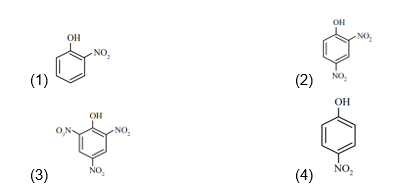
Given below are two statements : Statement (I) : p-nitrophenol is more acidic than m-nitrophenol and o-nitrophenol. Statement (II) : Ethanol will give immediate turbidity with Lucas reagent. In the light of the above statements, choose the correct answer from the options given below :
Correct option: A. Method: Statement I is true: p-nitrophenol is more acidic than m-nitrophenol and o-nitrophenol, because the para nitro group stabilises the phenoxide ion by resonance and by its electron-withdrawing effect, while the meta nitro group acts only by induction. Statement II is false: ethanol is a primary alcohol and does not give immediate turbidity with Lucas reagent; only tertiary alcohols do so at once. Statement I is true but Statement II is false.
Q227 Jan 2024, Shift 2
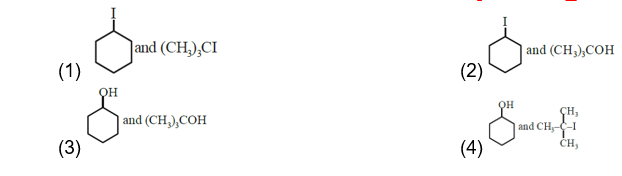
Major product formed in the following reaction is a mixture of Reaction: cyclohexyl tert-butyl ether is treated with HI. The stem figure on the site (Capture-46.png) returns 404, so the reaction is given here from the site solution image.
Correct option: D. Method: HI protonates the ether oxygen of cyclohexyl tert-butyl ether, and the tert-butyl group leaves as the stable tert-butyl cation, which iodide attacks to give tert-butyl iodide. The cyclohexyl part is released as cyclohexanol. The major products are therefore a mixture of cyclohexanol and tert-butyl iodide, option (4).
Q327 Jan 2024, Shift 2
Match List-I with List-II. Choose the correct answer from the options given below: List-I (Reaction): (A) Phenol to salicylic acid, (B) Phenol to salicylaldehyde, (C) Phenol to p-benzoquinone, (D) Phenol to anisole. List-II (Reagent(s)): (I) Na2Cr2O7, H2SO4; (II) (i) NaOH, (ii) CH3Cl; (III) (i) NaOH, CHCl3, (ii) NaOH, (iii) HCl; (IV) (i) NaOH, (ii) CO2, (iii) HCl.
Correct option: D. Method: Phenol to salicylic acid is the Kolbe-Schmitt reaction, NaOH then CO2 then HCl: (A)-(IV). Phenol to salicylaldehyde is the Reimer-Tiemann reaction, NaOH and CHCl3 then NaOH then HCl: (B)-(III). Phenol to p-benzoquinone is oxidation with Na2Cr2O7 and H2SO4: (C)-(I). Phenol to anisole is Williamson ether synthesis, NaOH then CH3Cl: (D)-(II). The match is (A)-(IV), (B)-(III), (C)-(I), (D)-(II).
Q427 Jan 2024, Shift 2
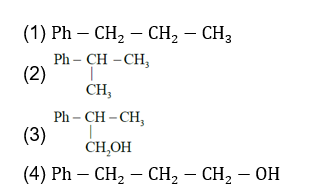
The final product A, formed in the following reaction sequence is: Styrene (Ph-CH=CH2) is treated with (i) BH3, (ii) H2O2 and OH−, (iii) HBr, (iv) Mg in ether and then HCHO with H3O+ to give final product A.
Correct option: D. Method: Hydroboration-oxidation of styrene gives 2-phenylethanol (anti-Markovnikov). HBr converts it to (2-bromoethyl)benzene. Magnesium in ether gives the Grignard reagent, which adds to formaldehyde; acid work-up gives 3-phenylpropan-1-ol, Ph-CH2-CH2-CH2-OH, option (4).
Q527 Jan 2024, Shift 2
Phenolic group can be identified by a positive:
Correct option: A. Method: The phenolic group is identified by a positive phthalein dye test, in which phenol reacts with phthalic anhydride in concentrated H2SO4 to give phenolphthalein. The Lucas test distinguishes primary, secondary and tertiary alcohols, Tollen's test identifies aldehydes, and the carbylamine test identifies primary amines. The answer is the phthalein dye test.
Q629 Jan 2024, Shift 1
Given below are two statements : one is labelled as Assertion A and the other is labelled as Reason R : Assertion A : Aryl halides cannot be prepared by replacement of hydroxyl group of phenol by halogen atom. Reason R : Phenols react with halogen acids violently. In the light of the above statements, choose the most appropriate from the options given below:
Correct option: C. Method: Assertion A is true: aryl halides cannot be prepared by replacing the hydroxyl group of phenol with a halogen, because the C-O bond of phenol has partial double bond character and phenol does not react with halogen acids. Reason R is false: phenols do not react with halogen acids violently; they do not react with them at all under these conditions. A is true but R is false.
Q729 Jan 2024, Shift 1
The major product (P) in the following reaction is 4-Vinylphenyl ethyl ether (p-CH2=CH-C6H4-O-CH2CH3) is treated with concentrated HBr (excess) with heat to give major product (P).
Correct option: D. Method: Concentrated HBr cleaves the aryl-alkyl ether at the alkyl-oxygen bond to give the phenol, and it also adds across the vinyl double bond by Markovnikov addition to give the 1-bromoethyl group. The major product P is therefore 4-(1-bromoethyl)phenol: a benzene ring with an OH group and a Br-CH-CH3 group para to each other, option (D).
Q829 Jan 2024, Shift 2
Phenol treated with chloroform in presence of sodium hydroxide, which further hydrolysed in presence of an acid results
Correct option: D. Method: Phenol with chloroform and sodium hydroxide undergoes the Reimer-Tiemann reaction to give salicylaldehyde, 2-hydroxybenzaldehyde, on acid hydrolysis. The product is 2-hydroxybenzaldehyde, option (D).
Q930 Jan 2024, Shift 2
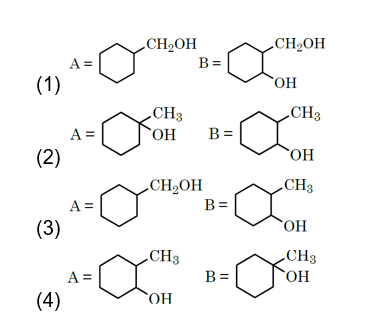
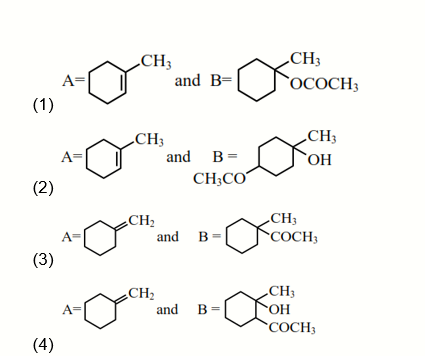
Product A and B formed in the following set of reactions are: 1-Methylcyclohex-1-ene is treated with H+/H2O to give A, and with B2H6 followed by H2O2 and aqueous NaOH to give B.
Correct option: B. Method: Acid-catalysed hydration of 1-methylcyclohex-1-ene follows Markovnikov addition to give the tertiary alcohol 1-methylcyclohexan-1-ol (A). Hydroboration-oxidation adds water anti-Markovnikov with syn stereochemistry to give trans-2-methylcyclohexan-1-ol (B). Option (2) has A as 1-methylcyclohexan-1-ol and B as 2-methylcyclohexan-1-ol.
Q1030 Jan 2024, Shift 2
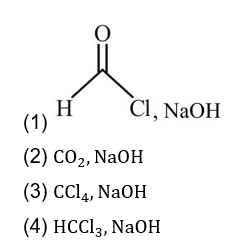
Salicylaldehyde is synthesized from phenol, when reacted with
Correct option: D. Method: Salicylaldehyde is made from phenol by the Reimer-Tiemann reaction: phenol with chloroform (CHCl3) and NaOH, followed by acidification, gives o-hydroxybenzaldehyde. Option (4) is CHCl3 with NaOH.
Q1131 Jan 2024, Shift 1
Given below are two statements: One is labelled as Assertion A and the other is labelled as Reason R: Assertion A: Alcohols react both as nucleophiles and electrophiles. Reason R: Alcohols react with active metals such as sodium, potassium and aluminum to yield corresponding alkoxides and liberate hydrogen. In the light of the above statements, choose the correct answer from the options given below:
Correct option: D. Method: Assertion A is true: alcohols react as nucleophiles (the oxygen lone pair attacks electrophiles) and as electrophiles (the carbon attached to OH is attacked after protonation). Reason R is true: alcohols react with active metals such as sodium, potassium and aluminium to give alkoxides and hydrogen gas. But R is not the correct explanation of A, because the reaction with metals shows the acidic character of alcohols, not their dual nucleophile-electrophile behaviour. Both A and R are true but R is NOT the correct explanation of A.
Q121 Feb 2024, Shift 2
Match List - I with List - II. Choose the correct answer from the options given below. List-I (Reactants): (A) Phenol, Zn/heat; (B) Phenol, CHCl3, NaOH, HCl; (C) Phenol, CO2, NaOH, HCl; (D) Phenol, concentrated HNO3. List-II (Products): (I) Salicylaldehyde; (II) Salicylic acid; (III) Benzene; (IV) Picric acid.
Correct option: C. Method: Phenol with Zn and heat is reduced to benzene: (A)-(III). Phenol with CHCl3, NaOH and HCl is the Reimer-Tiemann reaction giving salicylaldehyde: (B)-(I). Phenol with CO2, NaOH and HCl is the Kolbe-Schmitt reaction giving salicylic acid: (C)-(II). Phenol with concentrated HNO3 gives picric acid: (D)-(IV). The match is (A)-(III), (B)-(I), (C)-(II), (D)-(IV).
Q135 Apr 2024, Shift 1
Consider the given chemical reaction sequence : Total sum of oxygen atoms in Product A and Product B are Phenol is treated with concentrated H2SO4 to give product A; A is treated with concentrated HNO3 to give product B.
Answer: 14. Method: Concentrated H2SO4 sulfonates phenol to phenol-2,4-disulfonic acid (A), which has 7 oxygen atoms: 1 in the phenolic OH and 6 in the two SO3H groups. Concentrated HNO3 converts it to picric acid, 2,4,6-trinitrophenol (B), which also has 7 oxygen atoms: 1 in the OH and 6 in the three NO2 groups. The total sum is 7 + 7 = 14.
Q145 Apr 2024, Shift 1
Given below are two statement : Statement I: Bromination of phenol in solvent with low polarity such as CHCl3 or CS2 requires Lewis acid catalyst. Statement II: The lewis acid catalyst polarises the bromine to generate Br+. In the light of the above statements, choose the correct answer from the options given below :
Correct option: D. Method: Statement I is false: phenol is highly activated towards electrophilic substitution, so it is brominated directly by bromine even in a low-polarity solvent such as CHCl3 or CS2, with no Lewis acid catalyst needed. Statement II is true: a Lewis acid catalyst polarises bromine to generate the electrophile Br+. Statement I is false but Statement II is true.
Q155 Apr 2024, Shift 1
Identify compound (Z) in the following reaction sequence Chlorobenzene is treated with NaOH at 623 K and 300 atm to give X; X is treated with HCl to give Y; Y is treated with concentrated HNO3 to give Z.
Correct option: C. Method: Chlorobenzene with NaOH at 623 K and 300 atm (Dow process) gives sodium phenoxide (X); acidification gives phenol (Y). Concentrated HNO3 nitrates phenol at all three activated positions to give 2,4,6-trinitrophenol, picric acid (Z), option (3).
Q166 Apr 2024, Shift 1
In Reimer - Tiemann reaction, phenol is converted into salicylaldehyde through an intermediate. The structure of intermediate is ______.
Correct option: D. Method: In the Reimer-Tiemann reaction, dichlorocarbene generated from CHCl3 and NaOH attacks the phenoxide ring ortho to the oxygen. The intermediate formed is the sodium salt of 2-(dichloromethyl)phenol, that is, the o-(CHCl2) phenoxide, option (4). Hydrolysis of this intermediate gives salicylaldehyde.
Q176 Apr 2024, Shift 1
Given below are two statements : Statement I : Picric acid is 2, 4, 6-trinitrotoluene. Statement II : Phenol-2, 4-disulphuric acid is treated with conc. HNO3 to get picric acid. In the light of the above statement, choose the most appropriate answer from the options given below:
Correct option: A. Method: Statement I is incorrect: picric acid is 2,4,6-trinitrophenol, not 2,4,6-trinitrotoluene. Statement II is correct: phenol is first sulfonated with concentrated H2SO4 to phenol-2,4-disulfonic acid, which is then nitrated with concentrated HNO3 to give picric acid. Statement I is incorrect but Statement II is correct.
Q188 Apr 2024, Shift 1
Identify the major products A and B respectively in the following set of reactions. 1-Methylcyclohexan-1-ol is treated with concentrated H2SO4 with heat to give A, and with CH3COCl in pyridine to give B.
Correct option: A. Method: Concentrated H2SO4 with heat dehydrates 1-methylcyclohexan-1-ol to the more substituted alkene, 1-methylcyclohex-1-ene (A), by Saytzeff elimination. Acetyl chloride in pyridine converts the tertiary alcohol to its acetate ester, 1-methylcyclohexyl acetate (B). Option (1) has A as 1-methylcyclohex-1-ene and B as 1-methylcyclohexyl acetate.
What amount of bromine will be required to convert 2 g of phenol into 2,4,6-tribromophenol? (Given molar mass in gmol−1 of C,H,O,Br are 12,1,16,80 respectively)
Correct option: C. Method: Phenol reacts with bromine water to give 2,4,6-tribromophenol, using 3 moles of Br2 per mole of phenol. Moles of phenol = 2/94 = 0.021 mol. Moles of bromine needed = 0.021 × 3 = 0.064 mol. Mass of bromine = 0.064 × 160 = 10.22 g.
Q223 Jan 2025, Shift 2
Given below are two statements: Statement (I): The boiling points of alcohols and phenols increase with increase in the number of C -atoms. Statement (II): The boiling points of alcohols and phenols are higher in comparison to other class of compounds such as ethers, haloalkanes. In the light of the above statements, choose the correct answer from the options given below:
Correct option: A. Method: Statement I is true: the boiling point rises with the number of carbon atoms because the molecular mass and the van der Waals forces increase. Statement II is true: alcohols and phenols have intermolecular hydrogen bonding, so their boiling points are higher than those of ethers and haloalkanes of comparable molar mass, which cannot hydrogen-bond to the same extent. Both statements are true.
Q329 Jan 2025, Shift 2
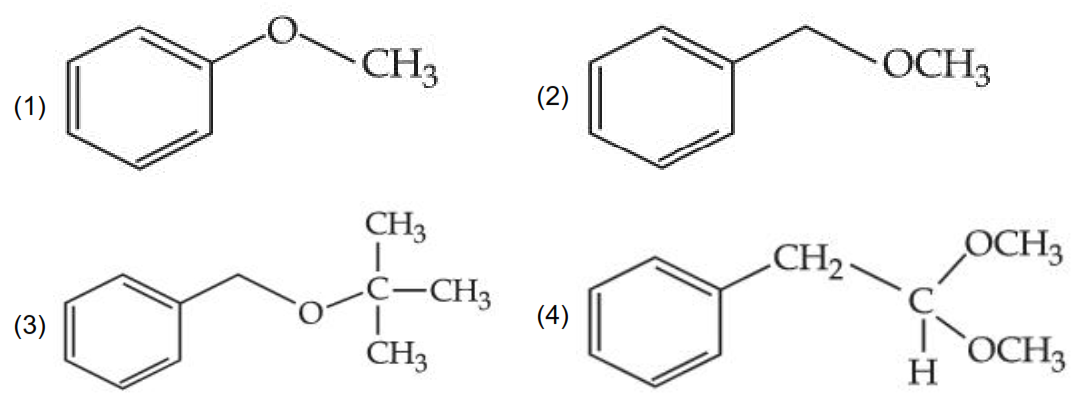
Which one of the following, with HBr will give a phenol?
Correct option: A. Method: Anisole (option 1) with HBr undergoes ether cleavage at the alkyl-oxygen bond: the methyl group leaves as methyl bromide and phenol is formed. The benzyl ethers in options (2) and (3) give benzyl bromide instead of phenol, and the acetal in option (4) gives an aldehyde. Only anisole gives a phenol.
Q42 Apr 2025, Shift 2
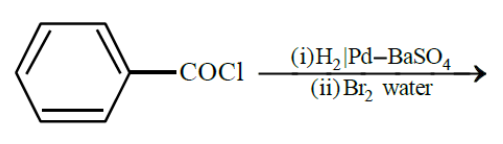
Consider the following reactions. (A) R-C≡N with (i) H+/H2O under mild conditions. (B) R-MgX with (i) CO2 and (ii) H3O+. (C) R-C≡N with (i) SnCl2/HCl and (ii) H3O+. (D) R-CH2-OH with PCC. (E) Benzoyl chloride with (i) H2/Pd-BaSO4 and (ii) Br2/water (see figure). From these reactions, which reaction will give carboxylic acid as a major product? Choose the correct answer from the options given below:
Correct option: B. Method: (A) R-C≡N with dilute acid under mild conditions stops at the amide, R-CONH2, not the acid. (B) R-MgX with CO2 followed by H3O+ gives the carboxylic acid R-COOH. (C) R-C≡N with SnCl2/HCl (Stephen reduction) gives the aldehyde R-CHO. (D) R-CH2-OH with PCC gives the aldehyde R-CHO. (E) Benzoyl chloride is reduced by H2/Pd-BaSO4 (Rosenmund) to benzaldehyde, which Br2/water oxidises to benzoic acid. Only B and E give a carboxylic acid as the major product.
Q54 Apr 2025, Shift 1
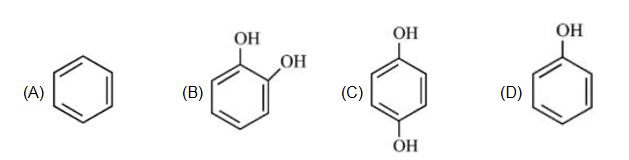
Benzene is treated with oleum to produce compound (X) which when further heated with molten sodium hydroxide followed by acidification produces compound (Y). The compound Y is treated with zinc metal to produce compound (Z). Identify the structure of compound (Z) from the following option.
Correct option: A. Method: Benzene with oleum gives benzenesulfonic acid (X). Molten NaOH followed by acidification converts it to phenol (Y) via sodium phenoxide. Zinc dust reduces phenol to benzene (Z). Compound Z is benzene, option (A).
Q64 Apr 2025, Shift 2
A toxic compound "A" when reacted with NaCN in aqueous acidic medium yields an edible cooking component and food preservative "B". "B" is converted to "C" by diborane and can be used as an additive to petrol to reduce emission. "C" upon reaction with oleum at yields an inhalable anesthetic "D". Identify "A", "B", "C" & "D", respectively :
Correct option: D. Method: Methanol (A) with NaCN in aqueous acidic medium gives acetonitrile, which hydrolyses to acetic acid (B), the edible cooking component and food preservative. Diborane reduces acetic acid to ethanol (C), the petrol additive. Ethanol with oleum dehydrates to diethyl ether (D), the inhalable anaesthetic. So A, B, C and D are methanol, acetic acid, ethanol and diethyl ether respectively.
Q77 Apr 2025, Shift 1
Given below are two statements: Statement I: Dimethyl ether is completely soluble in water. However, diethyl ether is soluble in water to a very small extent. Statement II: Sodium metal can be used to dry diethyl ether and not ethyl alcohol. In the light of given statements. choose the correct answer from the options given below
Correct option: B. Method: Statement I is true: dimethyl ether is completely soluble in water because it hydrogen-bonds with water, while diethyl ether, with its larger hydrocarbon part, is soluble only to a small extent. Statement II is true: sodium metal reacts with ethyl alcohol to release hydrogen gas, so it cannot be used to dry alcohol, but it does not react with diethyl ether and can dry it. Both statements are true.
Q87 Apr 2025, Shift 2
Match List-I with List-II. List-I (Conversion): (A) chlorobenzene to phenol, (B) 4-nitrochlorobenzene to 4-nitrophenol, (C) 2,4-dinitrochlorobenzene to 2,4-dinitrophenol, (D) 2,4,6-trinitrochlorobenzene to 2,4,6-trinitrophenol. List-II (Reagents, Conditions used): (I) Warm, H2O; (II) (a) NaOH, 368 K, (b) H3O+; (III) (a) NaOH, 443 K, (b) H3O+; (IV) (a) NaOH, 623 K, 300 atm, (b) H3O+. Choose the correct answer from the options given below:
Correct option: C. Method: Nucleophilic aromatic substitution of Cl by OH gets easier with more ortho/para nitro groups, because they stabilise the anionic intermediate. Chlorobenzene, with no activating group, needs the harshest conditions, the Dow process (NaOH, 623 K, 300 atm): (A)-(IV). 4-Nitrochlorobenzene reacts with NaOH at 443 K: (B)-(III). 2,4-Dinitrochlorobenzene reacts with NaOH at 368 K: (C)-(II). 2,4,6-Trinitrochlorobenzene is hydrolysed by warm water alone to picric acid: (D)-(I). The match is (A)-(IV), (B)-(III), (C)-(II), (D)-(I), which is option (C). The site's published key for this post is A, which is wrong; the match above is confirmed by independent solve and by the ExamSide and Molsynapse keys for this shift.
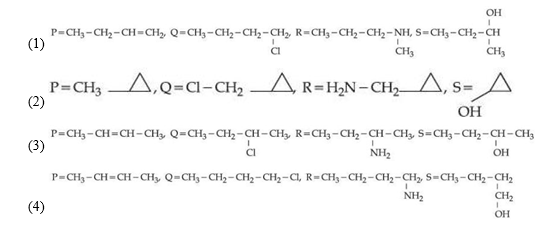
A hydrocarbon ' P ' (C4H8) on reaction with HCl gives an optically active compound ' Q ' (C4H9Cl) which on reaction with one mole of ammonia gives compound ' R′(C4H11 N). ' R′ on diazotization followed by hydrolysis gives ' S '. Identify P, Q, R and S.
Correct option: C. Method: P is an alkene that adds HCl to give an optically active chloride Q, so P is but-2-ene and Q is 2-chlorobutane (CH3-CH2-CHCl-CH3), which is chiral. Q with one mole of ammonia gives the amine R, sec-butylamine (CH3-CH2-CH(NH2)-CH3). Diazotisation of R followed by hydrolysis replaces NH2 by OH to give S, butan-2-ol (CH3-CH2-CH(OH)-CH3). Only option (3) matches all four: P = but-2-ene, Q = 2-chlorobutane, R = sec-butylamine, S = butan-2-ol.
Q222 Jan 2026, Shift 1
Given below are two statements: Statement I: Phenol on treatment with CHCl3 / aq. KOH under refluxing condition, followed by acidification produces p-hydroxy benzaldehyde as the major product and o-hydroxy benzaldehyde as the minor product. Statement II: The mixture of p-hydroxybenzaldehyde and o-hydroxybenzaldehyde can be easily separated through steam distillation. In the light of the above statements, choose the correct answer from the options given below
Correct option: D. Method: Statement I is false: the Reimer-Tiemann reaction of phenol with CHCl3 and aqueous KOH gives o-hydroxybenzaldehyde (salicylaldehyde) as the major product and p-hydroxybenzaldehyde as the minor product, not the other way round. Statement II is true: the ortho isomer is steam volatile because of intramolecular hydrogen bonding, so the two isomers are easily separated by steam distillation. Statement I is false but Statement II is true.
Q323 Jan 2026, Shift 2
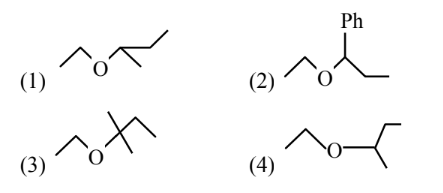
A mixed ether (P), when heated with excess of hot concentrated hydrogen iodide produces two different alkyl iodides which when treated with aq. NaOH give compounds (Q) and (R). Both (Q) and (R) give yellow precipitate with NaOI . Identify the mixed ether (P) :
Correct option: A. Method: Excess hot concentrated HI cleaves the mixed ether into two alkyl iodides, which aqueous NaOH converts to the alcohols Q and R. Both Q and R must give a yellow precipitate of iodoform with NaOI, so both must be ethanol or a secondary alcohol of the type CH3-CH(OH)-. Only ethyl sec-butyl ether, CH3CH2-O-CH(CH3)CH2CH3, gives ethanol (Q) and butan-2-ol (R), and both give iodoform. The tert-pentyl ether in option (3) would give a tertiary alcohol, which does not give iodoform.
Q428 Jan 2026, Shift 1
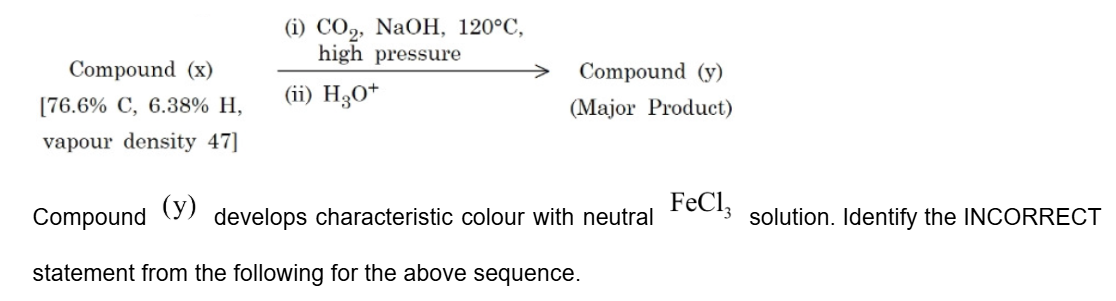
Consider the following reaction sequence Compound (x) [76.6% C, 6.38% H, vapour density 47] is treated with (i) CO2, NaOH, 120 degrees C, high pressure and (ii) H3O+ to give compound (y) (major product). Compound (y) develops characteristic colour with neutral FeCl3 solution. Identify the INCORRECT statement from the following for the above sequence.
Correct option: C. Method: Vapour density 47 gives a molar mass of 94, and 76.6% C with 6.38% H fits C6H5OH, so compound (x) is phenol. The Kolbe-Schmitt reaction (CO2, NaOH, heat, then acid) converts phenol to salicylic acid (y), which gives a violet colour with neutral FeCl3. Both phenol and salicylic acid dissolve in NaOH (A is correct), and salicylic acid dissolves in NaHCO3 with effervescence because it has a COOH group (B is correct). Both are aromatic and burn with a sooty flame (D is correct). Statement C is incorrect: salicylic acid, with its electron-withdrawing COOH group, is more acidic than phenol, not less.
Q55 Apr 2026, Shift 1
One mole of phenol is treated with dilute HNO3 at 298 K to give a mixture of products. The mixture is separated by steam distillation. The steam volatile compound (X) is separated. The increase in percentage of oxygen in (X) with respect to phenol is ____ × 10−1 % (Given molar mass in gmol−1 H: 1, C: 12, N: 14, O: 16 )
Answer: 175. Method: Dilute HNO3 nitrates phenol to a mixture of o-nitrophenol and p-nitrophenol. The steam volatile compound X is o-nitrophenol (intramolecular hydrogen bonding makes it steam volatile). Molar mass of phenol is 94, so oxygen is 16/94 × 100 = 17.02% of phenol. Molar mass of o-nitrophenol is 139, so oxygen is 48/139 × 100 = 34.53% of X. The increase is 34.53 - 17.02 = 17.51%, which is 175.1 × 10⁻¹ %. The nearest integer is 175.
Q65 Apr 2026, Shift 1
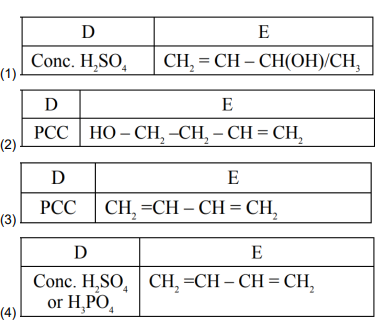
Consider compounds A, B and C with following structural formulae (see figure). For the conversion of B from A, reagent (D) required is ____ and structural formula of product (E) obtained when C undergoes same reaction using excess reagent (D) is ____. A = CH3-CH2-CH2-CH2-CH2-OH (pentan-1-ol), B = CH2=CH-CH2-CH2-CH3 (pent-1-ene), C = HO-CH2-CH2-CH(OH)-CH3 (butane-1,3-diol).
Correct option: D. Method: Converting pentan-1-ol (A) to pent-1-ene (B) is a dehydration, so reagent (D) is concentrated H2SO4 (or H3PO4). The same reagent in excess dehydrates butane-1,3-diol (C) at both OH groups to give buta-1,3-diene, CH2=CH-CH=CH2 (E). Only option (4) has D as concentrated H2SO4 or H3PO4 and E as buta-1,3-diene.
Q76 Apr 2026, Shift 1
4.7 g of phenol is heated with Zn to give product X . If this reaction goes to 60 % completion then the number of moles of compound X formed will be ____ × 10−2.(Nearest Integer) (Given molar mass in gmol−1: H: 1, C: 12, O: 16 )
Answer: 3. Method: Zinc dust reduces phenol to benzene (X), one mole of benzene per mole of phenol. Moles of phenol = 4.7/94 = 0.05 mol. At 60% completion, moles of benzene formed = 0.05 × 0.60 = 0.03 mol = 3 × 10⁻² mol. The answer is 3.
Q86 Apr 2026, Shift 1
Consider the following sequence of reactions The major product P is: The starting material is tert-butyl alcohol, (CH3)3C-OH, treated with (i) Cu at 573 K and (ii) H+ and PhCOOH to give major product P.
Correct option: B. Method: Hot copper at 573 K dehydrates tert-butyl alcohol to 2-methylpropene (isobutene). With H+ the alkene forms the tert-butyl cation, which alkylates the benzoic acid ring in a Friedel-Crafts reaction; the COOH group is meta-directing, so the major product is 3-tert-butylbenzoic acid, option (2). The tert-butyl benzoate ester in option (3) is the trap here: tert-butyl esters cleave in acid, so the ester is not the product under these acidic conditions. This matches the NTA final answer key for 6 April 2026 Shift 1, Question 67.
Q96 Apr 2026, Shift 2
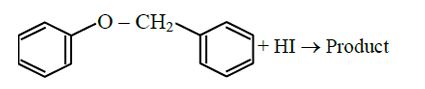
Consider the following reaction. Statement I: In the above reaction, product formed will be a mixture of benzyl alcohol and iodobenzene. Statement II : In the above reaction, the -O-CH2- bond is cleaved to give the product. In the light of the above statements, choose the correct answer from the options given below : The reaction shown is benzyl phenyl ether, Ph-O-CH2-Ph, treated with HI.
Correct option: D. Method: In the HI cleavage of benzyl phenyl ether, the benzyl-oxygen bond breaks because the benzyl cation is stable, while the phenyl-oxygen bond does not break (the C-O bond of phenol has partial double bond character). The products are phenol and benzyl iodide, not benzyl alcohol and iodobenzene, so Statement I is false. Statement II is true: the -O-CH2− bond is the one cleaved. Statement I is false but Statement II is true.
Pick an option for a multiple choice question, or type your answer for a numerical question and press Check. A correct choice turns green, a wrong choice turns red and the correct option turns green, and the short method appears below. Once answered, a card locks until you press Reset.
How many Alcohols, Phenols and Ethers questions are in this quiz, and from which years?
35 verified JEE Main Alcohols, Phenols and Ethers questions: 18 from 2024, 8 from 2025 and 9 from 2026, covering both the January and April sessions, each in shift order.
How should I use this quiz for revision?
Attempt one year timed, without looking at the method. After checking, note every miss by pattern, such as phenol acidity, ether cleavage, or named reactions, and rework that pattern the same day.
Do the questions cover both the January and April sessions?
Yes. The 2026 set covers both the January and April sessions, and the 2024 and 2025 sets cover their January and April sessions too.
Are these real JEE Main questions?
Yes. Every question here is a verified JEE Main Alcohols, Phenols and Ethers question from 2024, 2025 or 2026, shown with its shift.
Tags
JEE Main 2027Alcohols, Phenols and Ethers PYQJEE Main ChemistryPYQ AnalysisRepeat FrequencyUPO Unique PYQsAlcohols, Phenols and EthersPhenolReimer Tiemann ReactionJEE Main Preparation
Hello 👋 Welcome to Competishun – India’s most trusted platform for JEE & NEET preparation. Need help with JEE / NEET courses, fees, batches, test series or free study material? Chat with us now 👇