JEE Main Haloalkanes PYQs 2024, 2025 and 2026: All Questions with Solutions
By CompetishunNov 21, 202631 min read
JEE Main Haloalkanes PYQs 2024, 2025 and 2026: All Questions with Solutions
Verified JEE Main Haloalkanes questions from 2024, 2025 and 2026, shift by shift. The 2024, 2025 and 2026 sets are interactive now: pick an option or enter a number and check instantly. Attempt timed, check the method only after answering, and log every miss by pattern.
Score: 0 correct out of 0 attempted ( interactive questions)
How to use this quiz
1. Attempt one year timed, without looking at the method.
2. Click an option, or type a number and press Check, for instant right or wrong feedback.
3. Read the short method only after answering, then log the miss by pattern.
4. Rework your weak patterns the same day, then reattempt the year.
2024 Questions (19)
Q127 Jan 2024, Shift 1
The correct statement regarding nucleophilic substitution reaction in a chiral alkyl halide is ;
Correct option: D. Method: In a chiral alkyl halide, SN1 gives racemisation (attack from both faces of the planar carbocation) and SN2 gives inversion of configuration (back-side attack). Racemisation occurs in SN1 and inversion occurs in SN2.
Q227 Jan 2024, Shift 2
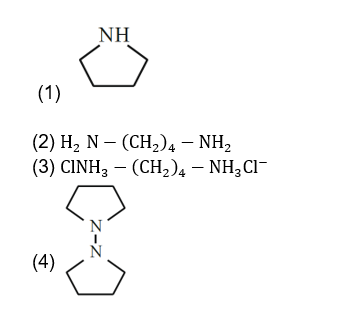
Identify B formed in the reaction. Cl-(CH2)4-Cl excess NH3 → A NaOH → B+H2O+NaCl The four options are: (1) pyrrolidine, (2) H2N-(CH2)4-NH2, (3) ClH3N-(CH2)4-NH3Cl (the dihydrochloride), (4) two pyrrolidine rings joined by an N-N bond.
Correct option: B. Method: Excess ammonia converts 1,4-dichlorobutane to the diammonium salt Cl− +H3N-(CH2)4-NH3+ Cl− (A). NaOH liberates the free diamine H2N-(CH2)4-NH2 (B).
Q327 Jan 2024, Shift 2
Which among the following halide/s will not show SN 1 reaction: Four halides: (A) allyl chloride, (B) 1-chloroprop-1-ene, (C) benzyl chloride, (D) isopropyl chloride.
Correct option: D. Method: SN1 needs a stable carbocation. The vinylic cation CH3-CH=CH+ is very unstable, so 1-chloroprop-1-ene (B) cannot undergo SN1. Allyl chloride, benzyl chloride and isopropyl chloride all form stable carbocations. Only (B) will not show SN1.
Q429 Jan 2024, Shift 2
Alkyl halide is converted into alkyl isocyanide by reaction with
Correct option: D. Method: AgCN is covalent, so the cyanide ion bonds through nitrogen and the alkyl halide is converted to the alkyl isocyanide. NaCN and KCN are ionic and give the nitrile.
Q530 Jan 2024, Shift 1
Compound A formed in the following reaction reacts with B gives the product C. Find out A and B. CH3-C≡CH + Na gives A; A with B gives CH3-C≡C-CH2-CH2-CH3 (C).
Correct option: A. Method: Propyne reacts with Na to give sodium propynide, CH3-C≡C− Na+ (A). It displaces bromide from n-propyl bromide (B) by SN2 to give pent-2-yne, CH3-C≡C-CH2-CH2-CH3 (C).
Q630 Jan 2024, Shift 1
Given below are two statement one is labeled as Assertion (A) and the other is labeled as Reason (R). Assertion (A): CH2=CH-CH2-Cl is an example of allyl halide Reason (R): Allyl halides are the compounds in which the halogen atom is attached to sp2 hybridised carbon atom. In the light of the two above statements, choose the most appropriate answer from the options given below:
Correct option: A. Method: Assertion (A) is true: CH2=CH-CH2-Cl is an allyl halide. Reason (R) is false: in an allyl halide the halogen is attached to an sp3 hybridised carbon atom next to the double bond, not to an sp2 carbon. (A) is true but (R) is false.
Q730 Jan 2024, Shift 1
Example of vinylic halide is Four structures numbered (1) to (4), matching options a to d: (1) X on the exocyclic double-bond carbon of methylenecyclohexane; (2) CH2X on a cyclohexene ring; (3) X on a benzene ring; (4) X on a cyclohexene ring carbon.
Correct option: A. Method: A vinylic halide has the halogen attached directly to an sp2 hybridised carbon of a carbon-carbon double bond. Structure (1), with X on the exocyclic double-bond carbon, is the vinylic halide. Structures (2) and (4) are allyl halides and (3) is an aryl halide.
Q830 Jan 2024, Shift 2
Given below are two statements: Statement-I: High concentration of strong nucleophilic reagent with secondary alkyl halides which do not have bulky substituents will follow SN 2 mechanism. Statement - II: A secondary alkyl halide when treated with a large excess of ethanol follows SN 1 mechanism. In the light of the above statements, choose the most appropriate from the questions given below:
Correct option: D. Method: Statement I is true: the rate of SN2 is proportional to [R-X][Nu−], so a high concentration of a strong nucleophile favours SN2 with a secondary alkyl halide that has no bulky substituents. Statement II is true: solvolysis of a secondary alkyl halide in a large excess of ethanol follows the SN1 path. Both statements are true.
Q931 Jan 2024, Shift 1
The total number of hydrogen atoms in product A and product B is ________ . CH3CH2Br + NaOH gives product A with C2H5OH and product B with H2O.
Answer: 10. Method: With ethanol, NaOH gives ethene (A) by elimination; with water, NaOH gives ethanol (B) by substitution. Ethene has 4 hydrogen atoms and ethanol has 6, so the total is 4 + 6 = 10.
Q1031 Jan 2024, Shift 1
The product (C) in the below mentioned reaction is: CH3-CH2-CH2-Br is treated with alc. KOH with heat to give A; A is treated with HBr to give B; B is treated with aq. KOH with heat to give C.
Correct option: D. Method: n-Propyl bromide with alcoholic KOH gives propene (A); HBr adds by Markovnikov addition to give 2-bromopropane (B); aqueous KOH gives propan-2-ol (C).
Q1131 Jan 2024, Shift 2
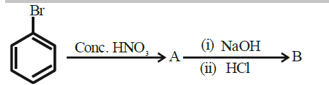
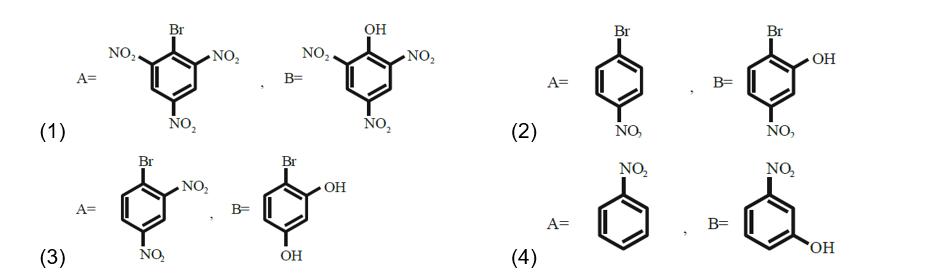
Identify A and B in the following reaction sequence. Bromobenzene is treated with conc. HNO3 to give A; A is treated with (i) NaOH and (ii) HCl to give B. The four options give pairs (A, B) numbered (1) to (4).
Correct option: A. Method: Bromobenzene with concentrated HNO3 gives 2,4,6-trinitrobromobenzene (A). A with NaOH followed by HCl gives picric acid, 2,4,6-trinitrophenol (B). A is 2,4,6-trinitrobromobenzene and B is 2,4,6-trinitrophenol, option (1).
Q121 Feb 2024, Shift 2
Match List - I with List - II. Choose the correct answer from the options given below : List-I: (A) Carbon tetrachloride, (B) Methylene chloride, (C) DDT, (D) Freons. List-II: (I) Paint remover, (II) Refrigerators and air conditioners, (III) Fire extinguisher, (IV) Non-biodegradable insecticide.
Correct option: B. Method: CCl4 is used as a fire extinguisher, so A-III. CH2Cl2 is used as a paint remover, so B-I. DDT is a non-biodegradable insecticide, so C-IV. Freons are used in refrigerators and air conditioners, so D-II. (A)-(III), (B)-(I), (C)-(IV), (D)-(II).
Q134 Apr 2024, Shift 1
Given below are two statements one is labelled as Assertion (A) and the other is labelled as Reason (R): Assertion (A) - SN 2 reaction of C6H5CH2Br occurs more readily than the SN 2 reaction of CH3CH2Br Reason (R): The partially bonded unhybridized p-orbital that develops in the trigonal bipyramidal transition state is stabilized by conjugation with the phenyl ring. In the light of the above statements, choose the most appropriate answer from the options given below:
Correct option: C. Method: The benzyl group stabilises the partially bonded unhybridised p-orbital in the trigonal bipyramidal SN2 transition state by conjugation with the phenyl ring, so benzyl bromide reacts faster than ethyl bromide. Both (A) and (R) are correct and (R) is the correct explanation of (A).
Q146 Apr 2024, Shift 1
The major products from the following reaction sequence are product A and product B. The total sum of π electrons in product A and product B are________(nearest integer) Cyclohexene is treated with (i) Br2 and (ii) alc. KOH (3 eq.) to give B, and with (i) Br2 and (ii) prop-2-yn-1-ol sodium salt (1.0 eq.) to give A.
Answer: 8. Method: Cyclohexene adds Br2 to give trans-1,2-dibromocyclohexane. With the propargyl alkoxide (1.0 eq.) one bromine is displaced by SN2 to give A, 2-bromo-1-(prop-2-yn-1-yloxy)cyclohexane, which has 4 π electrons (the triple bond). With alcoholic KOH (3 eq.) both HBr molecules are eliminated to give B, cyclohexa-1,3-diene, which has 4 π electrons. The total sum is 4 + 4 = 8.
Q156 Apr 2024, Shift 1
Match List I with List II : Choose the correct answer from the options given below : List-I: (A) Iodoform, (B) Carbon tetrachloride, (C) CFC, (D) DDT. List-II: (I) Fire extinguisher, (II) Insecticide, (III) Antiseptic, (IV) Refrigerants.
Correct option: C. Method: Iodoform is used as an antiseptic, so A-III. Carbon tetrachloride is used as a fire extinguisher, so B-I. CFCs are used as refrigerants, so C-IV. DDT is used as an insecticide, so D-II. A-III, B-I, C-IV, D-II.
Q168 Apr 2024, Shift 1
Major product B of the following reaction has ____ π-bonds. Ethylbenzene is oxidised with KMnO4-KOH with heat to give (A); (A) is nitrated with HNO3/H2SO4 to give (B).
Answer: 5. Method: Hot alkaline KMnO4 oxidises the ethyl side chain of ethylbenzene to a carboxyl group, so A is benzoic acid (as the potassium salt). The COOH group is meta-directing, so nitration gives B, 3-nitrobenzoic acid. The π bonds in B are 3 in the benzene ring, 1 in the C=O bond and 1 in the N=O bond of the nitro group, a total of 5.
Q178 Apr 2024, Shift 1
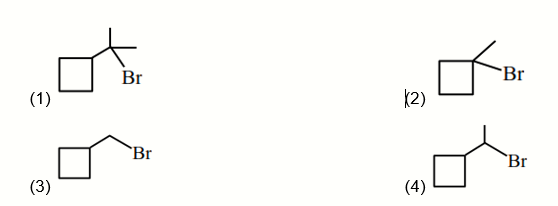
Which among the following compounds will undergo fastest SN 2 reaction. Four bromides numbered (1) to (4): (1) 2-bromo-2-cyclobutylpropane, (2) 1-bromo-1-methylcyclobutane, (3) (bromomethyl)cyclobutane, (4) 1-bromo-1-cyclobutylethane.
Correct option: C. Method: The rate of SN2 is Me-X > 1°-X > 2°-X > 3°-X. The fastest is the primary bromide (bromomethyl)cyclobutane, option (3).
Q189 Apr 2024, Shift 1
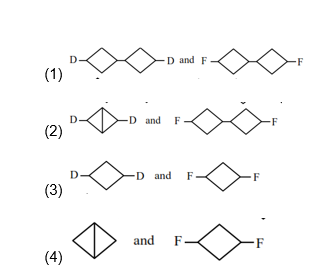
In the following sequence of reaction, the major products B and C respectively are : 1-Bromo-3-chlorocyclobutane is treated with Na/Et2O to give A; A is treated with (i) Mg/Et2O and (ii) D2O to give B, and with CoF2 to give C. The four options give pairs (B, C) numbered (1) to (4): (1) 3,3'-dideuterio-1,1'-bi(cyclobutyl) and 3,3'-difluoro-1,1'-bi(cyclobutyl); (2) 1,3-dideuterio-bicyclo[1.1.0]butane and 3,3'-difluoro-1,1'-bi(cyclobutyl); (3) 1,3-dideuterocyclobutane and 1,3-difluorocyclobutane; (4) bicyclo[1.1.0]butane and 1,3-difluorocyclobutane.
Correct option: A. Method: Sodium attacks the more reactive C-Br bond, and intermolecular Wurtz coupling of two 3-chlorocyclobutyl units gives A, 3,3'-dichloro-1,1'-bi(cyclobutyl). Mg in dry ether converts both C-Cl bonds to Grignard reagents and D2O replaces each by D, so B is 3,3'-dideuterio-1,1'-bi(cyclobutyl). CoF2 exchanges both chlorines for fluorine (Swarts reaction), so C is 3,3'-difluoro-1,1'-bi(cyclobutyl).
Q199 Apr 2024, Shift 1
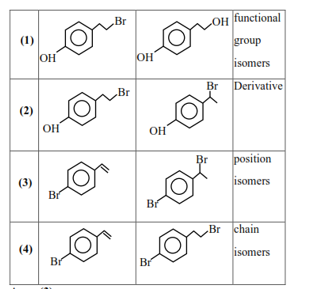
Identify (B) and (C) and how are (A) and (C) related (B) and (C) ? 1-Bromo-2-(4-bromophenyl)ethane is treated with alc. NaOH to give (B); (B) is treated with HBr/ether to give (C). The four options give pairs (B, C) with a relation label: (1) B is 4-hydroxyphenyl-CH2CH2Br and C is 4-hydroxyphenyl-CH2CH2OH, functional group isomers; (2) B is 4-hydroxyphenyl-CH2CH2Br and C is 1-(4-hydroxyphenyl)-1-bromoethane, Derivative; (3) B is 4-bromostyrene and C is 1-bromo-1-(4-bromophenyl)ethane, position isomers; (4) B is 4-bromostyrene and C is 1-bromo-2-(4-bromophenyl)ethane, chain isomers.
Correct option: C. Method: Alcoholic NaOH eliminates HBr from 1-bromo-2-(4-bromophenyl)ethane to give (B), 4-bromostyrene. HBr in ether adds to the alkene by Markovnikov addition to give (C), 1-bromo-1-(4-bromophenyl)ethane. (A) and (C) are position isomers (the bromine has moved from the terminal carbon to the benzylic carbon).
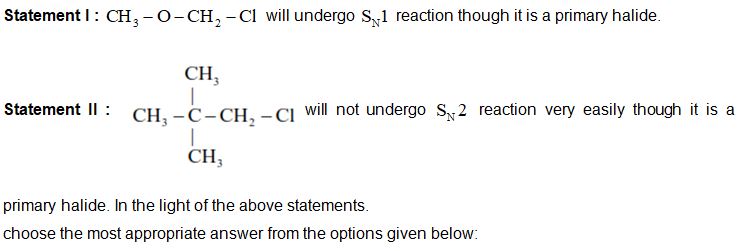
Given below are two statements : Statement I: CH3-O-CH2-Cl undergoes SN1 reaction though it is a primary halide. Statement II: (CH3)3C-CH2-Cl (neopentyl chloride) will not undergo SN2 reaction very easily though it is a primary halide.
Correct option: B. Method: Statement I is true: CH3-O-CH2-Cl undergoes SN1 readily because the CH3-O-CH2+ carbocation is highly stabilised by resonance with the oxygen lone pair, even though it is a primary halide. Statement II is true: neopentyl chloride is a primary halide but undergoes SN2 very slowly because it is sterically crowded. Both statements are correct.
Q222 Jan 2025, Shift 2
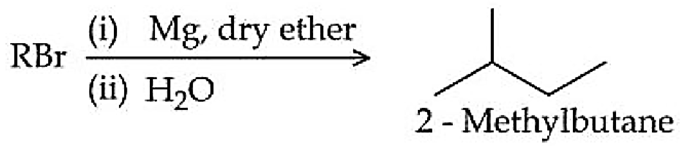
The maximum number of RBr producing 2-methylbutane by above sequence of reactions is _______ . (Consider the structural isomers only) RBr is treated with (i) Mg, dry ether and (ii) H2O to give 2-methylbutane.
Correct option: D. Method: RBr gives 2-methylbutane on treatment with Mg/dry ether followed by H2O, so R is a butyl group of the 2-methylbutane skeleton. Four structural isomers of RBr are possible: 1-bromo-2-methylbutane, 2-bromo-2-methylbutane, 2-bromo-3-methylbutane and 1-bromo-3-methylbutane. The maximum number is 4.
Q323 Jan 2025, Shift 2
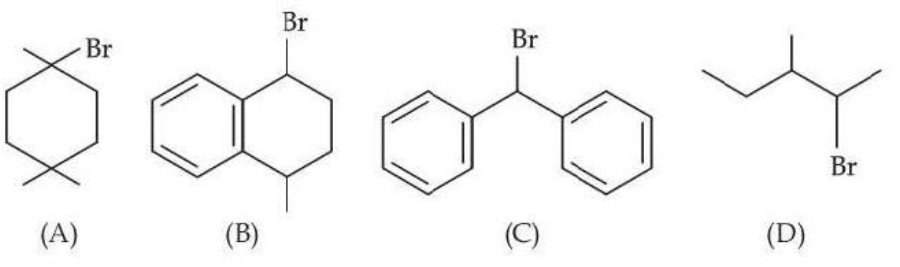
The ascending order of relative rate of solvolysis of following compounds is : Four bromides: (A) a tetramethyl-substituted bromocyclohexane, (B) 1-bromo-4-methyl-1,2,3,4-tetrahydronaphthalene, (C) benzhydryl bromide, (D) 2-bromo-3-methylpentane.
Correct option: C. Method: Solvolysis (SN1) follows carbocation stability: the benzhydryl cation (C) is most stable, then the benzylic tetralin cation (B), then the tertiary cyclohexyl cation (A), then the secondary cation (D). The ascending order is (D) < (A) < (B) < (C).
Q423 Jan 2025, Shift 2
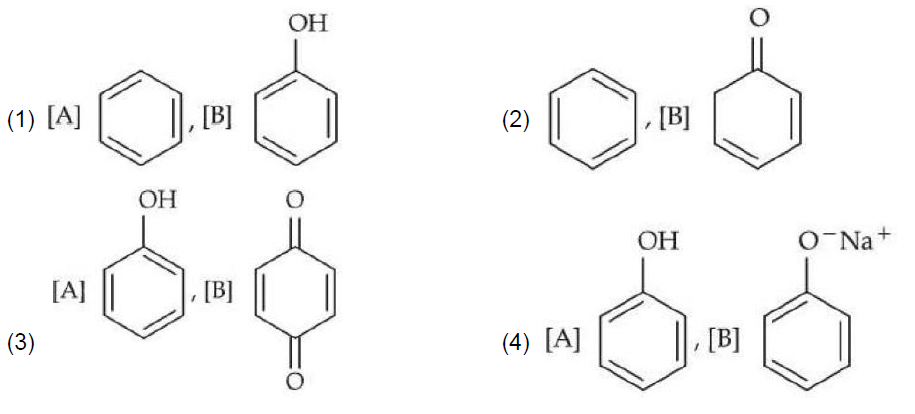
Identify the products [A] and [B], respectively in the following reaction: Chlorobenzene is treated with (i) NaOH, 623 K, 300 atm and (ii) H+ to give [A]; [A] is treated with Na2Cr2O7/H2SO4 to give [B]. The four options give pairs ([A], [B]) numbered (1) to (4).
Correct option: C. Method: Chlorobenzene with NaOH at 623 K and 300 atm followed by H+ (Dow process) gives phenol (A). Phenol on oxidation with Na2Cr2O7/H2SO4 gives p-benzoquinone (B). A is phenol and B is p-benzoquinone.
Q524 Jan 2025, Shift 2
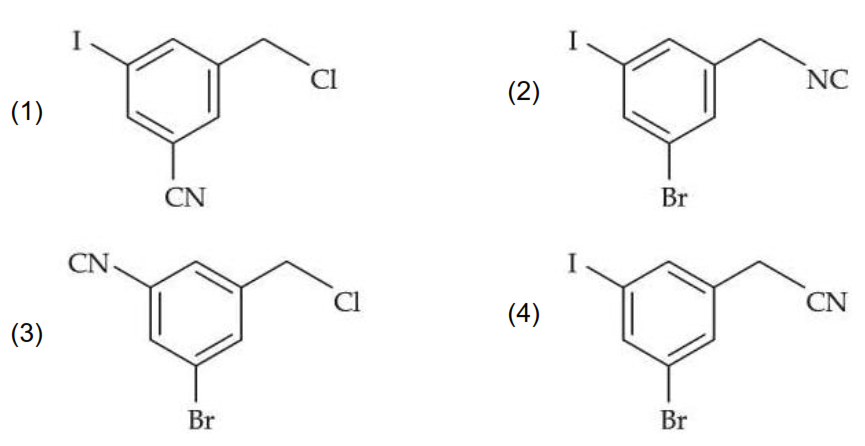
The structure of the major product formed in the following reaction is: 3-Bromo-5-iodobenzyl chloride is treated with AgCN to give the major product. The four options are structures numbered (1) to (4): (1) 3-cyano-5-iodobenzyl chloride, (2) 3-bromo-5-iodobenzyl isocyanide, (3) 3-bromo-5-cyanobenzyl chloride, (4) 3-bromo-5-iodobenzyl cyanide.
Correct option: B. Method: AgCN is covalent, so the cyanide ion attacks through nitrogen to give the isocyanide. The major product is 3-bromo-5-iodobenzyl isocyanide (CH2NC with I and Br retained on the ring), option (2).
Q628 Jan 2025, Shift 1
The products A and B in the following reactions, respectively are n-Propyl bromide is treated with AgNO2 to give A and with AgCN to give B.
Correct option: A. Method: AgNO2 is covalent, so the nitrite ion attacks through nitrogen to give the nitroalkane CH3CH2CH2NO2 (A). AgCN is covalent, so the cyanide ion attacks through nitrogen to give the isocyanide CH3CH2CH2NC (B).
Q728 Jan 2025, Shift 1
Given below are two statements: Statement I: Et2N-CH2CH2Cl undergoes alkaline hydrolysis at a faster rate than Et2CH-CH2CH2Cl. Statement II: In Et2N-CH2CH2Cl, intramolecular substitution takes place first by involving the lone pair of electrons on nitrogen.
Correct option: A. Method: Statement I is true: the nitrogen lone pair displaces chloride intramolecularly, so Et2N-CH2CH2Cl hydrolyses faster than Et2CH-CH2CH2Cl. Statement II is true: the faster hydrolysis is due to intramolecular substitution (neighbouring group participation) by the nitrogen lone pair. Both statements are correct.
Q828 Jan 2025, Shift 2
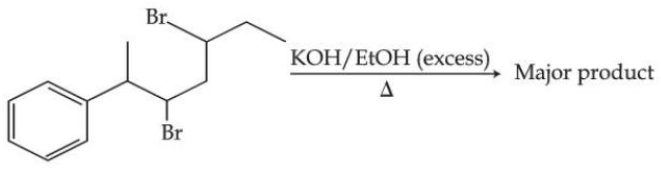
The major product of the following reaction is : A dibromide (Ph-CH(CH3)-CHBr-CHBr-CH2CH3) is treated with excess KOH/EtOH with heat to give the major product.
Correct option: A. Method: Excess KOH/EtOH with heat removes both HBr molecules from the dibromide to give the conjugated diene 2-phenylhepta-2,4-diene.
Q929 Jan 2025, Shift 2
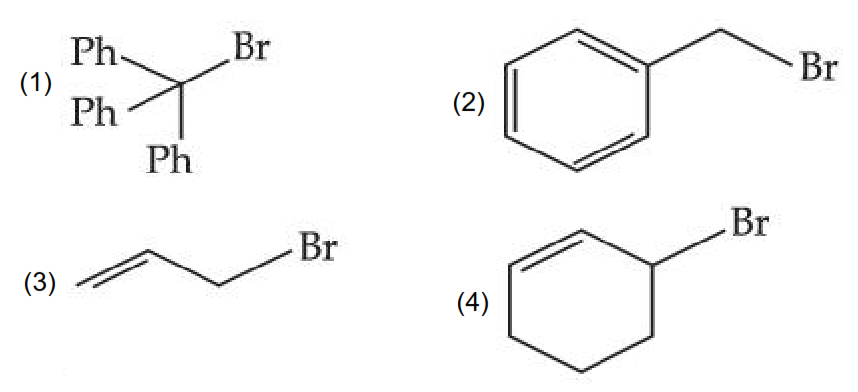
Which among the following halides will generate the most stable carbocation in the nucleophilic substitution reaction? Four bromides: (1) triphenylmethyl bromide, (2) benzyl bromide, (3) but-3-enyl bromide, (4) cyclohex-2-enylmethyl bromide.
Correct option: A. Method: Carbocation stability follows Ph3C+ > PhCH2+ > cyclohex-2-enyl-CH2+ > allyl+. The triphenylmethyl cation (option 1) is the most stable, so triphenylmethyl bromide generates the most stable carbocation.
Q103 Apr 2025, Shift 2
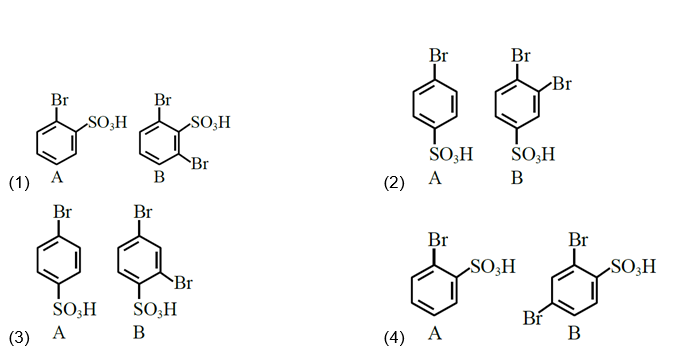
In the following series of reactions identify the major products A & B respectively Bromobenzene is sulfonated with SO3/H2SO4 to give A; A is brominated with Br2/Fe to give B. The four options give pairs of structures (A, B) numbered (1) to (4).
Correct option: B. Method: Sulfonation of bromobenzene gives 4-bromobenzenesulfonic acid (A) as the major product (the para position is favoured). Bromination of A with Br2/Fe puts the second bromine ortho to the sulfonic acid group to give 3,4-dibromobenzenesulfonic acid (B). Both steps are electrophilic substitution.
Q114 Apr 2025, Shift 1
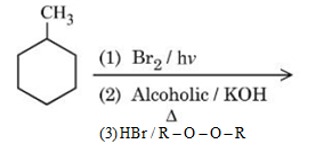
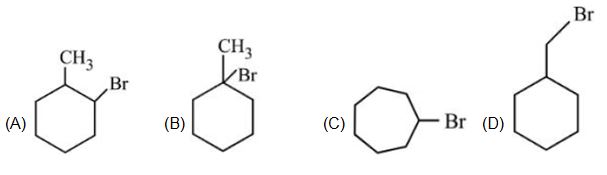
Predict the major product of the following reaction sequence:- Methylcyclohexane is treated with (1) Br2/hv, (2) alcoholic KOH with heat, (3) HBr/R-O-O-R. The four options are: (A) 2-bromo-1-methylcyclohexane, (B) 1-bromo-1-methylcyclohexane, (C) bromocycloheptane, (D) (bromomethyl)cyclohexane.
Correct option: A. Method: Br2/hv brominates methylcyclohexane at the tertiary position to give 1-bromo-1-methylcyclohexane; alcoholic KOH eliminates HBr to give 1-methylcyclohex-1-ene; HBr with peroxide adds by anti-Markovnikov addition (peroxide effect) to give 2-bromo-1-methylcyclohexane, option (A).
Q124 Apr 2025, Shift 2
Given below are two statements : Statement (I) : Alcohols are formed when alkyl chlorides are treated with aqueous potassium hydroxide by elimination reaction. Statement (II) : In alcoholic potassium hydroxide, alkyl chlorides form alkenes by abstracting the hydrogen from the β-carbon. In the light of the above statements, choose the most appropriate answer from the options given below :
Correct option: B. Method: Statement I is incorrect: aqueous KOH converts alkyl chlorides to alcohols by substitution (SN), not elimination. Statement II is correct: alcoholic KOH abstracts a beta-hydrogen to give an alkene by elimination. Statement I is incorrect but Statement II is correct.
Q137 Apr 2025, Shift 1
The reactions which cannot be applied to prepare an alkene by elimination, are. Choose the correct answer from the options given below: Five reactions: (A) 2-bromo-1-methylcyclohexane with NaOEt; (B) 2-bromobutane with aqueous KOH; (C) tert-butyl bromide with NaOMe; (D) phenol with Na2Cr2O7/H2SO4; (E) tert-butyl alcohol with Cu at 573 K.
Correct option: C. Method: A gives an alkene by E2 with NaOEt. B gives an alcohol by SN2 with aqueous KOH, not an alkene. C gives an alkene by E2 with NaOMe. D gives p-benzoquinone on oxidation with Na2Cr2O7/H2SO4, not an alkene. E gives an alkene (isobutene) by dehydration with Cu at 573 K. The reactions that cannot give an alkene are B and D only.
Q148 Apr 2025, Shift 2
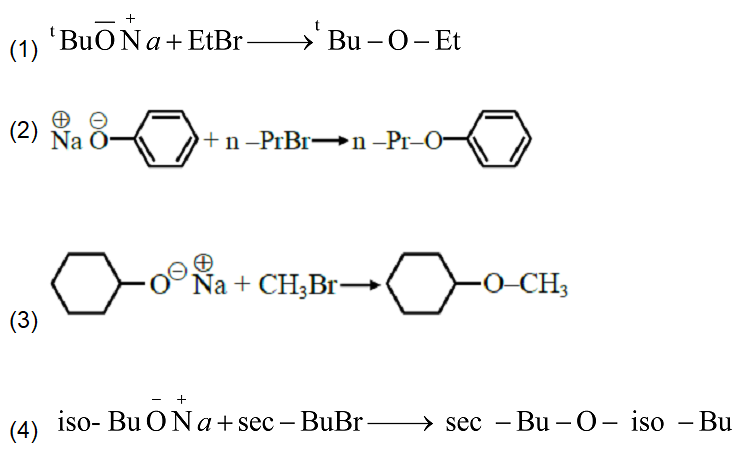
Which one of the following reactions will not lead to the desired ether formation in major proportion? (iso- Bu ⇒ isobutyl, sec -Bu ⇒ sec-butyl, nPr ⇒ n- propyl, tBu ⇒ tert-butyl, Et ⇒ ethyl Four Williamson ether syntheses: (1) t-BuO− Na+ + EtBr gives t-Bu-O-Et; (2) PhO− Na+ + n-PrBr gives n-Pr-O-Ph; (3) cyclohexyl-O− Na+ + CH3Br gives cyclohexyl-O-CH3; (4) iso-BuO− Na+ + sec-BuBr gives sec-Bu-O-iso-Bu.
Correct option: D. Method: Williamson ether synthesis needs an SN2 displacement. In option (4), isobutyl oxide ion with sec-butyl bromide gives elimination (but-2-ene) as the major product instead of the ether, so it will not lead to the desired ether. Options (1), (2) and (3) all give the ether by SN2.
Q158 Apr 2025, Shift 2
Choose the correct set of reagents for the following conversion. Ethylbenzene is converted to p-bromostyrene (4-bromophenyl-CH=CH2).
Correct option: C. Method: Br2/Fe brominates ethylbenzene at the para position; Cl2 with heat chlorinates the benzylic position; alcoholic KOH eliminates HCl to give p-bromostyrene. The reagents are Br2/Fe, Cl2, heat and alc. KOH.
The correct order of the rate of the reaction for the following reaction with respect to nucleophiles is : CH3Br+Nu− → CH3Nu+Br−
Correct option: D. Method: Nucleophilicity is the reverse of anion stability: the more stable the anion, the weaker its nucleophilicity. Anion stability is ClO4− > CH3COO− > PhO− > OH−, so the nucleophilicity order is OH− > PhO− > CH3COO− > ClO4−.
Q221 Jan 2026, Shift 2
The correct order of reactivity of the following benzyl halides towards reaction with KCN is : Four benzyl bromides: (a) p-hydroxybenzyl bromide, (b) p-aminobenzyl bromide, (c) p-nitrobenzyl bromide, (d) m-nitrobenzyl bromide.
Correct option: B. Method: This is an SN1 reaction, so the rate follows carbocation stability. The p-amino group (b) stabilises the benzyl cation most, then p-hydroxy (a); the nitro groups destabilise it, with the meta isomer (d) less destabilising than the para isomer (c). The order is b > a > d > c.
Q322 Jan 2026, Shift 1
As compared with chlorocyclohexane, which of the following statements correctly apply to chlorobenzene? A. The magnitude of negative charge is more on chlorine atom. B. The C-Cl bond has partial double bond character. C. C-Cl bond is less polar. D. C-Cl bond is longer due to repulsion between delocalised electrons of the aromatic ring and lone pairs of electrons of chlorine. E . The C-Cl bond is formed using sp2 hybridised orbital of carbon. Choose the correct answer from the options given below:
Correct option: D. Method: Chlorobenzene is less polar than chlorocyclohexane (C is correct) and its C-Cl bond has partial double bond character (B is correct); the bond is formed using an sp2 hybridised orbital of carbon (E is correct). A is incorrect (the negative charge is not greater on the chlorine of chlorobenzene) and D is incorrect (the C-Cl bond in chlorobenzene is shorter, not longer). B, C and E only.
Q422 Jan 2026, Shift 1
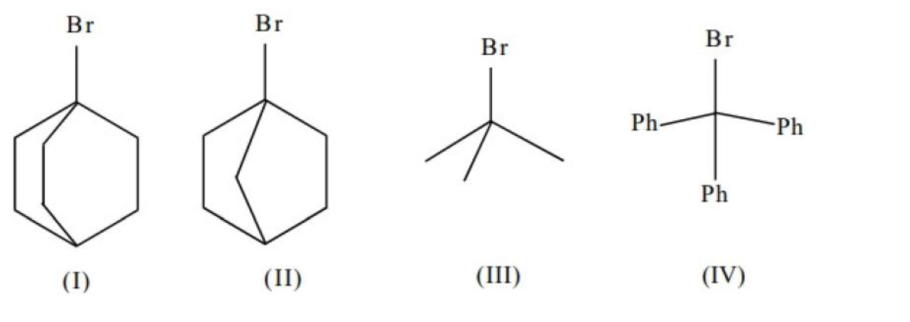
The correct order of the rate of reaction of the following reactants with nucleophile by SN 1 mechanism is : (Given : Structures I and II are rigid) Four bromides: (I) and (II) are bridged bicyclic tertiary bromides, (III) is tert-butyl bromide and (IV) is triphenylmethyl bromide.
Correct option: C. Method: The rate of SN1 follows carbocation stability. (I) and (II) are bridgehead bromides whose carbocations are unstable by Bredt's rule, with (I) more stable than (II) because of a greater +I effect. (III) is tert-butyl bromide and (IV) is triphenylmethyl bromide, whose carbocation is the most stable. The order is (II) < (I) < (III) < (IV).
Q522 Jan 2026, Shift 1
The correct order of reactivity of CH3Br in methanol with the following nucleophiles is F−, I−, C2H5O−and C6H5O−
Correct option: B. Method: In methanol (a polar protic solvent), nucleophilicity follows I− > C2H5O− > C6H5O− > F−.
Q622 Jan 2026, Shift 2
Consider the following reaction : The product Y formed is : 1,2-Dibromopentane is treated with 2NaNH2 to give X; X is then treated with (i) NaNH2 and (ii) isopropyl bromide to give Y.
Correct option: B. Method: 1,2-Dibromopentane with 2NaNH2 undergoes double dehydrohalogenation to give pent-1-yne (X). NaNH2 converts the terminal alkyne to its sodium salt, which displaces bromide from isopropyl bromide by SN2 to give 2-methylhex-3-yne (Y).
Q723 Jan 2026, Shift 1
Consider all the structural isomers with molecular formula C5H11Br are separately treated with KOH(aq) to give respective substitution products, without any rearrangement. The number of products which can exhibit optical isomerism from these is ____ .
Answer: 3. Method: The eight structural isomers of C5H11Br give eight alcohols with aqueous KOH. Three of these alcohols are chiral and can exhibit optical isomerism: pentan-2-ol, 2-methylbutan-1-ol and 3-methylbutan-2-ol. The number is 3.
Q823 Jan 2026, Shift 1
The correct sequence of reagents for the above conversion of X to Y is : X is 1-bromo-1-phenylethane (Ph-CHBr-CH3); it is converted to Y, phenylacetic acid (Ph-CH2-COOH).
Correct option: D. Method: (i) NaOEt eliminates HBr from 1-bromo-1-phenylethane to give styrene. (ii) B2H6/H2O2 (hydroboration-oxidation) converts styrene to 2-phenylethanol. (iii) Jones reagent oxidises the primary alcohol to phenylacetic acid (Y).
Q923 Jan 2026, Shift 2
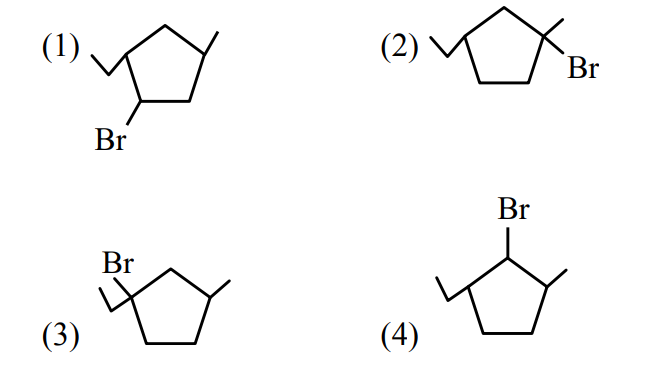
A cyclopentane ring bearing two Br atoms on adjacent carbons, an ethyl group and a methyl group, is treated with (i) Zn, heat and then (ii) HBr to give major product (P). Identify (P). The four options are cyclopentane structures numbered (1) to (4).
Correct option: B. Method: Zn with heat removes both bromine atoms from the vicinal dibromide to give the alkene. HBr adds to the alkene by Markovnikov addition to give a secondary carbocation, which undergoes a 1,2-hydride shift to the more stable tertiary carbocation; attack by Br− gives the tertiary bromide, option (2).
Q1024 Jan 2026, Shift 1
Given below are two statements: Statement I: ' C-Cl′ bond is stronger in CH2=CH-Cl than CH3-CH2-Cl Statement II: The given optically active molecule, hydrolysis gives a solution that can rotate the plane polarized light. In the light of the above statements, choose the correct answer from the options given below Statement II refers to the optically active molecule shown: a carbon bonded to Ph, Cl, a methyl group (hashed wedge) and an ethyl group (solid wedge).
Correct option: D. Method: Statement I is true: the C-Cl bond in vinyl chloride (CH2=CH-Cl) is stronger than in ethyl chloride because of partial double bond character from resonance. Statement II is false: the optically active chloride hydrolyses by SN1 to a racemic mixture, which is optically inactive and cannot rotate plane polarised light. Statement I is true but Statement II is false.
Q112 Apr 2026, Shift 1
Given below are two statements: Statement (I) : Benzyl chloride reacts faster in SN 1 mechanism than ethyl chloride. Statement (II) : Ethyl carbocation intermediate is less stabilized by hyperconjugation than benzyl carbocation by resonance. In the light of the above statements, choose the correct answer from the options given below :
Correct option: A. Method: The rate of SN1 depends on carbocation stability. The benzyl carbocation is stabilised by resonance, while the ethyl carbocation is stabilised only by hyperconjugation, so benzyl chloride reacts faster and the ethyl carbocation is less stabilised than the benzyl carbocation. Both statements are true.
Q122 Apr 2026, Shift 2
Correct statements regarding alkyl halides (R-X) among the following are : A. Alcohol being less polar solvent as compared to water, alcoholic KOH favours elimination reaction with R-X. B. Order of reactivity towards SN1 mechanism is C6H5-CH2-Cl>C6H5-CHCl-C6H5. C. Non substituted aryl halides exhibit properties similar to alkyl halides. D. Vinyl chloride is an example of haloalkene and allyl chloride is an example of haloalkyne. E. R-Cl can be prepared by reacting R-OH with SOCl2 but Ar-Cl cannot be prepared by reacting Ar-OH with SOCl2. Choose the correct answer from the options given below :
Correct option: C. Method: A is correct: alcohol is less polar than water, so alcoholic KOH favours elimination with R-X. B is incorrect: benzhydryl chloride is more reactive than benzyl chloride towards SN1. C is incorrect: aryl halides do not behave like alkyl halides. D is incorrect: both vinyl chloride and allyl chloride are haloalkenes. E is correct: R-OH gives R-Cl with SOCl2, but phenol does not give Ph-Cl with SOCl2. A and E only.
Q134 Apr 2026, Shift 1
Match the LIST-I with LIST-II Choose the correct answer from the options given below: List-I: (A) Finkelstein reaction, (B) Swarts reaction, (C) Sandmeyer's reaction, (D) Fittig reaction. List-II: (I) SbF3, (II) Na, dry ether, (III) NaI, (IV) Cu2Cl2.
Correct option: B. Method: Finkelstein reaction uses NaI in acetone, so A-III. Swarts reaction uses SbF3, so B-I. Sandmeyer reaction uses Cu2Cl2 (CuX), so C-IV. Fittig reaction uses Na in dry ether, so D-II. A-III, B-I, C-IV, D-II.
Q144 Apr 2026, Shift 2
Compound (X) is subjected to the sequence of reactions as shown above. Molar mass of the major product (Y) formed is ____ gmol−1. (Given molar mass in gmol−1 C: 12, H: 1, O: 16 ) Styrene (X) is treated with (i) Br2/CHCl3, (ii) NaNH2 excess, (iii) CH3I and (iv) H2/Na/NH3(l) to give major product (Y).
Correct option: B. Method: Styrene (X) adds Br2 to give 1,2-dibromo-1-phenylethane; excess NaNH2 eliminates both HBr to give phenylacetylene, which is methylated with CH3I to Ph-C≡C-CH3; reduction with H2/Na/NH3(l) gives the cis-alkene Ph-CH=CH-CH3 (Y), C9H10, whose molar mass is 118 g mol-1.
Q154 Apr 2026, Shift 2
Match the LIST-I with LIST-II Choose the correct answer from the options given below: List-I: (A) Williamson Synthesis, (B) Friedel Craft Reaction, (C) Bromination of vinyl benzene, (D) Chlorination of toluene in light. List-II: (I) Electrophilic addition on alkene, (II) Free radical substitution on alkane, (III) Nucleophilic substitution (SN2), (IV) Aromatic Electrophilic substitution.
Correct option: C. Method: Williamson synthesis is nucleophilic substitution (SN2), so A-III. Friedel-Crafts reaction is aromatic electrophilic substitution, so B-IV. Bromination of vinyl benzene is electrophilic addition on the alkene, so C-I. Chlorination of toluene in light is free radical substitution on the alkane side chain, so D-II. A-III, B-IV, C-I, D-II.
Q166 Apr 2026, Shift 1
Given below are two statements: Statement I: 3-phenylpropene reacts with HBr and gives secondary alkyl bromide having a chiral carbon atom as the major product. Statement II: Aryl chlorides and aryl cyanides can be prepared by Sandmeyer reaction as well as Gattermann reaction. In the light of the above statements, choose the correct answer from the options given below
Correct option: C. Method: Statement I is true: 3-phenylpropene reacts with HBr by Markovnikov addition with a hydride shift to give Ph-CHBr-CH2-CH3, a secondary alkyl bromide with a chiral carbon. Statement II is false: aryl cyanides cannot be prepared by the Gattermann reaction (it gives aryl chlorides and bromides; aryl cyanides are made by the Sandmeyer reaction with CuCN). Statement I is true but Statement II is false.
Q178 Apr 2026, Shift 2
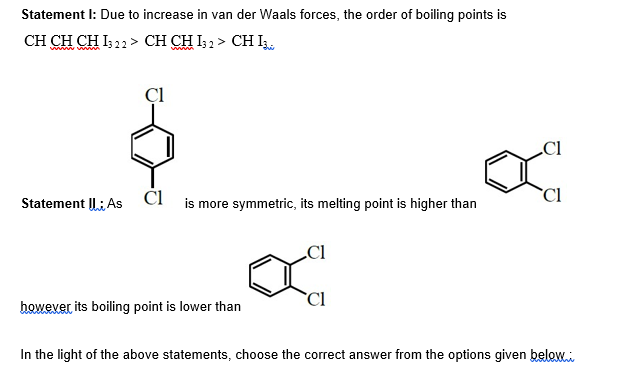
Given below are two statements: Statement I: Due to increase in van der Waals forces, the order of boiling points is CH3CH2CH2I > CH3CH2I > CH3I. Statement II: As p-dichlorobenzene is more symmetric, its melting point is higher than o-dichlorobenzene; however its boiling point is lower than o-dichlorobenzene.
Correct option: A. Method: Statement I is true: the boiling point rises with molecular weight because van der Waals forces increase, so CH3CH2CH2I > CH3CH2I > CH3I. Statement II is true: p-dichlorobenzene is more symmetric, so its melting point is higher than that of o-dichlorobenzene, but its boiling point is lower because o-dichlorobenzene has a dipole moment while p-dichlorobenzene has zero dipole moment. Both statements are true.
Q188 Apr 2026, Shift 2
n -Butane on monochlorination under photochemical condition gives an optically active compound "P". "P" on further chlorination gives dichloro compounds. The number of dichloro compounds obtained (ignore stereoisomers) is :
Correct option: B. Method: Monochlorination of n-butane under photochemical conditions gives 2-chlorobutane (P), the optically active product. Further chlorination of P gives four dichloro compounds, ignoring stereoisomers: 1,2-, 1,3-, 2,2- and 2,3-dichlorobutane.
Pick an option for a multiple choice question, or type your answer for a numerical question and press Check. A correct choice turns green, a wrong choice turns red and the correct option turns green, and the short method appears below. Once answered, a card locks until you press Reset.
How many Haloalkanes questions are in this quiz, and from which years?
52 verified JEE Main Haloalkanes questions: 19 from 2024, 15 from 2025 and 18 from 2026, covering both the January and April sessions, each in shift order.
How should I use this quiz for revision?
Attempt one year timed, without looking at the method. After checking, note every miss by pattern, such as nucleophilic substitution, elimination, or named reactions, and rework that pattern the same day.
Do the questions cover both the January and April sessions?
Yes. The 2026 set covers both the January and April sessions, and the 2024 and 2025 sets cover their January and April sessions too.
Are these real JEE Main questions?
Yes. Every question here is a verified JEE Main Haloalkanes question from 2024, 2025 or 2026, shown with its shift.
Tags
JEE Main 2027Haloalkanes PYQJEE Main ChemistryPYQ AnalysisRepeat FrequencyUPO Unique PYQsHaloalkanesHaloarenesNucleophilic SubstitutionJEE Main Preparation
Hello 👋 Welcome to Competishun – India’s most trusted platform for JEE & NEET preparation. Need help with JEE / NEET courses, fees, batches, test series or free study material? Chat with us now 👇