JEE Main Biomolecules PYQs 2024, 2025 and 2026: All Questions with Solutions
By CompetishunNov 21, 202633 min read
JEE Main Biomolecules PYQs 2024, 2025 and 2026: All Questions with Solutions
Verified JEE Main Biomolecules questions from 2024, 2025 and 2026, shift by shift. The 2024, 2025 and 2026 sets are interactive now: pick an option or enter a number and check instantly. Attempt timed, check the method only after answering, and log every miss by pattern.
Score: 0 correct out of 0 attempted ( interactive questions)
How to use this quiz
1. Attempt one year timed, without looking at the method.
2. Click an option, or type a number and press Check, for instant right or wrong feedback.
3. Read the short method only after answering, then log the miss by pattern.
4. Rework your weak patterns the same day, then reattempt the year.
2024 Questions (14)
Q127 Jan 2024, Shift 1
Two nucleotides are joined together by a linkage known as :
Correct option: A. Method: Two nucleotides are joined by a phosphodiester linkage between the 3-prime carbon of one sugar and the 5-prime carbon of the next. The glycosidic linkage joins the base to the sugar, the peptide linkage joins amino acids, and the disulphide linkage joins cysteine residues. So the phosphodiester linkage.
Q227 Jan 2024, Shift 2
Which structure of protein remains intact after coagulation of egg white on boiling?
Correct option: A. Method: Boiling an egg denatures its proteins: the secondary, tertiary and quaternary structures are lost, but the primary structure (the sequence of amino acids joined by peptide bonds) remains intact. So the primary structure.
Q329 Jan 2024, Shift 1
Number of compounds among the following which contain sulphur as heteroatom is Furan,Thiophene, Pyridine, Pyrrole, Cysteine, Tyrosine
Answer: 2. Method: Sulphur is present in thiophene (sulphur as the ring heteroatom) and in cysteine (sulphur in the thiol side chain). Furan has oxygen, pyridine and pyrrole have nitrogen, and tyrosine has no sulphur. So 2 compounds contain sulphur.
Q429 Jan 2024, Shift 1
Type of amino acids obtained by hydrolysis of proteins is :
Correct option: B. Method: Proteins are natural polymers of alpha-amino acids joined by peptide linkages. On hydrolysis they give alpha-amino acids. So the answer is alpha.
Q529 Jan 2024, Shift 2
Match List I with List II Choose the correct answer from the options given below : List-I (Bio polymer): (A) Starch; (B) Cellulose; (C) Nucleic acid; (D) Protein. List-II (Monomer): (I) nucleotide; (II) alpha-glucose; (III) beta-glucose; (IV) alpha-amino acid.
Correct option: D. Method: Starch is a polymer of alpha-glucose (A-II). Cellulose is a polymer of beta-glucose (B-III). A nucleic acid is a polymer of nucleotides (C-I). A protein is a polymer of alpha-amino acids (D-IV). So A-II, B-III, C-I, D-IV.
Q630 Jan 2024, Shift 1
Sugar which does not give reddish brown precipitate with Fehling's reagent is:
Correct option: A. Method: Sucrose does not contain a free hemiacetal group, so it does not reduce Fehling's reagent. Lactose, glucose and maltose all have a free aldehydic or hemiacetal group and give the reddish brown precipitate of Cu2O. So sucrose.
Q730 Jan 2024, Shift 2
The total number of correct statements, regarding the nucleic acids is _______. A. RNA is regarded as the reserve of genetic information. B. DNA molecule self-duplicates during cell division C. DNA synthesizes proteins in the cell. D. The message for the synthesis of particular proteins is present in DNA E. Identical DNA strands are transferred to daughter cells.
Answer: 3. Method: A is false: RNA is not the reserve of genetic information; DNA is. B is true: the DNA molecule self-duplicates during cell division. C is false: DNA does not synthesise proteins directly; it carries the message for protein synthesis. D is true: the message for the synthesis of particular proteins is present in DNA. E is true: identical DNA strands are transferred to daughter cells. The correct statements are B, D and E, so the total is 3.
Q831 Jan 2024, Shift 2
From the vitamins A, B1, B6, B12, C, D, E and K , the number vitamins that can be stored in our body is
Answer: 5. Method: The fat soluble vitamins A, D, E and K are stored in the body, and vitamin B12, although water soluble, is also stored in the liver. So the vitamins that can be stored are A, D, E, K and B12, a total of 5.
Q91 Feb 2024, Shift 2
The number of tripeptides formed by three different amino acids using each amino acid once is
Answer: 6. Method: Three different amino acids, each used once, can be arranged in 3 × 2 × 1 = 6 orders: ABC, ACB, BAC, BCA, CAB and CBA. So 6 tripeptides are formed.
Q104 Apr 2024, Shift 1
Total number of essential amino acid among the given list of amino acids is ______ Arginine, Phenylalanine, Aspartic acid, Cysteine, Histidine, Valine, Proline
Answer: 4. Method: The essential amino acids in the list are arginine, phenylalanine, histidine and valine. Aspartic acid, cysteine and proline are non-essential amino acids. So the total is 4.
Q115 Apr 2024, Shift 1
Which of the following gives a positive test with ninhydrin?
Correct option: D. Method: The ninhydrin test is a test for amino acids and proteins. Egg albumin is a protein, so it gives a positive ninhydrin test. Cellulose, starch and polyvinyl chloride contain no amino acids, so they do not give the test. So egg albumin.
Q126 Apr 2024, Shift 1
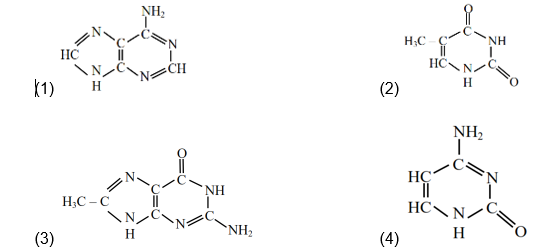
DNA molecule contains 4 bases whoes structure are shown below. One of the structure is not correct, identify the incorrect base structure. Four nitrogenous base structures: (1) adenine, a purine with an NH2 group; (2) thymine, a pyrimidine with two C=O groups and a CH3 group; (3) a purine with a C=O group, an NH2 group and a CH3 group on the ring; (4) cytosine, a pyrimidine with an NH2 group and a C=O group. (1) = A, (2) = B, (3) = C, (4) = D.
Correct option: C. Method: The four DNA bases are adenine, thymine, guanine and cytosine. Structure (3) is drawn as guanine but carries an extra methyl group on the purine ring; guanine has a hydrogen atom at that position, not a methyl group. Structures (1), (2) and (4) are the correct structures of adenine, thymine and cytosine. So the incorrect structure is (3).
Q138 Apr 2024, Shift 1
The incorrect statement regarding the given structure is The structure is D-glucose in Fischer projection: CHO at the top, OH on the right at C2, OH on the left at C3, OH on the right at C4, OH on the right at C5, and CH2OH at the bottom.
Correct option: A. Method: The structure is D-glucose. Bromine water oxidises glucose to gluconic acid, a monocarboxylic acid, not to a dicarboxylic acid (that needs nitric acid), so statement A is incorrect. The other statements are correct: glucose does not give Schiff's test because its aldehyde group is masked in the cyclic hemiacetal form; it has 4 asymmetric carbon atoms; and it co-exists in equilibrium with its two cyclic (alpha and beta) forms. So the incorrect statement is A.
Q149 Apr 2024, Shift 1
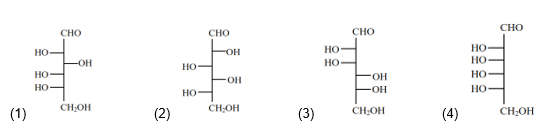
Which of the following is the correct structure of L-Glucose? Four Fischer projections of aldohexoses: (1) C2 OH on the left, C3 OH on the right, C4 OH on the left, C5 OH on the left; (2) C2 OH on the right, C3 OH on the left, C4 OH on the right, C5 OH on the left; (3) C2 OH on the left, C3 OH on the left, C4 OH on the right, C5 OH on the right; (4) C2 OH on the left, C3 OH on the left, C4 OH on the left, C5 OH on the left. (1) = A, (2) = B, (3) = C, (4) = D.
Correct option: A. Method: D-glucose has the OH groups at C2 on the right, C3 on the left, C4 on the right and C5 on the right. L-glucose is its mirror image: C2 OH on the left, C3 OH on the right, C4 OH on the left and C5 OH on the left, which is structure (1). So the correct structure of L-glucose is (1).
Correct option: D. Method: Ascorbic acid is vitamin C. Adipic acid, aspartic acid and saccharic acid are not vitamins. So the acid that is a vitamin is ascorbic acid.
Q223 Jan 2025, Shift 1
Given below are two statements: Statement I: Fructose does not contain an aldehydic group but still reduces Tollen's reagent Statement II: In the presence of base, fructose undergoes rearrangement to give glucose. In the light of the above statements, choose the correct answer from the options given below
Correct option: D. Method: Statement I is true: fructose has no aldehydic group, but in alkaline medium it rearranges through an enediol intermediate to glucose and mannose, which have aldehydic groups, so it reduces Tollen's reagent. Statement II is true: in the presence of base, fructose undergoes rearrangement (Lobry de Bruyn-van Ekenstein rearrangement) to give glucose. Both statements are true.
Q323 Jan 2025, Shift 2
The α-Helix and β-Pleated sheet structures of protein are associated with its :
Correct option: A. Method: The alpha-helix and beta-pleated sheet are the secondary structure of a protein, held together by hydrogen bonds. The primary structure is the sequence of amino acids, the tertiary structure is the overall folding, and the quaternary structure is the arrangement of subunits. So the secondary structure.
Q424 Jan 2025, Shift 1
The carbohydrate "Ribose" present in DNA, is A. A pentose sugar B. present in pyranose from C. in "D" configuration D. a reducing sugar, when free E. in ∝-anomeric form Choose the correct answer from the options given below:
Correct option: D. Method: The sugar in DNA is beta-2-deoxy-D-ribose (the stem calls it ribose). It is a pentose sugar (A is correct), in the D configuration (C is correct) and a reducing sugar when free (D is correct). It is present in the furanose form, not the pyranose form, so B is incorrect, and it is in the beta anomeric form, not the alpha form, so E is incorrect. The correct statements are A, C and D only.
Q528 Jan 2025, Shift 1
Given below are two statements: Statement I : D-glucose pentaacetate reacts with 2, 4-dinitrophenylhydrazine Statement II : Starch, on heating with concentrated sulfuric acid at 1000C and 2-3 atmosphere pressure produces glucose. In the light of the above statements, choose the correct answer from the options given below
Correct option: C. Method: Statement I is false: D-glucose pentaacetate has no free aldehydic group (all five OH groups are acetylated), so it does not react with 2,4-dinitrophenylhydrazine. Statement II is true: starch on heating with concentrated sulphuric acid at 100 degrees C and 2-3 atmosphere pressure gives glucose. Statement I is false but Statement II is true.
Q628 Jan 2025, Shift 2
Identify correct conversion during acidic hydrolysis from the following : (A) starch gives galactose. (B) cane sugar gives equal amount of glucose and fructose. (C) milk sugar gives glucose and galactose. (D) amylopectin gives glucose and fructose. (E) amylose gives only glucose. Choose the correct answer from the options given below :
Correct option: D. Method: A is incorrect: starch on acidic hydrolysis gives glucose, not galactose. B is correct: cane sugar (sucrose) gives equal amounts of glucose and fructose. C is correct: milk sugar (lactose) gives glucose and galactose. D is incorrect: amylopectin on acidic hydrolysis gives glucose only, not glucose and fructose. E is correct: amylose gives only glucose. The correct conversions are B, C and E only.
Q728 Jan 2025, Shift 2
Match List - I with List - II. Choose the correct answer from the options given below : List-I (Saccharides): (A) Sucrose; (B) Maltose; (C) Lactose; (D) Amylopectin. List-II (Glycosidic-linkages found): (I) alpha1-4; (II) alpha1-4 and alpha1-6; (III) alpha1-beta2; (IV) beta1-4.
Correct option: A. Method: Sucrose has an alpha1-beta2 glycosidic linkage (A-III). Maltose has an alpha1-4 linkage (B-I). Lactose has a beta1-4 linkage (C-IV). Amylopectin has alpha1-4 and alpha1-6 linkages (D-II). So A-III, B-I, C-IV, D-II.
Q829 Jan 2025, Shift 1
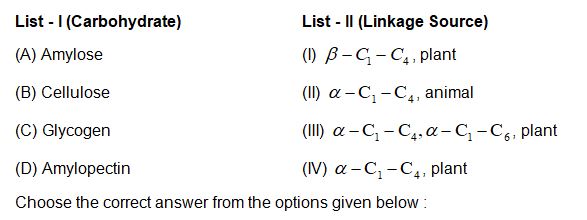
Match List - I with List - II. List-I (Carbohydrate): (A) Amylose; (B) Cellulose; (C) Glycogen; (D) Amylopectin. List-II (Linkage Source): (I) beta-C1−C4, plant; (II) alpha-C1−C4, animal; (III) alpha-C1−C4, alpha-C1−C6, plant; (IV) alpha-C1−C4, plant.
Correct option: D. Method: Amylose has alpha-1,4 linkages and comes from plants (A-IV). Cellulose has beta-1,4 linkages and comes from plants (B-I). Glycogen has alpha-1,4 linkages and comes from animals (C-II). Amylopectin has alpha-1,4 and alpha-1,6 linkages and comes from plants (D-III). So (A)-(IV), (B)-(I), (C)-(II), (D)-(III).
Q929 Jan 2025, Shift 2
Identify the essential amino acids from below : (A) Valine (B) Proline (C) Lysine (D) Threonine (E) Tyrosine Choose the correct answer from the options given below :
Correct option: C. Method: Valine, lysine and threonine are essential amino acids. Proline and tyrosine are non-essential amino acids. So the essential amino acids from the list are (A), (C) and (D) only.
Q102 Apr 2025, Shift 1
Given below are two statements : In the light of the above statements, choose the most appropriate answer from the options given below : Statement (I): Vanillin (4-hydroxy-3-methoxybenzaldehyde) will react with NaOH and also with Tollen's reagent. Statement (II): Vanillin will undergo self aldol condensation very easily.
Correct option: D. Method: Statement I is correct: the phenolic OH group of vanillin reacts with NaOH, and its aldehyde group reacts with Tollen's reagent. Statement II is incorrect: vanillin is an aromatic aldehyde with no alpha-hydrogen, so it cannot undergo self-aldol condensation. Statement I is correct but Statement II is incorrect.
Q112 Apr 2025, Shift 1
Identify the correct statement among the following :
Correct option: C. Method: A is incorrect: glycine is a naturally occurring amino acid and is optically inactive. B is incorrect: isoleucine has two chiral centres, so not every amino acid except glycine has exactly one chiral centre. C is correct: cysteine dimerises easily through its free SH group to form cystine. D is incorrect: aspartic acid also has a COOH group in its side chain. So the correct statement is C.
Q122 Apr 2025, Shift 2
A tetrapeptide, " x " on complete hydrolysis produced glycine (Gly), alanine (Ala), valine (Val), leucine (Leu) in equimolar proportion each. The number of tetrapeptides (sequences) possible involving each of these amino acids is :
Correct option: C. Method: A tetrapeptide made from four different amino acids, each used once, has 4 × 3 × 2 × 1 = 24 possible sequences. So 24 tetrapeptides are possible.
Q133 Apr 2025, Shift 1
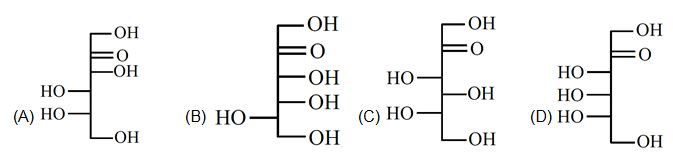
Which of the following is the correct structure of L− Fructose? Four Fischer projections of ketohexoses: (A) C3 OH on the right, C4 OH on the left, C5 OH on the left; (B) C3 OH on the right, C4 OH on the right, C5 OH on the left; (C) C3 OH on the left, C4 OH on the right, C5 OH on the left; (D) C3 OH on the left, C4 OH on the left, C5 OH on the left. (A) = A, (B) = B, (C) = C, (D) = D.
Correct option: A. Method: D-fructose has the OH groups at C3 on the left, C4 on the right and C5 on the right. L-fructose is its mirror image: C3 OH on the right, C4 OH on the left and C5 OH on the left, which is structure (A). So the correct structure of L-fructose is (A).
Q143 Apr 2025, Shift 2
Given below are two statements: Statement I : Wet cotton clothes made of cellulose based carbohydrate takes comparatively longer time to get dried than wet nylon polymer based clothes. Statement II : Intermolecular hydrogen bonding with water molecule is more in nylon-based clothes than in the case of cotton clothes. In the light of above statements, choose the correct answer from the options given below
Correct option: B. Method: Statement I is true: wet cotton clothes take longer to dry because cellulose has many hydroxy groups that form intermolecular hydrogen bonds with water. Statement II is false: the hydrogen bonding with water is more in cotton (cellulose) clothes than in nylon clothes, not the other way round. Statement I is true but Statement II is false.
Q153 Apr 2025, Shift 2
Fat soluble vitamins are: A. Vitamin B1 B. Vitamin C C. Vitamin E D. Vitamin B12 E. Vitamin K Choose the correct answer from the options given below:
Method: The fat soluble vitamins are A, D, E and K. Among the vitamins listed, vitamin E (C) and vitamin K (E) are fat soluble, while vitamin B1 (A), vitamin C (B) and vitamin B12 (D) are water soluble. So the fat soluble vitamins from the list are C and E only. Note: the site key for this question says A (A and B only), but that contradicts the site solution text, which lists vitamins D, E, K and A as fat soluble; the key cannot be confirmed, so no option is marked right or wrong and this card does not change the score.
Q164 Apr 2025, Shift 1
The total number of hydrogen bonds of a DNA-double Helix strand whose one strand has the following sequence of bases is ___________ 5′ G - G - C - A - A - A - T - C - G - G - C - T - A - 3′
Answer: 33. Method: Adenine pairs with thymine through 2 hydrogen bonds and guanine pairs with cytosine through 3 hydrogen bonds. The given strand 5-prime-G-G-C-A-A-A-T-C-G-G-C-T-A-3-prime has 7 G or C bases and 6 A or T bases. The total number of hydrogen bonds is 7 × 3 + 6 × 2 = 21 + 12 = 33.
Q174 Apr 2025, Shift 1
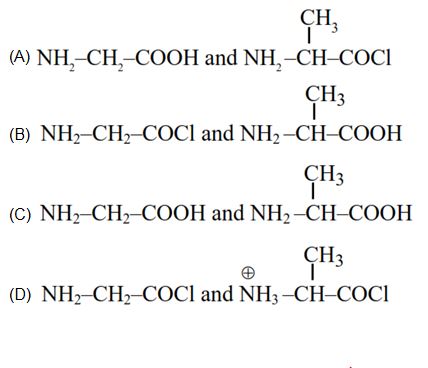
Identify the pair of reactants that upon reaction, with elimination of HCl will give rise to the dipeptide Gly-Ala. Four pairs of reactants: (A) NH2-CH2-COOH and NH2-CH(CH3)-COCl; (B) NH2-CH2-COCl and NH2-CH(CH3)-COOH; (C) NH2-CH2-COOH and NH2-CH(CH3)-COOH; (D) NH2-CH2-COCl and NH3+-CH(CH3)-COCl. (A) = A, (B) = B, (C) = C, (D) = D.
Correct option: B. Method: Gly-Ala is NH2-CH2-CO-NH-CH(CH3)-COOH. It is formed when the acid chloride of glycine, NH2-CH2-COCl, reacts with the amino group of alanine, NH2-CH(CH3)-COOH, with elimination of HCl. That pair is (B). In pair (A) the acid chloride is on alanine, which would give Ala-Gly instead.
Q184 Apr 2025, Shift 2
A dipeptide, " x " on complete hydrolysis gives " y " and " z ". " y " on treatment with aq. HNO2 produces lactic acid. On the other hand " z " on heating gives the following cyclic molecule. Based on the information given, the dipeptide X is : The cyclic molecule formed on heating (z) is a six-membered diketopiperazine ring: two C=O groups, two NH groups and two CH2 groups (2,5-piperazinedione).
Correct option: B. Method: On hydrolysis the dipeptide gives y and z. y gives lactic acid with aqueous HNO2, so y is alanine (alanine is converted to lactic acid by diazotisation). z on heating gives the cyclic diketopiperazine (glycine anhydride), so z is glycine. The dipeptide is therefore alanine-glycine.
Q197 Apr 2025, Shift 1
Given below are two statements: Statement I: D-(+)-glucose + D-(+) fructose -H2O → Sucrose sucrose hydrolysis → D-(+) glucose +D-(+) fructose Statement II: Invert sugar is formed during sucrose hydrolysis In the light of the above statements, choose the correct answer from the options given below
Correct option: D. Method: Statement I is false: hydrolysis of sucrose gives D-(+)-glucose and D-(-)-fructose, but statement I writes D-(+)-fructose, which is wrong; fructose is laevorotatory. Statement II is true: invert sugar is formed during the hydrolysis of sucrose. Statement I is false but Statement II is true.
Q207 Apr 2025, Shift 2
Given below are two statements : Statement (I) : On hydrolysis, oligo peptides give rise to fewer number of β-amino acids while proteins give rise to a large number of β-amino acids. Statement (II) : Natural proteins are denatured by acids which convert the water soluble form of fibrous proteins to their water insoluble form. In the light of the above statements, choose the most appropriate answer from the options given below :
Correct option: D. Method: Statement I is incorrect: proteins on hydrolysis give alpha-amino acids, not beta-amino acids, so oligopeptides and proteins do not give beta-amino acids. Statement II is incorrect: fibrous proteins are already water insoluble, so acids do not convert a water soluble form of fibrous proteins into a water insoluble form. Both statements are incorrect.
Identify the correct statements. A. Arginine and Tryptophan are essential amino acids. B. Histidine does not contain heterocyclic ring in its structure. C. Proline is a six membered cyclic ring amino acid. D. Glycine does not have chiral centre. E. Cysteine has characteristic feature of side chain as MeS-CH2-CH2-. Choose the correct answer from the options given below:
Correct option: D. Method: A is correct: arginine and tryptophan are both essential amino acids. B is incorrect: histidine contains a heterocyclic imidazole ring. C is incorrect: proline is a five-membered cyclic amino acid, not six-membered. D is correct: glycine has two hydrogen atoms on its alpha carbon, so it has no chiral centre. E is incorrect: the cysteine side chain is CH2-SH; CH2-SMe is the methionine side chain. The correct statements are A and D only.
Q221 Jan 2026, Shift 2
The correct statements are: A. Activation energy for enzyme catalysed hydrolysis of sucrose is lower than that of acid catalysed hydrolysis. B. During denaturation, secondary and tertiary structures of a protein are destroyed but primary structure remains intact. C. Nucleotides are joined together by glyosidic linkage between C1 and C4 carbons of the pentose sugar. D. Quaternary structure of proteins represents overall folding of the polypeptide chain. Choose the correct answer from the options given below:
Correct option: C. Method: A is correct: an enzyme lowers the activation energy, so enzyme-catalysed hydrolysis of sucrose has a lower activation energy than acid-catalysed hydrolysis. B is correct: denaturation destroys the secondary and tertiary structures but the primary structure stays intact. C is incorrect: nucleotides are joined by phosphodiester linkages, not glycosidic linkages; the glycosidic linkage joins the base to the pentose sugar. D is incorrect: the quaternary structure is the arrangement of two or more polypeptide subunits; the overall folding of a single chain is the tertiary structure. The correct statements are A and B only.
Q322 Jan 2026, Shift 1
Given below are two statements: Statement I: Sucrose is dextrorotatory. However, sucrose upon hydrolysis gives a solution having mixture of products. This solution shows laevorotation. Statement II: Hydrolysis of sucrose gives glucose and fructose. Since the laevorotation of glucose is more than the dextrorotation of fructose, the resulting solution becomes laevorotatory. In the light of the above statements, choose the correct answer from the options given below
Correct option: D. Method: Statement I is true: sucrose has a specific rotation of +66.5 degrees, so it is dextrorotatory, and on hydrolysis it gives glucose (+52.5 degrees) and fructose (-92.4 degrees), whose mixture is laevorotatory. Statement II is false: it is the laevorotation of fructose that outweighs the dextrorotation of glucose, not the other way round; glucose is dextrorotatory and fructose is laevorotatory. Statement I is true but Statement II is false.
Q422 Jan 2026, Shift 2
Match List - I with List - II. Choose the correct answer from the options given below : List-I (Reaction of glucose with): (A) Hydroxylamine; (B) Br2 water; (C) Excess acetic anhydride; (D) Concentrated HNO3. List-II (Product formed): (I) Gluconic acid; (II) Glucose pentaacetate; (III) Saccharic acid; (IV) Glucooxime.
Correct option: D. Method: Glucose reacts with hydroxylamine to give glucoxime (A-IV); with bromine water it is oxidised to gluconic acid (B-I); with excess acetic anhydride it gives glucose pentaacetate (C-II); with concentrated nitric acid it is oxidised to saccharic acid (D-III). So A-IV, B-I, C-II, D-III.
Q523 Jan 2026, Shift 1
From the given following (A to D) cyclic structures, those which will not react with Tollen's reagent are : Four cyclic structures: (A) a pyranose with a free anomeric OH group; (B) a pyranose with an OCH3 group at the anomeric carbon; (C) a furanose with an OCH3 group at the anomeric carbon; (D) a pyranose with a free anomeric OH group.
Correct option: D. Method: A compound reacts with Tollen's reagent only if it has a free anomeric OH group, that is, a free hemiacetal group that can open to the aldehyde form. (B) and (C) are acetals (methyl glycosides) with no free anomeric OH group, so they do not react with Tollen's reagent. (A) and (D) have a free anomeric OH group and do react. So B and C only.
Q623 Jan 2026, Shift 2
Both human DNA and RNA are chiral molecules. The chirality in DNA and RNA arises due to the presence of
Correct option: C. Method: DNA and RNA are chiral because of the D-sugar component: 2-deoxy-D-ribose in DNA and D-ribose in RNA. The sugar is the chiral unit; the phosphate group and the bases are not the source of the chirality. So the D-sugar component.
Q724 Jan 2026, Shift 2
The number of possible tripeptides formed involving alanine (ala), glycine (gly) and valine (val), where no amino acid has been used more than once is:
Correct option: A. Method: Three different amino acids, each used once, can be arranged in 3 × 2 × 1 = 6 orders: Gly-Ala-Val, Gly-Val-Ala, Val-Gly-Ala, Val-Ala-Gly, Ala-Val-Gly and Ala-Gly-Val. So 6 tripeptides are possible.
Q828 Jan 2026, Shift 1
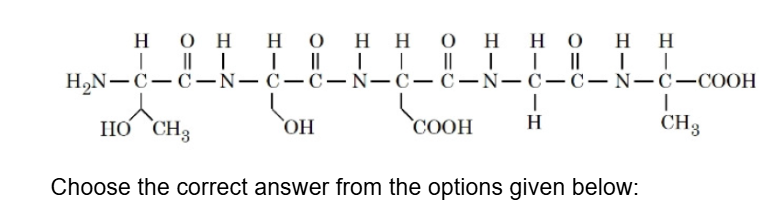
In the given pentapeptide, find out an essential amino acid (Y) and the sequence present in the pentapeptide: The pentapeptide is H2N-CH(CH(OH)CH3)-CO-NH-CH(CH2OH)-CO-NH-CH(CH2COOH)-CO-NH-CH2-CO-NH-CH(CH3)-COOH. The four options are: (1) Y = Threonine, sequence Ser-Thr-Asp-Gly-Ala; (2) Y = Serine, sequence Thr-Ser-Asp-Ala-Gly; (3) Y = Threonine, sequence Thr-Ser-Asp-Gly-Ala; (4) Y = Serine, sequence Ser-Asp-Thr-Ala-Gly. (1) = A, (2) = B, (3) = C, (4) = D.
Correct option: C. Method: Reading the pentapeptide from the N-terminal end, the residues are threonine (side chain CH(OH)CH3), serine (side chain CH2OH), aspartic acid (side chain CH2COOH), glycine (side chain H) and alanine (side chain CH3). The sequence is Thr-Ser-Asp-Gly-Ala. Of these, only threonine is an essential amino acid; serine, aspartic acid, glycine and alanine are non-essential. So Y is threonine and the sequence is Thr-Ser-Asp-Gly-Ala.
Q94 Apr 2026, Shift 1
Match the LIST-I with LIST-II Choose the correct answer from the options given below: List-I (Name of amino acid): (A) Arginine; (B) Aspartic acid; (C) Lysine; (D) Glutamic acid. List-II (One letter symbol): (I) D/Non-essential; (II) R/Essential; (III) E/Non-essential; (IV) K/Essential.
Correct option: A. Method: Arginine has the one-letter symbol R and is an essential amino acid (A-II). Aspartic acid has the symbol D and is non-essential (B-I). Lysine has the symbol K and is essential (C-IV). Glutamic acid has the symbol E and is non-essential (D-III). So A-II, B-I, C-IV, D-III.
Q104 Apr 2026, Shift 1
Given below are two statements: In the light of the above statements, choose the correct answer from the options given below Statement I: the structure of maltose is shown (two glucose units joined by an alpha-1,4 glycosidic linkage) and maltose is called a non reducing sugar. Statement II: the structure of lactose is shown (galactose and glucose units joined by a beta-1,4 glycosidic linkage) and lactose is called a reducing sugar.
Correct option: D. Method: Statement I is false: maltose has a free hemiacetal group on its second glucose unit, so it is a reducing sugar. Statement II is true: lactose also has a free hemiacetal group, so it is a reducing sugar. Statement I is false but Statement II is true.
Q114 Apr 2026, Shift 2
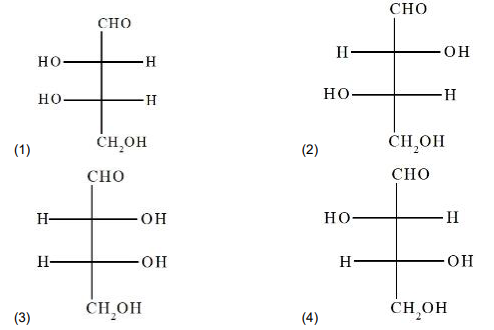
A D-aldotetrose on oxidation with concentrated HNO3 resulted in optically inactive dicarboxylic acid. The structure of the D -aldotetrose is: Four Fischer projections of aldotetroses: (1) C2 OH on the left, C3 OH on the left; (2) C2 OH on the right, C3 OH on the left; (3) C2 OH on the right, C3 OH on the right; (4) C2 OH on the left, C3 OH on the right. (1) = A, (2) = B, (3) = C, (4) = D.
Correct option: C. Method: The D-aldotetroses are D-erythrose (C2 OH right, C3 OH right) and D-threose (C2 OH right, C3 OH left). Oxidation with concentrated nitric acid converts both ends to COOH groups, giving tartaric acid. D-erythrose gives meso-tartaric acid, which is optically inactive; D-threose gives the chiral tartaric acid, which is optically active. The structure with C2 OH right and C3 OH right is D-erythrose, which is list (3).
Q125 Apr 2026, Shift 1
Identify the correct statements. A. Glucose exists in two anomeric forms. B. Anomers of glucose differ in configuration at C-1 in cyclic hemiacetal structure. C. Melting point of α-anomer of glucose is greater than β-anomer. D. Specific rotation of α-anomer is +19° while for β-anomer is +112° E. α and β-anomers of glucose are prepared by crystallization of saturated glucose solution at 303 K and 371 K respectively. Choose the correct answer from the options given below:
Correct option: D. Method: A is correct: glucose exists as alpha and beta anomers. B is correct: the anomers differ in configuration at C-1 of the cyclic hemiacetal. C is incorrect: the melting point of the alpha anomer (419 K) is lower than that of the beta anomer (423 K). D is incorrect: the specific rotation of the alpha anomer is +112 degrees and of the beta anomer is +19 degrees, the reverse of what is stated. E is correct: the alpha anomer crystallises from a saturated glucose solution at 303 K and the beta anomer at 371 K. The correct statements are A, B and E only.
Q135 Apr 2026, Shift 2
Given below are two statements : In the light of the above statements, choose the correct answer from the options given below : Statement I: two Haworth structures (alpha-D-glucopyranose and beta-D-glucopyranose) are two anomers of D-(+)-glucose. Statement II: The open chain forms of D-glucose and D-fructose contain three similar chiral carbons at C3, C4 and C5.
Correct option: A. Method: Statement I is true: the two structures differ only in the configuration at C-1, so they are the anomers of D-glucose. Statement II is true: the open-chain forms of D-glucose and D-fructose have identical configurations at C3, C4 and C5. Both statements are true.
Q145 Apr 2026, Shift 2
Identify the incorrect statement about tertiary structure of proteins.
Correct option: C. Method: The tertiary structure is disrupted by changes in pH, so statement C is incorrect. The other statements are correct: tertiary structures can be fibrous or globular; the structure is stabilised by hydrogen bonding, disulphide links, van der Waals forces and electrostatic forces; and a linear polypeptide folds first into a secondary structure and then into a tertiary structure. So the incorrect statement is C.
Q156 Apr 2026, Shift 1
Match the LIST-I with LIST-II Choose the correct answer from the options given below: List-I (Deficiency Disease): (A) Scurvy; (B) Convulsions; (C) Cheilosis; (D) Xerophthalmia. List-II (Vitamin): (I) Pyridoxine; (II) Vitamin A; (III) Ascorbic Acid; (IV) Riboflavin.
Correct option: C. Method: Scurvy is caused by the deficiency of ascorbic acid, vitamin C (A-III). Convulsions are caused by the deficiency of pyridoxine, vitamin B6 (B-I). Cheilosis is caused by the deficiency of riboflavin, vitamin B2 (C-IV). Xerophthalmia is caused by the deficiency of vitamin A (D-II). So A-III, B-I, C-IV, D-II.
Q166 Apr 2026, Shift 2
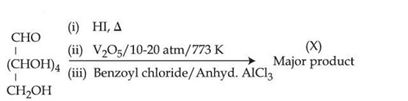
Consider the following reactions. Total number of electrons in the π bonds and lone pair of electrons in the product (X) is : Glucose, CHO-(CHOH)4-CH2OH, is treated (i) with HI and heat, (ii) with V2O5 at 10-20 atm and 773 K, (iii) with benzoyl chloride and anhydrous AlCl3, to give the major product (X).
Correct option: D. Method: Glucose is reduced by HI and heat to n-hexane. n-Hexane is aromatised by V2O5 at 773 K to benzene. Benzene reacts with benzoyl chloride in the presence of anhydrous AlCl3 (Friedel-Crafts acylation) to give benzophenone, C6H5-CO-C6H5. Benzophenone has 14 pi electrons (6 in each benzene ring and 2 in the C=O bond) and 4 lone-pair electrons on the carbonyl oxygen (two lone pairs). The total is 14 + 4 = 18.
Q178 Apr 2026, Shift 2
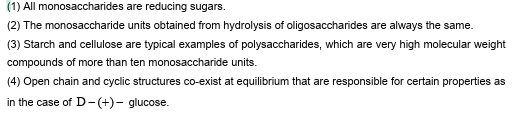
The incorrect statement from the following with respect to carbohydrates is : Four statements: (1) All monosaccharides are reducing sugars. (2) The monosaccharide units obtained from hydrolysis of oligosaccharides are always the same. (3) Starch and cellulose are typical examples of polysaccharides, which are very high molecular weight compounds of more than ten monosaccharide units. (4) Open chain and cyclic structures co-exist at equilibrium that are responsible for certain properties as in the case of D-(+)-glucose. (1) = A, (2) = B, (3) = C, (4) = D.
Correct option: B. Method: Statement (2) is incorrect: the monosaccharide units from the hydrolysis of an oligosaccharide may or may not be the same; lactose gives glucose and galactose (different units), while maltose gives two glucose units (same units). The other statements are correct: all monosaccharides are reducing sugars; starch and cellulose are high molecular weight polysaccharides; and the open-chain and cyclic forms of D-glucose co-exist at equilibrium. So the incorrect statement is (2).
Pick an option for a multiple choice question, or type your answer for a numerical question and press Check. A correct choice turns green, a wrong choice turns red and the correct option turns green, and the short method appears below. Once answered, a card locks until you press Reset.
How many Biomolecules questions are in this quiz, and from which years?
51 verified JEE Main Biomolecules questions: 14 from 2024, 20 from 2025 and 17 from 2026, each in shift order, covering both the January and April sessions, each in shift order.
How should I use this quiz for revision?
Attempt one year timed, without looking at the method. After checking, note every miss by pattern, such as carbohydrates, proteins, or nucleic acids, and rework that pattern the same day.
Why does one question show options without a right or wrong mark?
One question has an answer key that is not confirmed from the site, so its card shows the options and the method without marking any option right or wrong, and it does not change the score.
Are these real JEE Main questions?
Yes. Every question here is a verified JEE Main Biomolecules question from 2024, 2025 or 2026, shown with its shift.
Tags
JEE Main 2027Biomolecules PYQJEE Main ChemistryPYQ AnalysisRepeat FrequencyUPO Unique PYQsBiomoleculesCarbohydratesProteinsJEE Main Preparation
Hello 👋 Welcome to Competishun – India’s most trusted platform for JEE & NEET preparation. Need help with JEE / NEET courses, fees, batches, test series or free study material? Chat with us now 👇