How Many PYQs Should You Solve Daily for JEE Main 2027?
JEE Main PYQs · Competishun
How Many PYQs Should You Solve Per Chapter for JEE Main 2027?
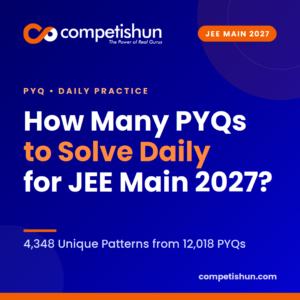
There is no fixed number of PYQs per chapter. The right number is the chapter unique patterns, not its raw question count. From 2019 to 2026, JEE Main Paper 1 asked 12,018 questions, but only 4,348 are unique patterns. Solve those unique patterns per chapter, in Repeat Frequency order, highest first, and keep the repeats for timed practice.
Ask ten JEE Main aspirants how many PYQs to solve per chapter and you will get ten different numbers. Fifty, a hundred, every question in the book. The numbers sound confident, but none of them answers the real question, which is how much new work a chapter actually holds.
The confusion comes from counting questions instead of patterns. A chapter with 200 questions in the book may hold only 80 genuinely different ideas, with the rest repeating those ideas in new numbers. Counting questions makes the chapter look two and a half times bigger than it is.
The UPO classification gives the real scale. From 2019 to 2026, Paper 1 asked 12,018 questions, sorting down to 4,348 unique patterns, about 36 percent. The other 7,670 are repeats. That is the whole pool: 4,348 patterns to learn, with the repeats available for speed practice once a pattern is understood.
This guide answers the per chapter question properly. It shows why a fixed number misleads, what Repeat Frequency is, how the 17 verified chapter counts from 2024 to 2026 should be read, and a three step method you can apply to any chapter, with Electrostatics worked out in full as the example.
One warning before the numbers. The chapter counts in this guide are questions asked in 2024, 2025 and 2026, not unique patterns. They show where recent papers asked the most, which is a workload signal, not a target to copy. Keep that distinction in mind in every section below.
In this guide
Why "How Many PYQs Per Chapter" Is the Wrong Question
A fixed number per chapter sounds fair. Thirty questions for every chapter, a hundred for every chapter, the same target from Vectors to Wave Optics. Fair is not the same as useful, because chapters do not hold the same amount of new work.
Look at the verified counts from 2024 to 2026. Vector Algebra asked 169 questions in three years, while Wave Optics asked 51. That is more than three times as many, 169 against 51. A single target for both chapters would overload one and starve the other.
The gap is wider than the raw counts suggest, because raw counts mix new patterns with repeats. Two chapters can ask the same number of questions and hold very different numbers of unique patterns. The count you see in a book is the size of the pile, not the size of the learning.
- A fixed number: ignores that chapters differ in unique patterns, so it sets the same target for very different workloads.
- A fixed number: rewards finishing the count, not mastering the patterns, so repeats feel like progress.
- A fixed number: hides weak chapters, because a chapter can hit its count while its rare patterns stay untouched.
Per Chapter Means Unique Patterns, Not Raw Question Counts
From 2019 to 2026, Paper 1 asked 12,018 questions. The UPO classification sorts them into 4,348 unique patterns and 7,670 repeats. A unique pattern is one representative question per cluster. A repeat is the same pattern with new numbers, a new function, or a small twist.
| Subject | Total PYQs (2019 to 2026) | Unique | Repeats | Unique Share |
|---|---|---|---|---|
| Physics | 4,369 | 1,527 | 2,842 | 35% |
| Chemistry | 3,781 | 1,242 | 2,539 | 33% |
| Mathematics | 3,868 | 1,579 | 2,289 | 41% |
| Total (PCM) | 12,018 | 4,348 | 7,670 | 36% |
| Full classification, JEE Main Paper 1, 2019 to 2026. | ||||
Swipe the table sideways to see all columns
Unique patterns against repeats, JEE Main Paper 1, 2019 to 2026. Maths holds the most unique patterns, Chemistry the fewest.
The split differs by subject. Chemistry compresses fastest, with only about 33 percent unique patterns. Physics sits at about 35 percent. Maths is the widest pool at about 41 percent, so it keeps producing new models longer than the other two.
Read the table as a workload guide. For every 100 questions in the pool, about 36 teach a new pattern and about 64 repeat one. A chapter whose questions mostly repeat is finished faster than its raw count suggests, while a chapter with many unique patterns needs more fresh solving.
Repeat Frequency: The Order That Decides What to Solve First Per Chapter
Unique patterns are not all equal. Some have come back year after year with new numbers. Others appeared once and never returned. Treating them the same way gives the rarest pattern the same time as the most examined one, which is poor use of limited weeks.
Repeat Frequency, or RF, is how often a pattern has come back across the 2019 to 2026 pool, listed highest to lowest. It is the practice order. High RF patterns are the ones the exam keeps rewarding, so they deserve mastery first and revision first.
- High RF first: start each chapter with its most repeated patterns, and revise them before rare ones.
- Middle RF next: work these after the frequent ones are automatic, with the same error log discipline.
- Low RF last: rare patterns still matter, but they come after the frequent ones, never before them.
The Workload Signal: 17 Chapters Asked 1,344 Questions in 2024 to 2026
The verified counts below show how many questions each of 17 chapters asked in JEE Main 2024, 2025 and 2026, a total of 1,344 questions. Read them as a workload signal: they show where recent papers asked the most, so you can see which chapters carry the heaviest recent load.
Say the distinction plainly once more. These are questions asked, not unique patterns. A chapter with 169 questions asked did not necessarily hold 169 unique patterns. The table measures recent exam attention, and it is the best verified signal available for planning chapter order.
| Chapter | Questions asked, 2024 to 2026 | Subject |
|---|---|---|
| Vector Algebra | 169 | Mathematics |
| Integral Calculus | 153 | Mathematics |
| Modern Physics | 99 | Physics |
| Matrices and Determinants | 89 | Mathematics |
| Geometrical Optics | 85 | Physics |
| Electrostatics | 77 | Physics |
| Differential Calculus | 77 | Mathematics |
| GOC | 66 | Chemistry |
| Chemical Bonding | 65 | Chemistry |
| Differential Equations | 63 | Mathematics |
| Mole Concept | 62 | Chemistry |
| Amines | 61 | Chemistry |
| Current Electricity | 61 | Physics |
| Probability | 58 | Mathematics |
| Complex Numbers | 55 | Mathematics |
| Hydrocarbons | 53 | Chemistry |
| Wave Optics | 51 | Physics |
| Verified counts from the site chapter question bank, JEE Main 2024 to 2026. Counts are questions asked, not unique patterns. 17 chapters, 1,344 questions in total. | ||
Swipe the table sideways to see all columns
Questions asked per chapter, JEE Main 2024 to 2026, top eight chapters. Vector Algebra leads with 169, Wave Optics is lowest of the 17 with 51.
The top two chapters alone, Vector Algebra with 169 and Integral Calculus with 153, asked 322 questions between them, about 24 percent of the 1,344. The top five chapters asked 595, about 44 percent. Recent papers concentrate heavily, and the concentration is the planning signal.
The range matters too. The busiest chapter asked 169 questions and the quietest of the 17 asked 51, a gap of about 3.3 times. The average across the 17 chapters is about 79 questions asked. A chapter near the top of this table deserves an earlier slot in the plan and more sessions, not a bigger raw target.
Worked Example: Electrostatics, 223 Questions Down to About 80 Patterns
Electrostatics is the one chapter with a verified unique count, so it is the worked example for this whole guide. From 2019 to 2026 it asked about 223 raw questions, which cluster down to about 80 unique patterns. That is a ratio of about 2.8 to 1, raw questions to unique patterns.
The recent counts fit the same picture. Electrostatics asked 77 questions in 2024 to 2026, about one third of its eight year raw count of about 223. Recent attention is strong, which is why the chapter deserves an early slot, but the work itself is still the 80 patterns, not the 223 questions.
How the 80 patterns are worked
First, solve the 80 unique patterns in Repeat Frequency order, highest first, untimed, with solutions open for study. Name each pattern in one line after solving it, so the pattern, not the answer, is what gets remembered.
Second, take the cluster repeats of the patterns you missed or solved slowly, and solve those timed. The repeats are speed practice now, not new learning, and they belong in a timed set, not in the first pass.
Third, log every miss with its pattern name and error type, and re-solve the logged misses seven days later, timed, without peeking at the solution first. A pattern that survives a week is owned. One that fails again goes back into its cluster.
That last line matters. No other chapter in this guide carries a verified unique count, so this guide gives none. A blog or book that quotes a unique count for another chapter without showing its classification is guessing, and a plan built on a guessed number is worse than no number at all.
The Per-Chapter Method: Unique First, Repeats Timed, Error Log Always
The method has three steps, and they run in the same order for every chapter. Unique patterns first, cluster repeats timed second, and the error log running through both. Skip a step and the chapter takes longer for less learning.
| Step | What to do | When it is done |
|---|---|---|
| 1. Unique first | Solve the chapter unique patterns in Repeat Frequency order, highest first, untimed, with solutions open | Every pattern met once and named in one line |
| 2. Repeats timed | Solve cluster repeats only for patterns missed or solved slowly, in timed sets | Misses and slow patterns are fast and accurate |
| 3. Error log | Log every miss with pattern name and error type, then re-solve logged misses after seven days, timed | Logged misses pass the seven day re-solve |
| The same three steps for every chapter, in the same order. | ||
Swipe the table sideways to see all columns
Step three is the memory step. An error log with one line per miss, chapter, pattern, and type, turns wrong answers into a revision list. Re-solve every logged miss seven days later, timed, without the solution open. A miss without a type is a miss you will repeat.
- Concept gap: the idea was missing, so relearn the theory, then re-solve the pattern slowly before timing it.
- Calculation slip: the idea was right and the execution slipped, so drill the pattern timed in its cluster until the slip disappears.
How to Set Your Own Per-Chapter Target Without Guessing
Without a verified unique count for a chapter, the honest target is a process target, not a number target. Set the target as finishing the chapter unique patterns in Repeat Frequency order, with the error log clean, instead of naming a question count to hit.
Use the 17 chapter table to decide order and sessions. A chapter near the top, like Vector Algebra with 169 questions asked, starts earlier and gets more weekly sessions than a chapter near the bottom, like Wave Optics with 51. The table sets priority, never the question count.
Use subject split the same way. Maths holds about 41 percent unique patterns, the widest pool of the three subjects, so its chapters keep producing new models longer. Chemistry compresses fastest at about 33 percent, so its chapters finish sooner once the patterns are met.
- Start order: heavy chapters first, by questions asked in 2024 to 2026, with the most recent chapter you learnt slotted in alongside.
- Session count: more sessions for heavy chapters, fewer for light ones, decided by the table, not by a guessed number.
- Stop rule: stop a chapter when its patterns are named and its logged misses pass, not when a count is reached.
Heavy Chapters Need More Sessions, Not More Questions
Split the 1,344 questions asked across the 17 chapters by subject and the load is clear. Maths chapters asked 664, Physics chapters asked 373, and Chemistry chapters asked 307. Maths alone asked about half of the 1,344, so its chapters deserve the earliest slots and the most sessions.
Maths also holds the widest unique pool, about 41 percent, against about 35 percent for Physics and about 33 percent for Chemistry. Heavy recent load plus the widest pool means Maths chapters need the most fresh solving time, and the least of that time should go to repeats.
| Subject | Chapters in the 17 | Questions asked, 2024 to 2026 | Share of 1,344 |
|---|---|---|---|
| Mathematics | 7 | 664 | about 49% |
| Physics | 5 | 373 | about 28% |
| Chemistry | 5 | 307 | about 23% |
| Total | 17 | 1,344 | 100% |
| Subject split of the 17 verified chapters, questions asked in JEE Main 2024 to 2026, not unique patterns. | |||
Swipe the table sideways to see all columns
Physics sits in the middle on both measures, with 373 questions asked and about 35 percent unique patterns. Its heavy chapters, Modern Physics with 99 and Geometrical Optics with 85, still deserve early slots, and Electrostatics has the worked method above to follow exactly.
A Weekly Per-Chapter Plan You Can Start Today
You do not need a new timetable to use this method. One chapter block per week, worked in the three steps, is enough to build the habit. Pick the chapter you are learning now, or the heaviest unfinished one, and start with its unique patterns.
| Day | Per-chapter work | Step it builds |
|---|---|---|
| Monday | List the chapter unique patterns in Repeat Frequency order, highest first | Step 1 |
| Tuesday | Solve high RF patterns untimed, naming each pattern in one line | Step 1 |
| Wednesday | Solve middle and low RF patterns, reading the solution for every miss | Step 1 |
| Thursday | Timed cluster repeats for missed and slow patterns only | Step 2 |
| Friday | Sort the error log by type and relearn the concept gaps | Step 3 |
| Saturday | Timed re-solve of the week logged misses without peeking at solutions | Step 3 |
| Sunday | Review the chapter, list next week patterns, and start the next chapter | All 3 steps |
| One chapter block per week, worked in the three steps. | ||
Swipe the table sideways to see all columns
UPO for JEE Main 2027
2019 to 2026 · Physics, Chemistry and Maths
All 12,018 JEE Main PYQs analysed and clustered: solve the 4,348 unique questions first, ranked by Repeat Frequency, with every repeat one tap away in its cluster and written, express and detailed solutions for each question.
PYQ Express
Video + Text Solutions · Chapter and Topic-wise
JEE Main PYQs sorted chapter-wise and topic-wise, with express video solutions for fast methods, detailed video solutions and step-by-step text solutions.
You can explore the method on the UPO page, where all 12,018 questions are clustered and ranked, and pair it with the analysis and strategy guides linked below. The work is finishable: 4,348 patterns, one chapter at a time.
Start With the Patterns That Return
Start with the 4,348 unique patterns first, ranked by Repeat Frequency, with every repeat inside its cluster and written, express and detailed solutions on one screen.
About Competishun
Competishun is an online JEE and NEET coaching platform with programs for Class 11, Class 12 and droppers, PYQ courses and books, study material and an All India Test Series, taught by experienced senior faculty. More than 2.2 million students follow the Competishun YouTube channel for free concept lectures and PYQ solutions.
PYQs Per Chapter, Solved the Smart Way
Follow Competishun for daily PYQ solutions, concept lectures and JEE Main 2027 updates.
Read These Next
Clusters, Repeat Frequency and three solution formats, explained on the UPO page.
Every JEE Main PYQ from 2019 to 2026, sorted chapter-wise and topic-wise, with text and video solutions.
What the full 12,018 question classification shows, and how to read the findings before practice.
Frequently Asked Questions
Tags