JEE Study Material Supplier in India: What Coaching Owners Should Check
JEE DLP for Institutes · Competishun
JEE Study Material Supplier in India: What Coaching Owners Should Check
A good JEE study material supplier in India is judged on ten checks, not on book covers: complete PCM modules with DPPs, updated JEE Main and Advanced PYQs, physical books with app solutions, a CBT test series with All India analysis, bulk onboarding with a test planner, a real update process, your brand staying yours, and exclusions stated upfront. This guide gives coaching owners the full checklist, shows how to verify each point with a sample kit and a demo, and maps Competishun DLP against the same ten checks.
If you run a coaching institute, you already know the most expensive line in your academic budget. It is not rent, and it is not advertising. It is the evening hours your best teachers spend writing modules, making DPPs, updating PYQ sets and setting tests, work that produces no admissions and no teaching, and that has to be redone every time the exam pattern shifts. Your students, meanwhile, buy books and test series from outside brands anyway, because your own material system is always one update behind.
That is why choosing a study material supplier is a decision about your academic system, not about a purchase order. The supplier you pick will decide what your teachers teach from, what your students practise every day, what your test reports say, and how credible your programme looks to the next parent who walks in. Get it right and your faculty teaches with a stronger system behind them. Get it wrong and you spend the whole session apologising for gaps you did not create.
This guide is written for coaching owners, directors and academic heads: people who will live with this decision for a full session. It gives you a ten-point checklist for evaluating any JEE study material supplier in India, explains how to verify each point before you sign, and then runs one institute-first option, Competishun DLP, against the same checklist, with its boundaries stated honestly. Use the checklist against every provider on your shortlist, including us.
In this guide
The Real Cost of Choosing the Wrong Supplier
Most owners evaluate a supplier on the sample book they are handed. That is the wrong unit of analysis. A supplier is not a book; it is a system your institute will run for a full session, across every batch, every subject and every test. The cost of a wrong choice shows up in five places, and none of them appears on the quotation.
- Faculty hours disappear: when material is incomplete, your teachers quietly fill the gaps: extra sheets, extra notes, extra tests. Within weeks your best teachers are content producers again, which is exactly the job you hired the supplier to remove.
- Batches drift apart: when DPPs and tests are not standardised, two batches of the same institute end up studying different things. Parents compare notes, students compare scores, and your institute looks inconsistent through no fault of your teachers.
- Stale PYQs date the programme: JEE repeats its patterns, so PYQ currency is academic currency. A supplier whose PYQ sets lag behind the latest exam cycle teaches your students last year’s exam with this year’s confidence.
- Students buy outside anyway: when your material feels thin, students fill the gap with retail books and test series. You then compete with outside brands inside your own classroom, and your programme stops being the main product.
- Switching mid-session is painful: once batches, DPP routines and test calendars are built around a supplier, changing supplier mid-session disrupts everything. That is why this decision deserves a checklist, not a brochure comparison.
None of this means every supplier is a risk. It means the evaluation has to be operational, not cosmetic. Book covers, topper photographs and discount percentages tell you nothing about whether your teachers will still be writing DPPs in October. The ten checks below do.
The 10-Point Supplier Checklist for Coaching Owners
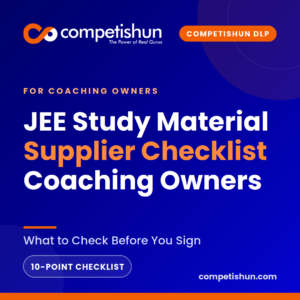
Work through this table with every supplier on your shortlist, in order. Each row can be verified in a single conversation and a sample kit, and together the ten rows predict your experience for the whole session. Score each supplier honestly; a supplier that fails three or more rows is not a bargain at any price, because your faculty will pay the difference in hours.
| Check | What Good Looks Like | How to Verify It |
|---|---|---|
| 1. Complete PCM coverage | Modules, DPPs and practice sets for Physics, Chemistry and Maths, for Class 11, Class 12 and droppers | Ask for the chapter list for all three classes, not a sample chapter |
| 2. Daily practice built in | Chapter-wise DPPs that run on a daily routine, not practice questions scattered through theory | Solve one full DPP yourself and time it |
| 3. Updated PYQs, Main and Advanced | JEE Main and Advanced previous year questions integrated into the material and refreshed after every exam cycle | Ask what changed in the material after the last JEE session |
| 4. Print plus app solutions | Physical books for the classroom with app solutions students can use at home | Open the same question in the book and in the app |
| 5. CBT test series, all three levels | Chapter, part-syllabus and full-syllabus tests on the Main and Advanced CBT patterns | Sit through one chapter test on the student screen |
| 6. All India analysis, not just scores | All India comparison plus chapter-level analysis of accuracy, time taken and weak chapters | Ask for a real student analysis report, not a brochure screenshot |
| 7. Bulk onboarding and a test planner | A process that puts all your students on the system and a planner that runs the test calendar | Ask who runs onboarding and how long it takes for your batch size |
| 8. A real update process | A named process and timeline for revising material when the syllabus or pattern changes | Ask for the last update note, with a date |
| 9. Your brand stays yours | A partnership, not a franchise: your institute keeps its management, teaching and brand | Read the agreement clause on branding before the demo, not after |
| 10. Exclusions stated upfront | A clear list of what is not included, such as lectures, mentorship or teaching | Ask directly: what will you not do for us |
| Use this table as your evaluation sheet. Ask for evidence on each row: a sample module, a sample test report, and the update note from the last exam cycle. | ||
Swipe the table sideways to see all columns
Two rows deserve emphasis because owners underweight them. Row 7, onboarding and planning, decides whether the system actually starts on time; the best material fails when implementation is left to chance. Row 10, exclusions, protects both sides: a supplier that clearly states what it will not do, such as lectures or mentorship, is being honest about its boundaries, and you can plan around them instead of discovering them in November.
Checks 1 to 4: Content Quality, DPPs and PYQ Currency
Content is the first four checks, and they have to be judged as a set. A supplier can have beautiful modules and no DPP routine, or strong DPPs built on stale PYQs, and either gap lands on your teachers. Start with coverage: modules, DPPs and practice sets for Physics, Chemistry and Maths, for Class 11, Class 12 and droppers. A partial system, however good, forces you to fill the missing class or subject yourself, which is the work you were trying to outsource.
Next, look at the DPPs as a routine, not as a feature. Daily practice sheets only work when they run every day, in a fixed structure, across every batch. Solve one full DPP yourself, from a chapter your teachers know well, and ask three questions: are the questions JEE-level or textbook-level, do they progress from basic to advanced inside the sheet, and does the sheet end with questions that resemble the actual exam? If you cannot answer yes to all three, the DPPs are decoration.
PYQ currency is the check owners most often skip, and it matters most. JEE Main and Advanced previous year questions should be integrated into the material chapter by chapter, not saved for a final-month booklet, and they should be refreshed after every exam cycle. Ask the supplier what changed in the material after the last JEE session, and ask to see the change, not just hear about it. A supplier with a real update process shows you a dated update note. A supplier without one changes the subject.
Finally, check the format pair: physical books for the classroom with app solutions students can use at home. Students study in both places, and material that works in only one creates support work for your team: doubts that cannot be resolved at home come back to your teachers the next morning. Open the same question in the book and in the app during the demo. If the two do not match, or if one of them does not exist, that is a gap your faculty will fill all session.
- Red flag: a sample chapter, not a sample set: a supplier that shows one polished chapter and hides the rest is telling you the rest is weaker.
- Red flag: PYQs as a separate booklet: PYQs kept apart from modules are PYQs your students will meet too late.
- Red flag: no DPP routine: practice questions without a daily structure are a question bank, not a system.
Checks 5 to 7: Tests, Analysis and Onboarding
A test series is where most supplier relationships are actually won or lost, because tests are where your students and parents see results. Judge it on three levels. First, coverage: chapter tests, part-syllabus tests and full-syllabus tests, on the Main and Advanced CBT patterns, so testing follows teaching instead of arriving as a surprise at the end. Second, analysis: All India comparison plus chapter-level diagnosis of accuracy, time taken and weak chapters. Scores do not improve students; diagnosis does, and your faculty will teach from the analysis, not from the rank list.
Third, and most underrated, is onboarding and planning. Bulk student onboarding should be a process the supplier runs with you, not a login sheet emailed to your coordinator. A session test planner should exist before the session starts, so chapter tests land where your teaching lands. Ask who runs onboarding, how long it takes for your batch size, and what happens when a student cannot log in during the first week. The answers tell you whether you are buying a system or a set of credentials.
From first call to first test
Ask for the sample kit
One module, its DPPs and its PYQ set, plus a live look at the test interface.
Week oneRead one analysis report
A real student report after a chapter test: accuracy, time, weak chapters, All India comparison.
Before you signConfirm onboarding and the planner
Who onboards your batches, and the test calendar for the session, in writing.
At signingRun the first chapter test
One full cycle, teaching to test to analysis, before judging the system.
First monthOne more test-series question that separates serious suppliers from the rest: can you take tests only, without the material? Many established institutes have strong material and weak testing, and a supplier that forces a bundle on them is selling a package, not solving a problem. A flexible supplier lets you take material only, tests only, or both together, and that flexibility is itself evidence of an institute-first model.
Checks 8 to 10: Updates, Brand and the Fine Print
The last three checks are commercial, and they are where partnerships quietly succeed or fail. Updates first: JEE patterns shift every few years, and a provider without an update process sells you a depreciating asset. Ask for the update note from the last exam cycle, with a date, and ask who owns updates inside the supplier’s team. If nobody owns them, they do not happen.
Brand second, and this one is existential. A partnership keeps your institute’s management, teaching and brand in front; a franchise replaces them. Read the branding clause before the demo, not after: whose name appears on the material, on the test interface, and in front of parents? If the answer is the supplier’s name everywhere, you are building someone else’s institute with your admissions effort. The right model keeps your teachers and your brand exactly where they are, and replaces only the weak layers underneath.
Exclusions third. Ask directly: what will you not do for us? Lectures, mentorship and classroom teaching are commonly excluded from material partnerships, and that is legitimate, as long as it is stated before you sign. A clear no lets you plan: your faculty teaches, the supplier supplies. A vague yes becomes a dispute in the middle of the session, when neither side can afford one. Get the exclusions in writing, alongside the inclusions, and the partnership starts honest.
How Competishun DLP Scores Against This Checklist
Swipe to see all four numbers
Competishun DLP is the institute-first academic system from the team behind one of India’s most followed JEE faculties, packaged for coaching institutes and schools. It is not a retail programme with a bulk discount: it is built for batches, with the layers of the checklist supplied as one system. Here is how it maps, check by check, against the same ten points you would apply to any supplier.
| Checklist Check | Competishun DLP Position |
|---|---|
| Complete PCM coverage | Pratham for Class 11, Prakhar for Class 12 and Praveen for droppers, each with structured PCM modules |
| DPPs built in | Chapter-wise DPPs are part of every set, alongside the modules |
| Updated PYQs | Updated JEE Main and Advanced PYQs integrated into the material |
| Print plus app solutions | Physical books with app solutions, so classroom and home study match |
| CBT test series | Chapter, part and full-syllabus tests on the Main and Advanced CBT patterns |
| All India analysis | All India comparison and detailed analysis of accuracy, time taken and weak chapters |
| Bulk onboarding and planner | Bulk student onboarding and a session test planner in the complete package |
| Update discipline | PYQs and material are updated as part of the academic system, and the demo shows the current cycle |
| Your brand stays yours | An academic resource partnership, not a franchise; your management, teaching and brand stay yours |
| Exclusions upfront | Video lectures and mentorship are not included unless separately agreed; teaching stays with your faculty |
| Each position is taken from the live DLP programme description. Verify it the same way you would verify any supplier: sample kit, demo and analysis report. | |
Swipe the table sideways to see all columns
Two boundaries decide fit, and they are stated on the programme itself. First, this is an academic resource partnership, not a franchise: your institute keeps its own management, teaching and brand, and Competishun does not teach your students; your faculty does, with a stronger system behind them. Second, DLP covers material, practice, tests and solutions; video lectures and mentorship are not part of it unless separately agreed. The partnership is built for local JEE institutes, centres with roughly 25 to 500 students, schools running Class 11 and 12 PCM, schools starting JEE preparation, and independent faculty teams, and it can be taken as material only, tests only, or both together. The full programme is on the Competishun DLP page.
DLP Study Material Partnership
Class 11 · Class 12 · Droppers
Structured PCM modules with DPPs and updated JEE Main & Advanced PYQs: physical books with app solutions, bulk onboarding for your batches and a test planner, under an academic partnership that keeps your brand and your teachers in front.
Tests Your Students Can Benchmark
CBT · Main & Advanced Patterns
Chapter, part and full-syllabus tests on the real CBT pattern, with All India comparison and detailed analysis of accuracy, time taken and weak chapters.
Questions to Ask on the First Call
You do not need a second meeting to judge a supplier. Take this list to the first call, and let the answers, not the brochure, decide whether there is a second one.
- Who writes and updates your material, and what changed after the last JEE session?: Tests the update cycle and the academic team behind the covers.
- Can I see a full sample module, its DPPs and its PYQ set, not a brochure?: Real products survive inspection; compiled content does not.
- What does a student’s test analysis report actually show?: Ask for chapter-level diagnosis, accuracy and time data, not only a score and rank.
- What is the minimum batch, and how does per-student pricing change with strength?: Confirms the model fits a local institute, not only a chain.
- Whose brand appears on the material and the test interface?: Decides whether you are building your institute’s name or someone else’s.
- What onboarding and in-session support do we get?: Bulk onboarding, a test planner and a responsive team matter as much as content.
- What is not included?: Lectures, mentorship and teaching are commonly excluded from material partnerships; a clear no protects both sides.
When you are ready to run Competishun DLP through this list, share your requirements and student strength on the contact page. The team calls back within 24 hours, Monday to Sunday, 10 AM to 7 PM, walks you through the books, the test interface and the analysis report, and sends the right quote for your batch size. Judge the sample kit against this checklist, and let the material answer the questions for itself.
Talk to the Competishun Team About a Partnership
Share your student strength and what you need: material, test series, or both. The team calls back within 24 hours, walks you through the books, the test interface and the analysis report, and sends the right quote for your batch size.
About Competishun
Competishun is an online JEE and NEET coaching platform with programs for Class 11, Class 12 and droppers, PYQ courses and books, study material and an All India Test Series, taught by experienced senior faculty. More than 2.2 million students follow the Competishun YouTube channel for free concept lectures and PYQ solutions.
Free JEE Lectures & Study Guidance
Follow Competishun for free concept lectures, PYQ solutions and JEE updates your students can use alongside your teaching.
Read These Next
The partnership programme itself: material, tests and the complete package.
The provider models compared, and eight quality criteria.
How one standard set deploys across batches and centres.
Frequently Asked Questions
Tags