JEE Main Amines PYQs 2024, 2025 and 2026: All Questions with Solutions
JEE Main Amines PYQs 2024, 2025 and 2026: All Questions with Solutions
Verified JEE Main Amines questions from 2024, 2025 and 2026, shift by shift. The 2024, 2025 and 2026 sets are interactive now: pick an option or enter a number and check instantly. Attempt timed, check the method only after answering, and log every miss by pattern.
How to use this quiz
1. Attempt one year timed, without looking at the method.
2. Click an option, or type a number and press Check, for instant right or wrong feedback.
3. Read the short method only after answering, then log the miss by pattern.
4. Rework your weak patterns the same day, then reattempt the year.
2024 Questions (17)
9.3 g of aniline is subjected to reaction with excess of acetic anhydride to prepare acetanilide. The mass of acetanilide produced if the reaction is 100 % completed is × 10−1 g. (Given molar mass in gmol−1 N: 14, O: 16, C: 12, H: 1 )
The arenium ion which is not involved in the bromination of Aniline is . The arenium ion formed by electrophilic attack at the meta position of aniline is shown (the ion labelled 3 in the paper).

The product A formed in the following reaction is: Aniline is diazotised with NaNO2, HCl at 0°C and then treated with Cu2Cl2 to give A. The four options are: (1) 2-chloroaniline; (2) anilinium chloride; (3) chlorobenzene; (4) 1,2-dichlorobenzene. (1) = A, (2) = B, (3) = C, (4) = D.


Which of the following reaction is correct ? The four reactions are: (1) propylamine with HNO2/H2O gives ethanol + N2 + HCl; (2) 1-methylcyclohexene with HI gives 1-iodo-1-methylcyclohexane; (3) cyclohexene with Br2, heat/UV light gives 1,2-dibromocyclohexane; (4) propanamide with Br2 + NaOH gives propylamine + Na2CO3 + NaBr + H2O. (1) = A, (2) = B, (3) = C, (4) = D.

Following is a confirmatory test for aromatic primary amines. Identify reagent (A) and (B) Aniline is treated with (A) to give benzenediazonium chloride, which with (B) and NaOH gives a scarlet red dye. The four options give (A, B) pairs: (1) A = HNO3/H2SO4, B = phenol; (2) A = NaNO2 + HCl, 0-5°C, B = aniline; (3) A = NaNO2 + HCl, 0-5°C, B = 1-naphthol; (4) A = NaNO2 + HCl, 0-5°C, B = 2-naphthol. (1) = A, (2) = B, (3) = C, (4) = D.


The products A and B formed in the following reaction scheme are respectively Benzene is nitrated (conc. HNO3/conc. H2SO4, 323-333 K) and reduced (Sn/HCl) to give A; A is diazotised (NaNO2, HCl, 273-278 K) and coupled with phenol to give B. The four options give (A, B) pairs: (1) A = 3-chloronitrobenzene, B = 4'-hydroxy-3-nitrobiphenyl; (2) A = aniline, B = 2-amino-4'-hydroxybiphenyl; (3) A = aniline, B = 4-hydroxyazobenzene (para-coupled); (4) A = aniline, B = 2-hydroxyazobenzene (ortho-coupled). (1) = A, (2) = B, (3) = C, (4) = D.


A compound (x) with molar mass 108 g mol−1 undergoes acetylation to give product with molar mass 192 g mol−1. The number of amino groups in the compound (x) is ____ .
Given below are two statements : Statement I: Aniline reacts with con. H2 SO4 followed by heating at 453-473 K gives p - aminobenzene sulphonic acid, which gives blood red colour in the 'Lassaigne's test'. Statement II: In Friedel - Craft's alkylation and acylation reactions, aniline forms salt with the AlCl3 catalyst. Due to this, nitrogen of aniline aquires a positive charge and acts as deactivating group. In the light of the above statements, choose the correct answer from the options given below i
The azo-dye (Y) formed in the following reactions is Sulphanilic acid +NaNO2+CH3 COOH → X Sulphanilic acid with NaNO2 and CH3COOH gives X; X with 1-naphthylamine gives the azo dye (Y). The four options are: (1) a bis-azo dye with two sulphanilic acid units; (2) a bis-azo product with two SO3H groups; (3) the 5-azo isomer of (4-sulphophenylazo)-1-naphthylamine; (4) 4−(4-sulphophenylazo)-1-naphthylamine, the azo group para to the NH2 group. (1) = A, (2) = B, (3) = C, (4) = D.


Given below are two statements: Statement (I): The NH2 group in Aniline is ortho and para directing and a powerful activating group. Statement (II) : Aniline does not undergo Friedel- Craft's reaction (alkylation and acylation). In the light of the above statements, choose the most appropriate answer from the options given below
Number of compounds which give reaction with Hinsberg's reagent is Compounds: benzenediazonium chloride; benzanilide; aniline; N-phenylpiperidine; benzyl-NH-N(CH3)2 (a substituted hydrazine); ethylenediamine; piperidine; pyridine; butylamine; urea.

9.3 g of pure aniline is treated with bromine water at room temperature to give a white precipitate of the product ' P '. The mass of product ' P ' obtained is 26.4 g . The percentage yield is %.
The number of halobenzenes from the following that can be prepared by Sandmeyer's reaction is ....... Five halobenzenes: (I) fluorobenzene; (II) chlorobenzene; (III) bromobenzene; (IV) iodobenzene; (V) astatobenzene.

9.3 g of pure aniline upon diazotisation followed by coupling with phenol gives an orange dye. The mass of orange dye produced (assume 100% yield/ conversion) is g. (nearest integer)
If 279g of aniline is reacted with one equivalent of benzenediazonium chloride, the mximum amount of aniline yellow formed will be g. (nearest integer) (consider complete conversion)
Number of amine compounds from the following giving solids which are soluble in NaOH upon reaction with Hinsberg's reagent is ________. Amines: aniline; benzamide; semicarbazide; N-methylaniline; diphenylamine; 1,4-phenylenediamine; urea; 2-methoxyaniline; propylamine; triethylamine; N-ethyl-N-methyl(cyclohexylmethyl)amine; cyclohexylamine.

Xg of ethylamine is subjected to reaction with NaNO2/HCl followed by water; evolved dinitrogen gas which occupied 2.24 L volume at STP. X is ____ × 10−1 g.
UPO
Unique PYQs Only. Solve only what is new.
✓4,348 unique PYQs
✓Repeated questions grouped in clusters
PYQ Express
Every JEE Main PYQ in one place.
✓10,000+ PCM PYQs
✓Physics, Chemistry, Maths
2025 Questions (18)
Consider the following sequence of reactions : Nitrobenzene is treated with (i) Sn + HCl (ii) NaNO2, HCl, 0°C (iii) Cu2Cl2 (iv) Na, ether to give product A. Molar mass of the product formed (A) is ___ g mol-1.

The products formed in the following reaction sequence are : Nitrobenzene is treated with (i) Br2, AcOH (ii) Sn, HCl (iii) NaNO2, HCl, 273 K (iv) C2H5OH to give A + B. The four options give (A, B) pairs: (a) 3-bromophenetole and acetic acid; (b) 3-bromophenol and 3-bromophenetole; (c) bromobenzene and acetaldehyde; (d) 3-bromophenol and acetaldehyde. (a) = A, (b) = B, (c) = C, (d) = D.


Match the Compounds (List - I) with the appropriate Catalyst/Reagents (List - II) for their reduction into corresponding amines. Choose the correct answer from the options given below : List I: (A) R-CONH2 (an amide); (B) nitrobenzene; (C) R-C≡N (a nitrile); (D) N-substituted phthalimide. List II: (I) NaOH (aqueous); (II) H2/Ni; (III) LiAlH4, H2O; (IV) Sn, HCl.

Consider the following sequence of reactions to produce major product (A) 3-Nitrotoluene is treated with (i) Br2, Fe (ii) Sn, HCl (iii) NaNO2, HCl, 273 K (iv) H3PO2, H2O to give the major product (A). Molar mass of product (A) is ___ g mol-1. (Given molar mass in gmol-1 of C: 12, H: 1, O: 16, Br: 80, N: 14, P: 31.)

Which among the following react with Hinsberg's reagent? A. Aniline; B. N,N-Dimethylaniline; C. Methylamine; D. Trimethylamine; E. N-Methylaniline.

Consider the following sequence of reactions. Total number of sp3 hybridised carbon atoms in the major product C formed is ____ . 4-Ethoxyaniline is diazotised with NaNO2, HCl at 0-5°C to give (A); (A) is coupled with phenol (dil. HCl, NaOH) to give (B) (molecular formula C14H14N2O2); (B) is treated with (i) NaOH (ii) ethyl bromide to give (C) (molecular formula C16H18N2O2).

For reaction The correct order of set of reagents for the above conversion is: Aniline is converted into 2-bromoaniline (major product).

Consider the following sequence of reactions: Chlorobenzene is treated with (i) Mg, dry ether (ii) CO2, H3O+ (iii) NH3, heat to give A; A is treated with Br2, NaOH to give B. 11.25 mg of chlorobenzene will produce ___ × 10−1 mg of product B (complete conversion). (Given molar mass of C, H, O, N and Cl as 12, 1, 16, 14 and 35.5 gmol-1 respectively.)

Identify correct statements : (A) Primary amines do not give diazonium salts when treated with NaNO2 in acidic condition. (B) Aliphatic and aromatic primary amines on heating with CHCl3 and ethanolic KOH form carbylamines. (C) Secondary and tertiary amines also give carbylamine test. (D) Benzenesulfonyl chloride is known as Hinsberg's reagent. (E) Tertiary amines reacts with benzenesulfonyl chloride very easily. Choose the correct answer from the options given below :
Given below are some nitrogen containing compounds Four nitrogen compounds: 4-nitroaniline, benzylamine, acetanilide, aniline. Each is treated with HCl separately. 1.0 g of the most basic compound will consume ___ mg of HCl. (Given molar mass in gmol-1: C: 12, H: 1, O: 16, Cl: 35.5.)

Which one of the following reaction sequences will give an azo dye? The four sequences are: (1) aniline, (i) HCl/NaNO2 (ii) toluene; (2) nitrobenzene, (i) Sn/HCl (ii) NaNO2/HCl (iii) β-naphthol, NaOH; (3) benzenesulphonic acid, (i) SOCl2 (ii) NH3 (iii) benzyl chloride; (4) benzonitrile, (i) 70% H2SO4 (ii) PCl5 (iii) aniline. (1) = A, (2) = B, (3) = C, (4) = D.

When a concentrated solution of sulphanilic acid and 1-naphthylamine is treated with nitrous acid ( 273 K ) and acidified with acetic acid, the mass (g) of 0.1 mole of product formed is : (Given molar mass in gmol−1 H: 1, C: 12, N: 14, O: 16, S: 32 )
Identify [A] ,[B] and [C] , respectively in the following reaction sequence: [A] is diazotised with NaNO2, HCl at 273-278 K to give benzenediazonium chloride; with KI it gives [B]; with 2Na, dry ether it gives [C]. The four options give ([A], [B], [C]) sets: (A) aniline, chlorobenzene, iodobenzene; (B) aniline, iodobenzene, biphenyl; (C) nitrobenzene, iodobenzene, biphenyl; (D) aniline, chlorobenzene, benzene. (A) = A, (B) = B, (C) = C, (D) = D.


In the following reactions, which one is NOT correct? The four reactions are: (A) benzenediazonium chloride with EtOH gives phenetole; (B) benzenediazonium chloride with H3PO2/H2O gives benzene; (C) benzenediazonium chloride with CuCN/KCN gives benzonitrile; (D) benzenediazonium chloride with potassium iodide gives iodobenzene.

The sequence from the following that would result in giving predominantly 3,4,5 Tribromoaniline is : The four sequences are: (1) benzene, (i) Br2/AlBr3 (ii) NH3; (2) nitrobenzene, (i) Br2, acetic acid (ii) Sn, HCl; (3) aniline, Br2, water; (4) 4-nitroaniline, (i) Br2 (excess), acetic acid (ii) NaNO2, HCl, CuBr (iii) Sn, HCl. (1) = A, (2) = B, (3) = C, (4) = D.

The major product (A) formed in the following reaction sequence is Nitrobenzene is treated with (i) Sn, HCl (ii) Ac2O, pyridine (iii) Br2, AcOH (iv) NaOH (aq) to give A. The four options are: (A) 3-bromoaniline; (B) 2,4-dibromoaniline; (C) 2,4,6-tribromoaniline; (D) 4-bromoaniline.


Which of the following amine (s) show (s) positive carbylamine test? Choose the correct answer from the options given below: A. Aniline; B. Dimethylamine; C. Methylamine; D. Trimethylamine; E. N-Methylaniline.

A is treated with (i) NaOH (ii) H3O+ to give B; B is treated with (i) EtOH (ii) H2SO4, heat to give C. A shows a positive Lassaigne's test for N and its molar mass is 121. B gives effervescence with aq. NaHCO3. C gives a fruity smell. The four options give (A, B, C) sets: (1) A = 2-aminobenzaldehyde, B = (4-aminophenyl)(2-hydroxyphenyl)methanone, C = the corresponding hydroxy-ethoxy ketal; (2) A = benzamide, B = benzoic acid, C = ethyl benzoate; (3) A = 2-aminobenzaldehyde, B = a benzene ring carrying NH2, CHO and CO2H, C = the same ring carrying NHEt and CO2Et; (4) A = benzylhydrazine, B = benzoic acid, C = ethyl benzoate. (1) = A, (2) = B, (3) = C, (4) = D.


JEE Mates
Online Mock Test Series.
✓50 online mock tests
✓Video solutions + analysis
UTS
Ultimate Test Series.
✓20 full mocks + 6 special tests
✓Projected percentile after every test
2026 Questions (26)
Consider the following equation: Benzene is nitrated (conc. HNO3 + conc. H2SO4, 333 K) to give P; P is reduced with Sn/HCl, heat and neutralised to give Q; Q is acetylated with (CH3CO)2O to give R; R is nitrated (conc. HNO3 + conc. H2SO4) to give S (major product); S is treated with (i) HCl/EtOH, heat (ii) pH neutralised to give T. The percentage of nitrogen in product T formed is ___ % (nearest integer). (Given molar mass in gmol-1: H: 1, C: 12, N: 14, O: 16.)

An organic compound (P) on treatment with aqueous ammonia under hot condition forms compound (Q) which on heating with Br2 and KOH forms compound (R) having molecular formula C6 H7 N. Names of P, Q and R respectively are.
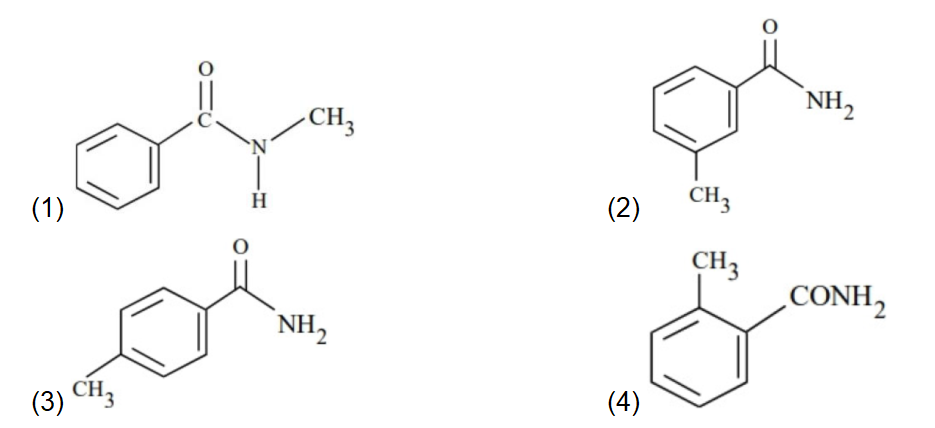
' A ' is a neutral organic compound (M . F: C8 H9 ON). On treatment with aqueous Br2 / HO(−), ' A ' forms a compound ' B ' which is soluble in dilute acid. ' B ' on treatment with aqueous NaNO2 / HCl(0-5° C) produces a compound ' C ' which on treatment with CuCN / NaCN produces ' D '. Hydrolysis of ' D ' produces ' E ' which is also obtainable from the hydrolysis of ' A '. ' E ' on treatment with acidified KMnO4 produces ′ F′. ' F′ ' contains two different types of hydrogen atoms. The structure of ' A ' is The four options are: (1) N-methylbenzamide; (2) 3-methylbenzamide; (3) 4-methylbenzamide; (4) 2-methylbenzamide. (1) = A, (2) = B, (3) = C, (4) = D.
The mass of benzanilide obtained from the benzoylation reaction of 5.8 g of aniline, if yield of product is 82 %, is ____ g (nearest integer). (Given molar mass in gmol−1 H: 1, C: 12, N: 14, O: 16 )
The final product [B] is : Cyclohexylmethylamine is treated with benzoyl chloride and NaOH to give [A]; [A] is treated with LiAlH4/H2O to give [B]. The four options are: (1) cyclohexyl-CH2−NH-CH(OH)-Ph; (2) cyclohexyl-CH2−NH-CO-Ph; (3) Ph-CH2−NH-CO-cyclohexyl; (4) cyclohexyl-CH2−NH-CH2−Ph. (1) = A, (2) = B, (3) = C, (4) = D.


Consider the following sequence of reactions. Assuming that the reaction proceeds to completion, then 137 mg of 4 -nitrotoluene will produce ____ mg of B. (Given molar mass in g mol−1 H: 1, C: 12, N: 14, O: 16, Br: 80 ) 4-Nitrotoluene is treated with (i) Sn, HCl, heat (ii) pH neutralisation to give (A); (A) is treated with (i) (CH3CO)2O (ii) Br2/AcOH to give (B).

A student has been given a compound " x " of molecular formula- C6 H7 N · x ' is sparingly soluble in water. However, on addition of dilute mineral acid, ' x ' becomes soluble in water. ' x ' when treated with CHCl3 and KOH( alc), ' y ' is produced. ' y ' has a specific unpleasant smell. On treatment with benzenesulphonyl chloride, ′ x ' gives a compound' z ' which is soluble in alkali. The number of different " H " atoms present in ' z ' is:-
Given below are two statements: Statement I: o-phenylenediamine can be synthesized from 1,2-diethylbenzene using (i) acidic KMnO4 (ii) ammonia (iii) bromine and alkali. Statement II: 4-methylaniline (p-toluidine) can be converted into 3,5-dibromotoluene using (i) bromine-water (ii) NaNO2/HCl (0-5°C) (iii) aq. H3PO2.

The correct stability order of the following diazonium salts is Four benzenediazonium chlorides: (A) 4-methoxybenzenediazonium chloride; (B) 4-nitrobenzenediazonium chloride; (C) benzenediazonium chloride; (D) 4-cyanobenzenediazonium chloride.

A student has planned to prepare acetanilide from aniline using acetic anhydride. The student has started from 9.3 g of aniline. However, the student has managed to obtain 11 g of dry acetanilide. The % yield of this reaction is :-
Consider the following reactions giving major product. Identify the correct reaction. The four reactions are: (1) benzanilide with HNO3/H2SO4 (1:2) gives 4-nitrobenzanilide with the NO2 group para on the benzoyl ring; (2) potassium phthalimide with Ph-X, (i) heat (ii) hydrolysis, gives aniline; (3) benzylamine with CHCl3/KOH, heat gives benzyl isocyanide, which with (i) Sn/HCl, heat (ii) pH adjusted gives benzylamine; (4) propanamide with Br2 + 4KOH (alcoholic), heat gives ethylamine + 2KBr + K2CO3 + 2H2O. (1) = A, (2) = B, (3) = C, (4) = D.

The correct order of acidic strength of the major products formed in the given reactions, is : A. PhNH2 (1) NaN2-HC(C-S+ C) → (2) CuCN, (3) H3 O+ / Δ[A] B. CH3 CH2 CHO [Ag(NH3)3]+ . OH− → Δ[B] C. CH4+O2 (a) Mo3 O3 → (ii) Na2 Cr2 O7 / H+[C] D. PhCH2 MgBr+CO2 Dryather → H3 O+[D] Choose the correct answer from the options given below :
Which of the following reaction is NOT correctly represented ? The four reactions are: (1) toluene with Br2, Fe, dark gives ortho and para bromotoluenes; (2) benzenediazonium chloride with Cu2Br2/HBr gives bromobenzene; (3) toluene with Br2, hv gives benzyl bromide; (4) 4-methylcyclohexene with Br2, hv gives 4−(bromomethyl)cyclohexene. (1) = A, (2) = B, (3) = C, (4) = D.

Total number of alkali insoluble solid sulphonamides obtained by reaction of given amines with Hinsberg's reagent is________. Aniline, N-Methylaniline, Methanamine, N, N-Dimethylmethanamine, N-Methyl methanamine, Phenylmethanamine, N-propylaniline, N-phenylaniline, N, N-Dimethylaniline, Allyl amine, Isopropyl amine
Consider the three aromatic molecules (P, Q and R) whose structures have been given below : The correct order regarding the reactivity of these compounds with Ph-N(+) ≡ NCl(−)under optimum but slightly acidic medium is : P = N,N-dimethylaniline; Q = N,N-dimethyl-2-methylaniline (a methyl group ortho to the NMe2 group); R = N,N-dimethyl-2,6-dimethylaniline (a methyl group on each side of the NMe2 group).


Consider the following reactions sequence When the product (P) is subjected to Carius analysis using AgNO3, 1.0 g of the product (P) will produce ____ g of the precipitate of AgBr . (Nearest Integer) (Given : molar mass in gmol −1 C: 12, H: 1, O: 16, N: 14, Br: 80, Ag: 108 ) 4-Nitrotoluene is treated with (i) Sn/HCl; OH− (ii) (CH3CO)2O (iii) Br2/AlBr3 (iv) H3O+ to give the major product (P).

Identify compounds A and E in the following reaction sequence. Reaction sequence: 1-ethyl-4-nitrobenzene is brominated with Br2/AlBr3 to give A; A is reduced with Sn/HCl to give B; B is diazotised with NaNO2/HCl at 273-278 K to give C; C is treated with C2H5OH to give D; D is oxidised with (i) KMnO4/KOH (ii) H3O+ to give E. The four options give (A, E) pairs: (1) A = 3-bromo-1-ethyl-4-nitrobenzene, E = 3-bromobenzoic acid; (2) A = 2-bromo-1-ethyl-4-nitrobenzene, E = 2-bromobenzoic acid; (3) A = 1−(2-bromoethyl)-4-nitrobenzene, E = benzoic acid; (4) A = 2-bromo-1-ethyl-4-nitrobenzene, E = 2-bromo-4-hydroxybenzoic acid. (1) = A, (2) = B, (3) = C, (4) = D.


Product C of the following reaction sequence will be Aniline is treated with Br2/water to give A (major product); A is diazotised with NaNO2/HCl at 273-278 K to give B; B is treated with (i) HBF4 (ii) NaNO2, Cu, heat to give C.

Identify the incorrect statements. Choose the correct answer from the options given below: A. Benzylamine is a stronger base than aniline. B. 4-Methoxyaniline (p-anisidine) can be synthesized by Gabriel phthalimide synthesis. C. Phenylacetamide with Br2, NaOH gives a primary aromatic amine. D. 4-Nitroaniline with (i) NaNO2, HCl, 0°C (ii) heating gives a product that will dissolve in NaOH.


Benzyl isocyanide can be obtained from Choose the correct answer from the options given below : (A) Benzyl bromide + AgCN; (B) Benzylamine + CHCl3, aq. NaOH; (C) Bromobenzene + AgCN; (D) Aniline + CHCl3, aq. NaOH; (E) Phenethyl bromide + KCN.


Given below are two statements : Statement I: Heating benzamide with bromine in an ethanolic solution of sodium hydroxide will give benzylamine. Statement II : Nitration of aniline with HNO3 / H2 SO4 at 288 K produces m-nitroaniline in higher amount than o-nitroaniline ( pH adjusted). In the light of the above statements, choose the correct answer from the options given below :
Consider the following sequence of reactions Diazoaminobenzene (C6H5−N=N-NH-C6H5) is treated with (i) HCl (ii) aniline (in excess) (iii) warm, 40-48°C (iv) cool, acetic acid to give the yellow product (X). The percentage of nitrogen in the yellow product (X) formed is ___ % (nearest integer). (Given molar mass in gmol-1: H: 1, C: 12, N: 14.)

Arrange the following compounds according to increasing order of boiling points. n-C4 H9 OH( A), n-C4 H9 NH2( B), n-C4 H10(C) and C2 H5 NHC2 H5(D)
The number of compounds from the following which can undergo reaction with Br2 / KOH (alcoholic) to give respective products and these respective products can also be obtained separately by Gabriel phthalimide reaction is : The six compounds are: benzamide (C6H5CONH2); phenylacetamide (C6H5CH2CONH2); acetamide (CH3CONH2); N-ethyl lauramide (C11H23CONHCH2CH3); N-methyl pivalamide ((CH3)3CCONHCH3); lauramide (C11H23CONH2).

Consider the following organic reaction sequence. Choose the final product (X) from the following (consider the major product in all intermediate reactions) Propanoic acid is treated with (i) NH3, heat (ii) NaOH/Br2 (iii) HNO2/H2O, 0°C (iv) benzenediazonium chloride, 0°C to give the major product (X).

Which statements are True A. In Hoffmann bromamide degradation, 4 moles of NaOH and 2 moles of Br2 are consumed per mole of an amide B. Hoffmann bromamide reaction is not given by alkyl amides. C. Primary amines can be synthesized by Hoffmann bromamide degradation. D. Secondary amide on reaction with Br2 and NaOH will give secondary amine. E. The by-products of Hoffmann degradation are Na2 CO3 and H2 O. Choose the correct answer from the options given below :
Chemistry PYQ Book
JEE Main 5 Years Chemistry PYQ Book 2022-2026.
✓Chapter-wise solved papers
✓Detailed solutions
JEE Advanced Online
Online Mock Test Series.
✓10 online mock tests
✓Video solutions + analysis
Frequently Asked Questions
Tags