JEE Main IUPAC Nomenclature PYQs 2024, 2025 and 2026: All Questions with Solutions
By CompetishunNov 20, 202629 min read
JEE Main IUPAC Nomenclature PYQs 2024, 2025 and 2026: All Questions with Solutions
Verified JEE Main IUPAC Nomenclature questions from 2024, 2025 and 2026, shift by shift. The 2024, 2025 and 2026 sets are interactive now: pick an option or enter a number and check instantly. Attempt timed, check the method only after answering, and log every miss by pattern.
Score: 0 correct out of 0 attempted ( interactive questions)
How to use this quiz
1. Attempt one year timed, without looking at the method.
2. Click an option, or type a number and press Check, for instant right or wrong feedback.
3. Read the short method only after answering, then log the miss by pattern.
4. Rework your weak patterns the same day, then reattempt the year.
2024 Questions (23)
Q127 Jan 2024, Shift 1
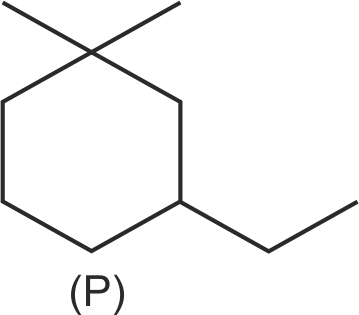
IUPAC name of following compound (P) is : Compound (P) is a cyclohexane ring with two methyl groups on the top carbon and an ethyl group on the lower right carbon.
Correct option: B. Method: Numbering the ring so the substituents get the lowest locants: the carbon with the two methyl groups is C1 and the ethyl group is on C3. The name is 3-ethyl-1,1-dimethylcyclohexane.
Q227 Jan 2024, Shift 1
Cyclohexene is _______ type of an organic compound. Cyclohexene, a six-membered ring with one double bond.
Correct option: D. Method: Cyclohexene is a cyclic compound with no benzene ring, so it is alicyclic: a cyclic aliphatic compound. It is not benzenoid aromatic, not benzenoid non-aromatic and not acyclic.
Q327 Jan 2024, Shift 2
Total number of compounds with Chiral carbon atoms from following is CH3-CH2-CH(NO2)-COOH CH3-CH2-CHBr-CH2-CH3 CH3-CH(I)-CH2-NO2 CH3-CH2-CH(OH)-CH2OH CH3-CH-CH(I)-C2H5 Two compounds: 2-methylcyclohexanone, a six-membered ring ketone with a methyl group next to the carbonyl group, and cyclopentane-1,3-dione, a five-membered ring with two ketone groups.
Answer: 5. Method: The compounds with a chiral carbon are: 2-methylcyclohexanone (the C2 bearing the methyl group); 2-nitrobutanoic acid, CH3CH2-CH(NO2)-COOH; 1-iodo-2-nitropropane, CH3-CH(I)-CH2-NO2; 2,3-diiodopentane, CH3-CH(I)-CH(I)-CH2-CH3 (two chiral carbons); and butane-1,2-diol, CH3CH2-CH(OH)-CH2OH. 3-Bromopentane and cyclopentane-1,3-dione have no chiral carbon. So 5 compounds have chiral carbons.
Q427 Jan 2024, Shift 2
Bond line formula of HOCH(CN)2 is: Four drawings of HOCH(CN)2: (1) the central carbon drawn with an explicit H, HO on the left and two CN groups; (2) HO-CH with two C≡N groups drawn out; (3) HO-CH with two CN groups; (4) bond-line style, a carbon vertex bearing OH above and two CN groups below, with no H drawn. (1) = A, (2) = B, (3) = C, (4) = D.
Correct option: D. Method: In a bond-line formula the carbon atoms are vertices and the hydrogens on carbon are not drawn. Only (4) is drawn in bond-line style: a carbon vertex bearing the OH group and the two CN groups, with the hydrogen left implicit. The others draw the hydrogen or the CH group out in full.
Q529 Jan 2024, Shift 2
The total number of 'Sigma' and Pi bonds in 2formylhex-4-enoic acid is
Answer: 22. Method: Counting the bonds in HOOC-CH(CHO)-CH2-CH=CH-CH3: there are 19 sigma bonds and 3 pi bonds (one in each C=O bond and one in the C=C bond). The total is 19 + 3 = 22.
Q629 Jan 2024, Shift 2
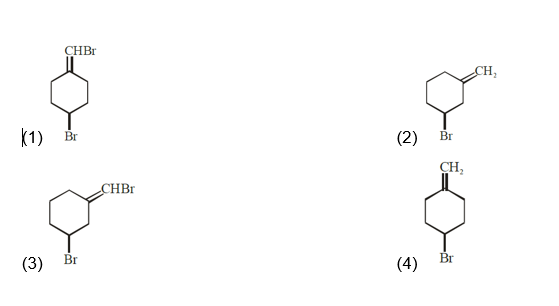
Which one of the following will show geometrical isomerism? Four compounds: (1) 4-bromocyclohexylidene-CHBr, the =CHBr carbon outside a cyclohexane ring bearing Br at C4; (2) 3-bromo-methylenecyclohexane, =CH2 on a ring with Br at C3; (3) 3-bromocyclohexylidene-CHBr, =CHBr on a ring with Br at C3; (4) 4-bromo-methylenecyclohexane, =CH2 on a ring with Br at C4. (1) = A, (2) = B, (3) = C, (4) = D.
Correct option: C. Method: Geometrical isomerism needs two different groups on each carbon of the double bond. In (2) and (4) the exocyclic carbon is =CH2, so no isomerism is possible. In (1) the ring carbon of the double bond has two identical paths round the ring (the bromine is at C4, equidistant on both sides), so no isomerism is possible. In (3) the bromine is at C3, so the two paths round the ring differ and the exocyclic double bond can be E or Z. Only (3) shows geometrical isomerism.
Q729 Jan 2024, Shift 2
According to IUPAC system, the compound is named as A six-membered ring with a double bond and an OH group on the carbon next to the double bond.
Correct option: D. Method: Numbering the ring so the OH group gets the lowest locant: the carbon bearing the OH is C1 and the double bond starts at C2. The name is cyclohex-2-en-1-ol.
Q830 Jan 2024, Shift 1
Structure of 4-Methylpent-2-enal is Four structures: (1) 3-methylbutanal, (CH3)2CH-CH2-CHO; (2) 3-methylpentanal, CH3-CH2-CH(CH3)-CH2-CHO; (3) 2-methylpent-2-enal, CH3-CH2-CH=C(CH3)-CHO; (4) 4-methylpent-2-enal, (CH3)2CH-CH=CH-CHO. (1) = A, (2) = B, (3) = C, (4) = D.
Correct option: D. Method: 4-Methylpent-2-enal is (CH3)2CH-CH=CH-CHO, which is structure (4).
Q930 Jan 2024, Shift 2
Number of geometrical isomers possible for the given structure is/are ______. A triene chain: the left C=C bond carries H and D on the terminal carbon and a methyl group on the inner carbon; the right C=C bond carries D and H on the terminal carbon and a methyl group on the inner carbon; the central C=C bond carries methyl and ethyl substituents.
Answer: 4. Method: Geometrical isomerism is possible at the two terminal C=C bonds, where the two groups on each carbon differ (H and D on the terminal carbon, CH3 and the chain on the inner carbon). Each of these bonds can be E or Z, giving 2 × 2 = 4 geometrical isomers.
Q1030 Jan 2024, Shift 2
IUPAC name of following compound is The compound is CH3-CH(NH2)-CH2-CN.
Correct option: C. Method: Numbering from the nitrile carbon as C1: C2 is the CH2 group, C3 carries the NH2 group and C4 is the CH3 group. The name is 3-aminobutanenitrile.
Q1131 Jan 2024, Shift 1
Given below are two statements: Statement I: IUPAC name of HO-CH2-(CH2)3-CH2-COCH3 is 7-hydroxyheptan-2-one. Statement II: 2-oxoheptan-7-ol is the correct IUPAC name for above compound. In the light of the above statements. choose the most appropriate answer from the options given below:
Correct option: A. Method: Statement I is correct: the IUPAC name of HO-CH2-(CH2)3-CH2-COCH3 is 7-hydroxyheptan-2-one (a 7-carbon chain with the ketone at C2 and the OH at C7). Statement II is incorrect: 2-oxoheptan-7-ol is not the correct IUPAC name, since the ketone outranks the alcohol and the name must end in -one. Statement I is correct but Statement II is incorrect.
Q1231 Jan 2024, Shift 2
Identify structure of 2,3-dibromo-1-phenylpentane. Four structures: (1) 1,3-dibromo-1-phenylpentane, Ph-CH(Br)-CH2-CH(Br)-CH2-CH3; (2) 3,4-dibromo-1-phenylpentane, Ph-CH2-CH2-CH(Br)-CH(Br)-CH3; (3) 2,3-dibromo-1-phenylpentane, Ph-CH2-CH(Br)-CH(Br)-CH2-CH3; (4) 1,3-dibromo-1-phenylhexane, Ph-CH(Br)-CH2-CH(Br)-CH2-CH2-CH3. (1) = A, (2) = B, (3) = C, (4) = D.
Correct option: C. Method: In 2,3-dibromo-1-phenylpentane the bromine atoms are on C2 and C3 of the pentane chain, counting the benzylic CH2 as C1: Ph-CH2-CH(Br)-CH(Br)-CH2-CH3, which is structure (3).
Q131 Feb 2024, Shift 1
Number of optical isomers possible for 2 – chlorobutan
Answer: 2. Method: 2-Chlorobutane, CH3-CHCl-CH2-CH3, has one chiral carbon (the C2 bearing the chlorine), so it has 2 optical isomers.
Q141 Feb 2024, Shift 1
Given below are two statements: Statement (I) : Aminobenzene and aniline are same organic compounds. Statement (II) : Aminobenzene and aniline are different organic compounds. In the light of the above statements, choose the most appropriate answer from the options given below:
Correct option: B. Method: Statement I is correct: aminobenzene and aniline are the same compound (C6H5-NH2). Statement II is incorrect: they are not different compounds. Statement I is correct but Statement II is incorrect.
Q151 Feb 2024, Shift 2
Total number of isomeric compounds (including stereoisomers) formed by monochlorination of 2 -methyl butane is
Answer: 6. Method: Monochlorination of 2-methylbutane, (CH3)2CH-CH2-CH3, gives: 1-chloro-2-methylbutane from the two equivalent methyl groups (chiral, 2 stereoisomers); 2-chloro-2-methylbutane from the CH group (1); 2-chloro-3-methylbutane from the CH2 group (chiral, 2 stereoisomers); and 1-chloro-3-methylbutane from the terminal CH3 group (1). The total is 2 + 1 + 2 + 1 = 6 isomeric compounds.
Q165 Apr 2024, Shift 1
Given below are two statements : one is labelled as Assertion (A) and the other is labelled as Reason (R). Assertion (A): Cis form of alkene is found to be more polar than the trans form Reason (R): Dipole moment of trans isomer of 2-butene is zero. In the light of the above statements, choose the correct answer from the options given below :
Correct option: C. Method: Assertion (A) is true: the cis form of an alkene is more polar than the trans form. Reason (R) is true: the dipole moment of trans-but-2-ene is zero, since the two C-CH3 bond dipoles cancel. The zero dipole moment of the trans form is the reason the cis form is more polar, so both (A) and (R) are true and (R) is the correct explanation of (A).
Q175 Apr 2024, Shift 1
Number of σ and π bonds present in ethylene molecule is respectively :
Correct option: D. Method: Ethylene, CH2=CH2, has 5 sigma bonds (4 C-H bonds and 1 C-C sigma bond) and 1 pi bond (in the C=C bond). So there are 5 sigma and 1 pi bond.
Q186 Apr 2024, Shift 1
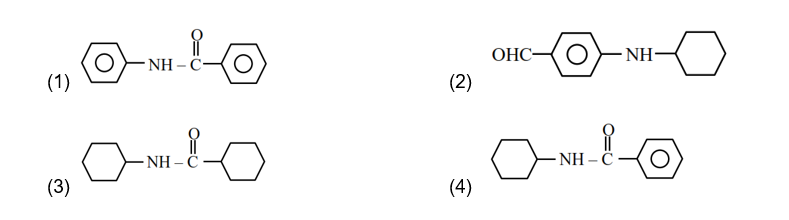
Which of the following is metamer of the given compound (X)? Compound (X) is N-phenylcyclohexanecarboxamide, Ph-NH-CO-C6H11. The four options are: (1) benzanilide, Ph-NH-CO-Ph; (2) OHC-C6H4-NH-cyclohexyl, an aldehyde, not an amide; (3) N-cyclohexylcyclohexanecarboxamide, cyclohexyl-NH-CO-cyclohexyl; (4) N-cyclohexylbenzamide, cyclohexyl-NH-CO-Ph. (1) = A, (2) = B, (3) = C, (4) = D.
Correct option: D. Method: A metamer has the same molecular formula and the same functional group but different alkyl groups on the two sides of the functional group. (X), Ph-NH-CO-C6H11, is C13H17NO. In (4) the phenyl and cyclohexyl groups have swapped sides of the amide group, so it has the same formula and the same amide group: it is the metamer. (1) is C13H11NO and (3) is C13H23NO, so their formulas differ, and (2) has an aldehyde group instead of an amide group.
Q196 Apr 2024, Shift 1
Functional group present in sulphonic acid is :
Correct option: B. Method: The functional group of a sulphonic acid is -SO3H, the sulfonic acid group attached through sulphur to the carbon chain.
Q208 Apr 2024, Shift 1
The number of optical isomers in following compound is : _____ . A fused tricyclic compound: three fused cyclohexane rings bearing a Br atom at one bridgehead carbon and a CH3 group at another ring junction.
Answer: 32. Method: The compound has 5 chiral centres, as the solution shows. The number of optical isomers is 25 = 32.
Q218 Apr 2024, Shift 1
In the given compound, the number of 2° carbon atom /s is The compound is 2,4-dimethylpentane, (CH3)2CH-CH2-CH(CH3)-CH3.
Correct option: B. Method: In 2,4-dimethylpentane the carbons are: four CH3 groups (primary), two CH groups (tertiary) and one CH2 group (secondary). Only the CH2 carbon is a secondary carbon, so there is one 2-degree carbon atom.
Q228 Apr 2024, Shift 1
Given below are two statements: Statement I : IUPAC name of Compound A is 4-chloro-1, 3-dinitrobenzene: Statement II: IUPAC name of Compound B is 4-ethyl-2-methylaniline. In the light of the above statements, choose the most appropriate answer from the options given below: Compound (A) is 1-chloro-2,4-dinitrobenzene, a benzene ring with Cl and two NO2 groups. Compound (B) is 4-ethyl-2-methylaniline, a benzene ring with NH2, CH3 and C2H5 groups.
Correct option: B. Method: Statement I is incorrect: the correct IUPAC name of compound (A) is 1-chloro-2,4-dinitrobenzene, not 4-chloro-1,3-dinitrobenzene, which numbers the ring the wrong way round. Statement II is correct: compound (B) is 4-ethyl-2-methylaniline. Statement I is incorrect but Statement II is correct.
Q239 Apr 2024, Shift 1
The number of different chain isomers for C7H16 is ____ .
Answer: 9. Method: The chain isomers of C7H16 are: heptane (1); 2-methylhexane and 3-methylhexane (2); 2,2-, 2,3-, 2,4- and 3,3-dimethylpentane (4); and 2,2,3- and 2,3,3-trimethylbutane (2). The total is 1 + 2 + 4 + 2 = 9.
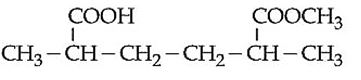
The IUPAC name of the following compound is : The compound is CH3-CH(COOH)-CH2-CH2-CH(COOCH3)-CH3.
Correct option: C. Method: Numbering the longest chain from the carboxylic acid carbon as C1: C2 carries a methyl group, C3 and C4 are CH2 groups, C5 carries a methyl group and C6 is the methoxycarbonyl carbon. The name is 6-methoxycarbonyl-2,5-dimethylhexanoic acid.
Q222 Jan 2025, Shift 1
How many different stereoisomers are possible for the given molecule? The molecule is pent-3-en-2-ol, CH3-CH(OH)-CH=CH-CH3.
Correct option: C. Method: The C2 carbon is chiral (2 arrangements) and the C3=C4 double bond can be cis or trans (2 arrangements). The total number of stereoisomers is 2 × 2 = 4.
Q322 Jan 2025, Shift 1
The incorrect statements regarding geometrical isomerism are : (A) Propene shows geometrical isomerism. (B) Trans isomer has identical atoms/groups on the opposite sides of the double bond. (C) Cis-but-2-ene has higher dipole moment than trans-but-2-ene. (D) 2-methylbut-2-ene shows two geometrical isomers. (E) Trans-isomer has lower melting point than cis isomer. Choose the correct answer from the options given below :
Correct option: C. Method: A is incorrect: propene cannot show geometrical isomerism (two hydrogens on C1). B is correct: in the trans isomer the identical groups are on opposite sides of the double bond. C is correct: cis-but-2-ene has a higher dipole moment than trans-but-2-ene. D is incorrect: 2-methylbut-2-ene has two methyl groups on the same carbon, so it cannot show geometrical isomerism. E is incorrect: the trans isomer has a higher melting point than the cis isomer. The incorrect statements are A, D and E only.
Q422 Jan 2025, Shift 2
The alkane from below having two secondary hydrogens is :
Correct option: C. Method: Counting secondary hydrogens (hydrogens on CH2 carbons): 2,2,4,5-tetramethylheptane has 4, 4-ethyl-3,4-dimethyloctane has 8, 2,2,3,3-tetramethylpentane has 2 (only the CH2 group between the two quaternary carbons and the CH3 group), and 2,2,4,4-tetramethylhexane has 4. The alkane with two secondary hydrogens is 2,2,3,3-tetramethylpentane.
Q522 Jan 2025, Shift 2
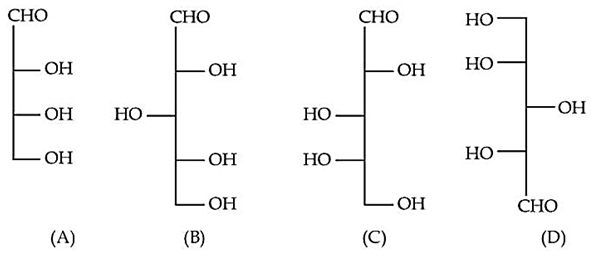
Identify the number of structure/s from the following which can be correlated to D-glyceraldehyde. Four Fischer projections (A)-(D) of a pentose: (A) all three OH groups on the right; (B) OH on the right, left and right; (C) OH on the right, left and left; (D) the chain drawn with CHO at the bottom, OH on the left at the top two centres and on the right at the third centre. (A) = A, (B) = B, (C) = C, (D) = D.
Correct option: A. Method: A structure can be correlated to D-glyceraldehyde when the OH group on the reference carbon is on the right-hand side in the Fischer projection. That is the case in (A), (B) and (D), so three structures can be correlated to D-glyceraldehyde.
Q623 Jan 2025, Shift 1
Propane molecule on chlorination under photochemical condition gives two di-chloro products, "x" and "y". Amongst "x" and "y", "x" is an optically active molecule. How many tri-chloro products (consider only structural isomers) will be obtained from "x" when it is further treated with chlorine under the photochemical condition?
Correct option: C. Method: Chlorination of propane gives 1,1-, 1,2-, 1,3- and 2,2-dichloropropane. Of these, 1,2-dichloropropane is optically active (its C2 is attached to CH2Cl, Cl, H and CH3), so x is 1,2-dichloropropane. Further chlorination of x gives three structural isomers: 1,1,2-trichloropropane, 1,2,2-trichloropropane and 1,2,3-trichloropropane. So 3 trichloro products are formed.
Q724 Jan 2025, Shift 2
The hydrocarbon (X) with molar mass 80 g mol−1 and 90 % carbon has ____ degree of unsaturation.
Answer: 3. Method: The mass of carbon is 80 × 90 / 100 = 72, so there are 72 / 12 = 6 carbon atoms. The mass of hydrogen is 80 × 10 / 100 = 8, so there are 8 hydrogen atoms. The molecular formula is C6H8, and the degree of unsaturation is 6 + 1 - 8 / 2 = 3.
Q824 Jan 2025, Shift 2
The possible number of stereoisomers for 5-phenylpent-4-en-2-ol is ____ .
Answer: 4. Method: In 5-phenylpent-4-en-2-ol, Ph-CH=CH-CH2-CH(OH)-CH3, the C2 carbon is chiral (2 arrangements) and the C4=C5 double bond can be cis or trans (2 arrangements). The total number of stereoisomers is 2 × 2 = 4.
Q924 Jan 2025, Shift 2
In the given structure, number of sp and sp2 hybridized carbon atoms present respectively are: The structure is CH3-CO-CH=CH-CH2-C≡C-CH=CH-CN, a chain with a ketone group, two C=C bonds, one C≡C bond and a terminal nitrile group.
Correct option: C. Method: The sp2 carbons are the carbonyl carbon and the four carbons of the two C=C bonds, giving 5 sp2 carbons. The sp carbons are the two carbons of the C≡C bond and the nitrile carbon, giving 3 sp carbons. So there are 3 sp and 5 sp2 hybridised carbon atoms.
Q1028 Jan 2025, Shift 2
Given below are two statements : In the light of the above statements, choose the correct answer from the options given below: Statement (I): methylcyclopentane and hex-2-ene, labelled 'are isomeric compounds'. Statement (II): pentan-1-amine and N-ethylpropan-1-amine, CH3CH2-NH-CH2CH2CH3, labelled 'are functional group isomers'.
Correct option: D. Method: Statement (I) is true: methylcyclopentane and hex-2-ene both have the molecular formula C6H12, so they are isomers. Statement (II) is true: pentan-1-amine and N-ethylpropan-1-amine both have the molecular formula C5H13N, and a primary amine and a secondary amine are functional group isomers. Both statements are true.
Q1129 Jan 2025, Shift 1
The sum of sigma (σ) and pi (π) bonds in Hex-1,3-dien-5-yne is
Answer: 15. Method: In hex-1,3-dien-5-yne, CH2=CH-CH=CH-C≡CH, the sigma bonds are 5 C-C sigma bonds and 6 C-H sigma bonds, giving 11 sigma bonds. The pi bonds are 1 in each C=C bond and 2 in the C≡C bond, giving 4 pi bonds. The sum is 11 + 4 = 15.
Q1229 Jan 2025, Shift 1
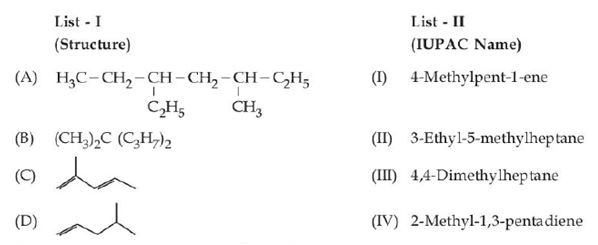
Match List - I with List - II. List-I (Structure): (A) H3C-CH2-CH(C2H5)-CH2-CH(CH3)-C2H5; (B) (CH3)2C(C3H7)2; (C) 2-methyl-1,3-pentadiene, CH2=C(CH3)-CH=CH-CH3; (D) 4-methylpent-1-ene, CH2=CH-CH2-CH(CH3)2. List-II (IUPAC Name): (I) 4-methylpent-1-ene; (II) 3-ethyl-5-methylheptane; (III) 4,4-dimethylheptane; (IV) 2-methyl-1,3-pentadiene.
Correct option: B. Method: (A) is 3-ethyl-5-methylheptane (II); (B) is 4,4-dimethylheptane, a central carbon with two methyl and two propyl groups (III); (C) is 2-methyl-1,3-pentadiene (IV); (D) is 4-methylpent-1-ene (I). So A-II, B-III, C-IV, D-I.
Q1329 Jan 2025, Shift 2
Isomeric hydrocarbons → negative Baeyer's test (Molecular formula C9H12 ) The total number of isomers from above with four different non-aliphatic substitution sites is -
Answer: 2. Method: A negative Baeyer test means no carbon-carbon double bond outside the ring, so the C9H12 isomers are the aromatic ones: propylbenzenes, ethyltoluenes and trimethylbenzenes. The isomers with four different ring sites for aromatic electrophilic substitution are 1-ethyl-2-methylbenzene and 1-ethyl-3-methylbenzene, as the solution shows. So there are 2 such isomers.
Q1429 Jan 2025, Shift 2
Total number of sigma ( σ ) ____ and pi(π) ____ bonds respectively present in hex-1-en-4-yne are :
Correct option: C. Method: In hex-1-en-4-yne, CH2=CH-CH2-C≡C-CH3, the sigma bonds are: 5 C-C sigma bonds and 8 C-H sigma bonds, giving 13 sigma bonds. The pi bonds are: 1 in the C=C bond and 2 in the C≡C bond, giving 3 pi bonds. So there are 13 sigma and 3 pi bonds.
Q153 Apr 2025, Shift 1
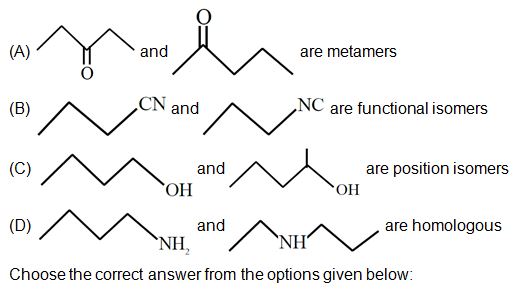
Identify the correct statements from the following. (A) pentan-3-one and pentan-2-one, labelled 'are metamers'; (B) butyl cyanide and butyl isocyanide, labelled 'are functional isomers'; (C) pentan-1-ol and 2-methylbutan-1-ol, labelled 'are position isomers'; (D) butan-1-amine and N-ethylpropan-1-amine, labelled 'are homologous'.
Correct option: A. Method: (A) is correct: pentan-3-one and pentan-2-one are both C5H10O ketones with different alkyl groups on the two sides of the carbonyl group, so they are metamers. (B) is correct: R-CN and R-NC are functional isomers. (C) is incorrect: pentan-1-ol and 2-methylbutan-1-ol have different carbon skeletons, so they are chain isomers, not position isomers. (D) is incorrect: a primary amine and a secondary amine are not homologues. The correct statements are A and B only.
Q163 Apr 2025, Shift 2
The total number of structural isomers possible for the substituted benzene derivatives with the molecular formula C9H12 is ____
Answer: 8. Method: The substituted benzene derivatives with formula C9H12 are: propylbenzenes (n-propyl and isopropyl, 2); ethyltoluenes (ortho, meta and para, 3); and trimethylbenzenes (1,2,3-; 1,2,4- and 1,3,5-, 3). The total is 2 + 3 + 3 = 8.
Q173 Apr 2025, Shift 2
What is the correct IUPAC name of A benzene ring bearing CO2H at the upper right, OH at the lower right, Br at the bottom and NO2 at the upper left.
Correct option: A. Method: Numbering from the COOH carbon as C1, the OH group is ortho to it (C2), the bromine is meta to it (C3) and the nitro group is at C5. The name is 3-bromo-2-hydroxy-5-nitrobenzoic acid.
Q184 Apr 2025, Shift 2
The IUPAC name of the following compound is The compound is HC≡C-CH2-CH(OH)-CH2-CH=CH2.
Correct option: C. Method: Numbering to give the OH group the lowest locant: C1 is the terminal alkene carbon, C2 is the CH, C3 is the CH2, C4 carries the OH, C5 is the CH2, C6 is the alkyne carbon and C7 is the terminal alkyne carbon. The name is hept-1-en-6-yn-4-ol.
Q197 Apr 2025, Shift 1
Which of the following is the correct IUPAC name of given organic compound (X) ? Compound (X) is (CH3)2C=CH-CH2Br, with two CH3 groups on the left carbon of the double bond and a CH2Br group on the right carbon.
Correct option: A. Method: Numbering the longest chain from the bromine end: C1 is the CH2Br carbon, C2 is the CH, C3 carries the methyl group and C4 is the methyl carbon. The name is 1-bromo-3-methylbut-2-ene.
Q208 Apr 2025, Shift 2
What is the correct IUPAC name of A cyclopent-2-ene ring with an OH group on C1 and an ethyl group on C4.
Correct option: D. Method: The OH group gets priority in numbering, so the ring carbon bearing the OH is C1 and the double bond starts at C2; the ethyl group is then on C4. The name is 4-ethylcyclopent-2-en-1-ol.
Identify correct statements from the following : A. Propanal and propanone are functional isomers. B. Ethoxyethane and methoxypropane are metamers. C. But-2-ene shows optical isomerism. D. But-1-ene and but-2-ene are functional isomers. E. Pentane and 2,2-dimethyl propane are chain isomers. Choose the correct answer from the options given below :
Correct option: C. Method: A is correct: propanal and propanone are functional isomers (both C3H6O). B is correct: ethoxyethane and methoxypropane are metamers (both C4H10O ethers with different alkyl groups on the two sides of the oxygen). C is incorrect: but-2-ene shows geometrical isomerism, not optical isomerism. D is incorrect: but-1-ene and but-2-ene are position isomers, not functional isomers. E is correct: pentane and 2,2-dimethylpropane are chain isomers. The correct statements are A, B and E only.
Q221 Jan 2026, Shift 2
Statement I: Compound (X) is 2-(4-bromobenzoyl)cyclopentane-1-carboxylic acid, a cyclopentane ring bearing a COOH group and a 4-bromobenzoyl group on adjacent carbons; it dissolves in NaHCO3 solution and has two chiral carbon atoms. Statement II: Compound (Y) is CH3-CH2-CH=C=O, a ketene with two sp3 carbons, one sp2 carbon and one sp carbon.
Correct option: C. Method: Statement I is true: (X) has a carboxylic acid group, so it dissolves in NaHCO3 solution, and the two ring carbons bearing the COOH and the benzoyl groups are both chiral, so it has two chiral carbon atoms. Statement II is true: (Y), CH3-CH2-CH=C=O, has two sp3 carbons (the CH3 and CH2 groups), one sp2 carbon (the CH group) and one sp carbon (the ketene carbon). Both statements are true.
Q321 Jan 2026, Shift 2
Given below are four compounds: (a) n-propyl choride (b) iso-propyl chloride (c) sec-butyl chloride (d) neo-pentyl chloride Percentage of carbon in the one which exhibits optical isomerism is:
Correct option: A. Method: The optically active chloride is sec-butyl chloride, CH3-CHCl-CH2-CH3, whose CHCl carbon is attached to four different groups. Its molecular formula is C4H9Cl, so its molar mass is 48 + 9 + 35.5 = 92.5 and its carbon percentage is 48 / 92.5 × 100 = 52 percent. n-Propyl chloride, isopropyl chloride and neopentyl chloride have no chiral carbon. So the percentage of carbon is 52.
Q422 Jan 2026, Shift 2
The IUPAC name of the following compound is : The compound is n-propyl 2-bromo-5-methylheptanoate: an isopropyl group joined by two CH2 groups to a CH(Br) group next to the ester carbonyl, with an n-propyl group on the ester oxygen.
Correct option: B. Method: Numbering the acid chain from the carbonyl carbon: C1 is the carbonyl carbon, C2 carries the bromine, C3 and C4 are CH2 groups, C5 carries the methyl group and C6 and C7 are the two methyl carbons of the isopropyl end, so the acid part is 2-bromo-5-methylheptanoic acid and the alcohol part is n-propyl. The name is n-propyl 2-bromo-5-methylheptanoate.
Q524 Jan 2026, Shift 1
Match the List-I with List-II Choose the correct answer from the options given below: List-I (Chloro derivative): (A) Vinyl Chloride; (B) Benzyl chloride; (C) Alkyl chloride; (D) Allyl chloride. List-II (Example): (I) CH2=CH-CH2Cl; (II) CH3-CH(Cl)-CH3, printed on the site as CH3=CH(Cl)CH3; (III) CH2=CHCl; (IV) C6H5-CH(Cl)-CH3.
Correct option: C. Method: Vinyl chloride is CH2=CHCl (III); benzyl chloride is matched here with the benzylic chloride C6H5-CH(Cl)-CH3 (IV); an alkyl chloride is CH3-CH(Cl)-CH3 (II); allyl chloride is CH2=CH-CH2Cl (I). So A-III, B-IV, C-II, D-I.
Q624 Jan 2026, Shift 2
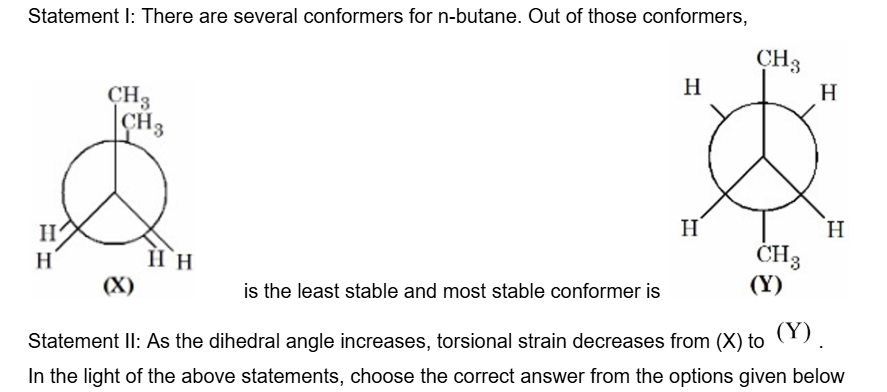
Given below are two statements: Statement I: Newman projections of n-butane: (X) the fully eclipsed conformer with the two CH3 groups together and (Y) the anti conformer with the two CH3 groups opposite. Statement II: as the dihedral angle increases, torsional strain decreases from (X) to (Y).
Correct option: D. Method: Statement I is true: the fully eclipsed conformer (X), with the two CH3 groups eclipsing each other, has the highest energy and is the least stable, while the anti conformer (Y), with the CH3 groups opposite each other, has the lowest energy and is the most stable. Statement II is true: going from the eclipsed conformer (X) to the anti conformer (Y) the dihedral angle increases from 0 degrees to 180 degrees and the torsional strain decreases. Both statements are true.
Q724 Jan 2026, Shift 2
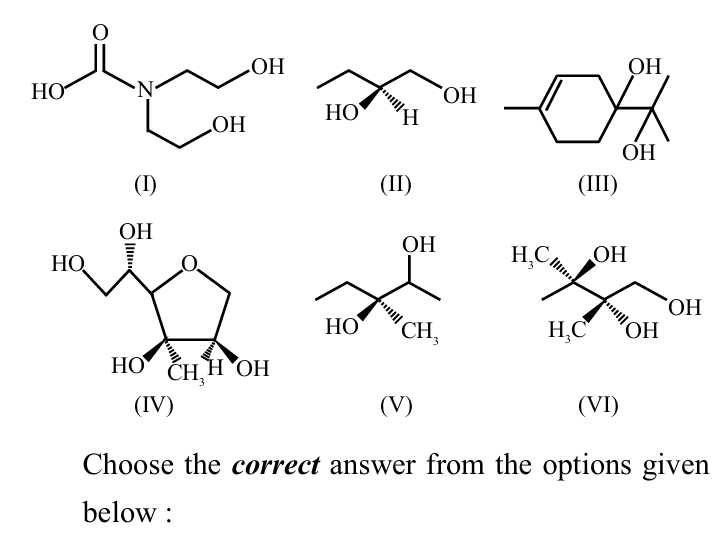
From the following, how many compounds contain at least one secondary alcohol? Six compounds: (I) N,N-bis(2-hydroxyethyl)carbamic acid, HOOC-N(CH2CH2OH)2; (II) a butanediol with a secondary alcohol group, stereochemistry shown with wedge and dash bonds; (III) a methylcyclohexene bearing a C(OH)(CH3)2 group; (IV) a furanose sugar with several OH groups; (V) 3-methylpentane-2,3-diol, CH3CH2-C(OH)(CH3)-CH(OH)-CH3; (VI) a triol, (CH3)2C(OH)-C(OH)(CH3)-CH2OH.
Correct option: B. Method: A secondary alcohol has its OH group on a carbon attached to two other carbons. (II) has a CH-OH group, (IV) has CH-OH groups on the sugar ring and (V) has a CH(OH)-CH3 group, so these three contain a secondary alcohol. (I) has only primary CH2OH groups, and (III) and (VI) have only tertiary C-OH groups. So three compounds contain at least one secondary alcohol.
Q82 Apr 2026, Shift 1
Consider the isomers of hydrocarbon with molecular formula C5H10. These isomers do not decolourise KMnO4 solution. These isomers are subjected to chlorination with chlorine in presence of light to give monochloro compounds. The total number of monochloro compounds (structural isomers only) formed is ____。
Answer: 14. Method: The C5H10 isomers that do not decolourise KMnO4 are the saturated cyclic ones: cyclopentane, methylcyclobutane, ethylcyclopropane, 1,1-dimethylcyclopropane and 1,2-dimethylcyclopropane (cis and trans). Counting distinct monochloro products (structural isomers only): cyclopentane gives 1, methylcyclobutane gives 4, ethylcyclopropane gives 4, 1,1-dimethylcyclopropane gives 2 and 1,2-dimethylcyclopropane gives 3. The total is 1 + 4 + 4 + 2 + 3 = 14.
Q92 Apr 2026, Shift 1
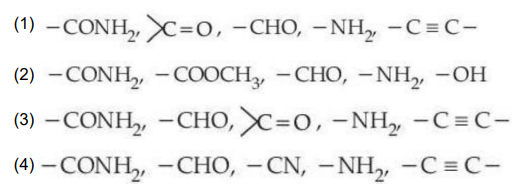
In IUPAC nomenclature, the correct order of decreasing priority of functional group is: Four lists of functional groups in decreasing-priority order: (1) -CONH2, >C=O, -CHO, -NH2, -C≡C−; (2) -CONH2, -COOCH3, -CHO, -NH2, -OH; (3) -CONH2, -CHO, >C=O, -NH2, -C≡C−; (4) -CONH2, -CHO, -CN, -NH2, -C≡C−. (1) = A, (2) = B, (3) = C, (4) = D.
Correct option: C. Method: The IUPAC priority order is: carboxylic acid derivatives (amide) > nitrile > aldehyde > ketone > alcohol > amine > alkyne. So the correct decreasing order is -CONH2 (amide) > -CHO (aldehyde) > >C=O (ketone) > -NH2 (amine) > -C≡C− (alkyne), which is list (3). List (1) puts the ketone before the aldehyde, list (2) puts the ester after the amide although an ester outranks an amide, and list (4) puts the aldehyde before the nitrile although a nitrile outranks an aldehyde.
Q104 Apr 2026, Shift 2
The following structures are Two structures, each a central carbon bonded to Br, Cl and two methyl groups (one methyl shown with a hashed wedge, one with a solid wedge); the second structure is the mirror image of the first.
Correct option: B. Method: Each central carbon carries two methyl groups, so it is not a stereocentre and there is no enantiomer or diastereomer. The two drawings show the same connectivity with the same atoms, so they are identical molecules.
Q115 Apr 2026, Shift 2
Identify the correct IUPAC name of hydrocarbon (x) containing three primary carbon atoms and with molar mass 72 g mol−1.
Correct option: C. Method: The molar mass 72 fits C5H12 (5 × 12 + 12). 2-Methylbutane, (CH3)2CH-CH2-CH3, has three primary carbons: the two methyl groups on C2 and the methyl group on C4. Neopentane (2,2-dimethylpropane) has four primary carbons, n-pentane has two, and 1,1-dimethylcyclopropane is C5H10, not C5H12. So the answer is 2-methylbutane.
Pick an option for a multiple choice question, or type your answer for a numerical question and press Check. A correct choice turns green, a wrong choice turns red and the correct option turns green, and the short method appears below. Once answered, a card locks until you press Reset.
How many IUPAC Nomenclature questions are in this quiz, and from which years?
54 verified JEE Main IUPAC Nomenclature questions: 23 from 2024, 20 from 2025 and 11 from 2026, each in shift order.
How should I use this quiz for revision?
Attempt one year timed, without looking at the method. After checking, note every miss by pattern, such as IUPAC naming, isomerism, or optical isomerism, and rework that pattern the same day.
Do the questions cover both the January and April sessions?
Yes. The 2026 set covers both the January and April sessions, and the 2024 and 2025 sets cover their January and April sessions too.
Are these real JEE Main questions?
Yes. Every question here is a verified JEE Main IUPAC Nomenclature question from 2024, 2025 or 2026, shown with its shift.
Tags
JEE Main 2027IUPAC PYQJEE Main ChemistryPYQ AnalysisRepeat FrequencyUPO Unique PYQsIUPAC NomenclatureIsomerismOrganic ChemistryJEE Main Preparation
Hello 👋 Welcome to Competishun – India’s most trusted platform for JEE & NEET preparation. Need help with JEE / NEET courses, fees, batches, test series or free study material? Chat with us now 👇