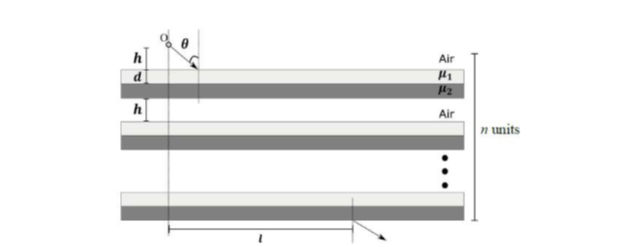
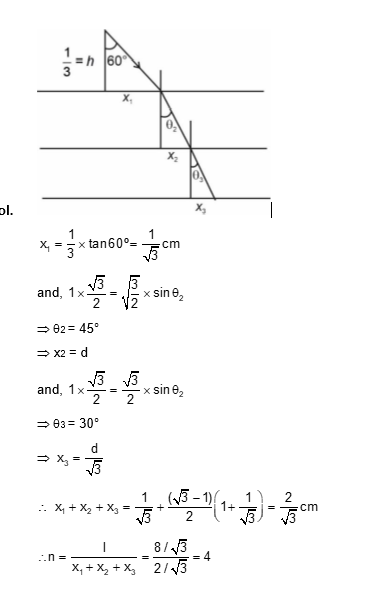
Consider a configuration of n identical units, each consisting of three layers. The first layer is a column of air of height $h=\frac{1}{3} \mathrm{~cm}$, and the second and third layers are of equal thickness $d=\frac{\sqrt{3}-1}{2} \mathrm{~cm}$, and refractive indices $\mu_1=\sqrt{\frac{3}{2}}$ and $\mu_2=\sqrt{3}$, respectively. A light source O is placed on the top of the first unit, as shown in the figure. A ray of light from $O$ is incident on the second layer of the first unit at an angle of $\theta=60^{\circ}$ to the normal. For a specific value of n , the ray of light emerges from the bottom of the configuration at a distance $I=\frac{8}{\sqrt{3}} \mathrm{~cm}$, shown in the figure. The value of $n$ is $\_\_\_\_$ .
Hello 👋 Welcome to Competishun – India’s most trusted platform for JEE & NEET preparation. Need help with JEE / NEET courses, fees, batches, test series or free study material? Chat with us now 👇