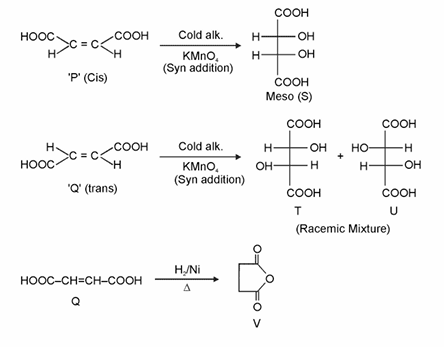
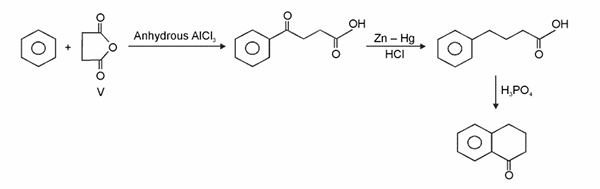
$\mathbf{P}$ and $\mathbf{Q}$ are isomers of dicarboxylic acid $\mathrm{C}_4 \mathrm{H}_4 \mathrm{O}_4$. Both decolorize $\mathrm{Br}_2 / \mathrm{H}_2 \mathrm{O}$. On heating, $\mathbf{P}$ forms the cyclic anhydride.
Upon treatment with dilute alkaline $\mathrm{KMnO}_4, \mathbf{P}$ as well as $\mathbf{Q}$ could produce one or more than one from $\mathbf{S}, \mathbf{T}$ and $\mathbf{U}$.
Compounds formed form P and Q are, respectively
Select the correct option:
A
Optically active $\mathbf{S}$ and optically active pair ( $\mathbf{T}, \mathbf{U}$ )
B
Optically inactive $\mathbf{S}$ and optically inactive pair (T, U)
C
Optically active pair (T, U) and optically active S
D
Optically inactive pair (T, U) and optically inactive $\mathbf{S}$
Hello 👋 Welcome to Competishun – India’s most trusted platform for JEE & NEET preparation. Need help with JEE / NEET courses, fees, batches, test series or free study material? Chat with us now 👇
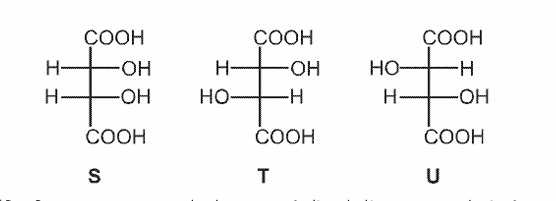 Compounds formed form P and Q are, respectively