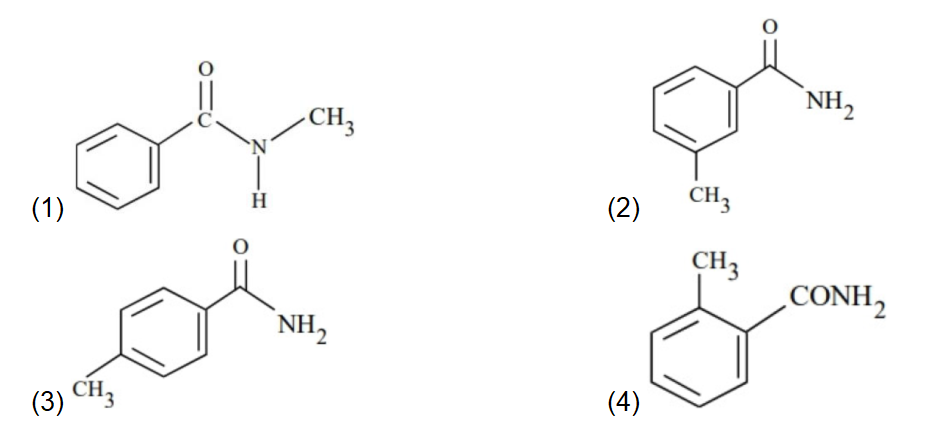
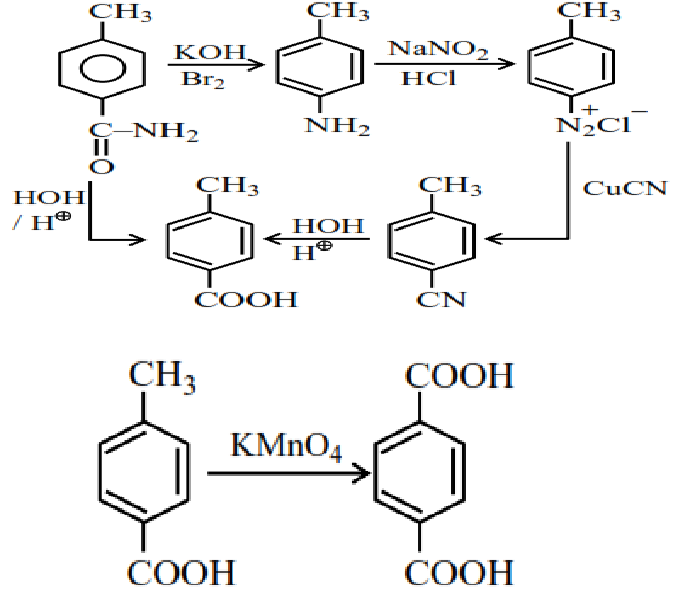
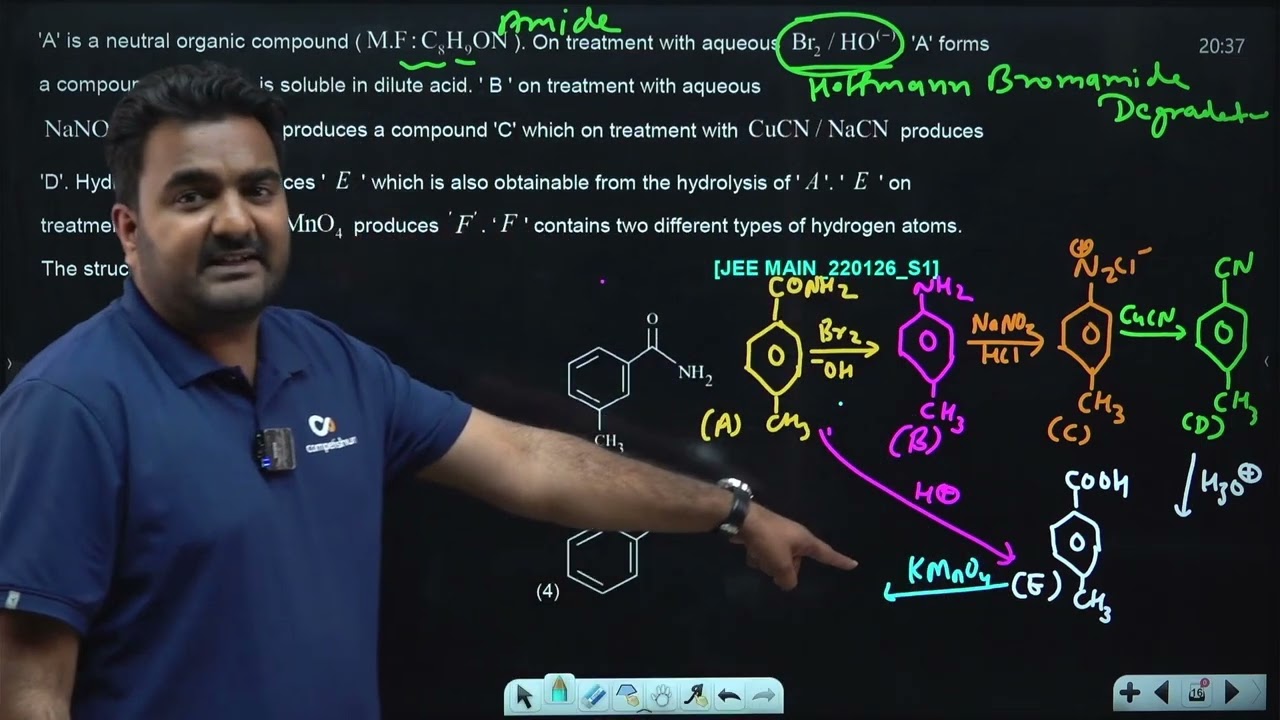
' A ' is a neutral organic compound $\left(\mathrm{M} . \mathrm{F}: \mathrm{C}_8 \mathrm{H}_9 \mathrm{ON}\right)$. On treatment with aqueous $\mathrm{Br}_2 / \mathrm{HO}^{(-)}$, ' A ' forms a compound ' B ' which is soluble in dilute acid. ' B ' on treatment with aqueous
$\mathrm{NaNO}_2 / \mathrm{HCl}\left(0-5^{\circ} \mathrm{C}\right)$ produces a compound ' C ' which on treatment with $\mathrm{CuCN} / \mathrm{NaCN}$ produces
' D '. Hydrolysis of ' D ' produces ' $E$ ' which is also obtainable from the hydrolysis of ' $A$ '. ' $E$ ' on treatment with acidified $\mathrm{KMnO}_4$ produces ${ }^{\prime} F^{\prime}$. ' $F^{\prime}$ ' contains two different types of hydrogen atoms.
The structure of ' $A$ ' is
Hello 👋 Welcome to Competishun – India’s most trusted platform for JEE & NEET preparation. Need help with JEE / NEET courses, fees, batches, test series or free study material? Chat with us now 👇