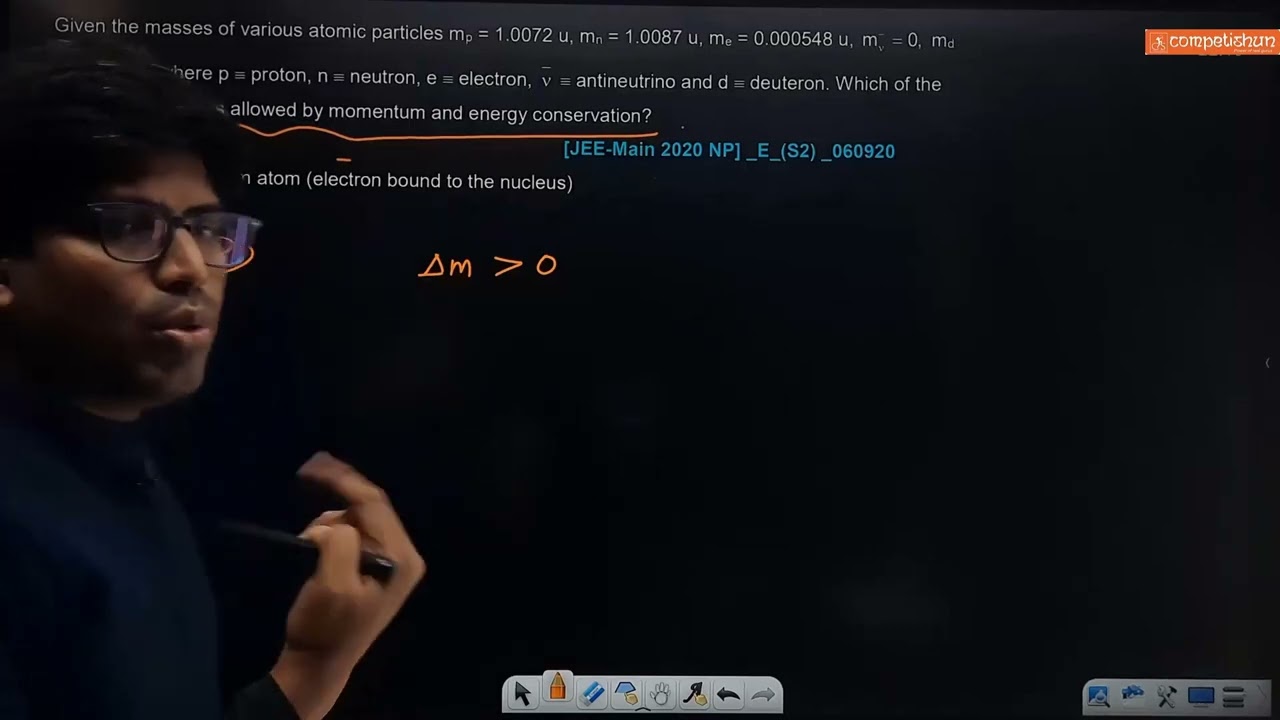
Given the masses of various atomic particles $\mathrm{m}_{\mathrm{p}}= 1.0072 \mathrm{u}, \mathrm{m}_{\mathrm{n}}=1.0087 \mathrm{u}, \mathrm{m}_{\mathrm{e}}=0.000548 \mathrm{u}$, $\mathrm{m}_{\mathrm{v}}^{-}=0, \quad \mathrm{~m}_{\mathrm{d}}=2.0141 \mathrm{u}$, where $\mathrm{p} \equiv$ proton, $\mathrm{n} \equiv$ neutron, $\mathrm{e} \equiv$ electron, $\overline{\mathrm{v}} \equiv$ antineutrino and $\mathrm{d} \equiv$ deuteron. Which of the following process is allowed by momentum and energy conservation?
Select the correct option:
A
$n+n \rightarrow$ deuterium atom (electron bound to the nucleus)
Hello 👋 Welcome to Competishun – India’s most trusted platform for JEE & NEET preparation. Need help with JEE / NEET courses, fees, batches, test series or free study material? Chat with us now 👇