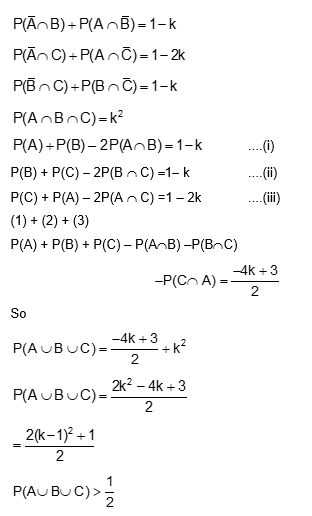
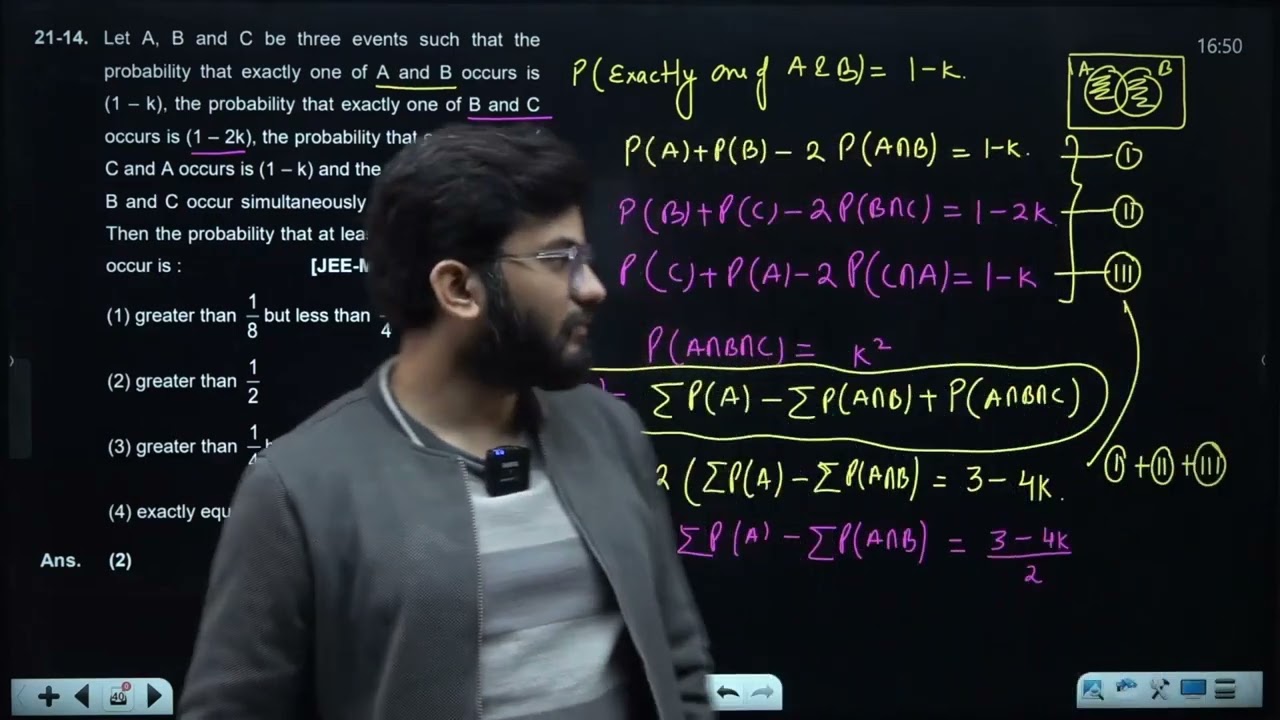
Let $A, B$ and $C$ be three events such that the probability that exactly one of $A$ and $B$ occurs is $(1-k)$, the probability that exactly one of $B$ and $C$ occurs is $(1-2 k)$, the probability that exactly one of $C$ and $A$ occurs is $(1-k)$ and the probability of all $A, B$ and $C$ occur simultaneously is $k^2$, where $0
Select the correct option:
A
greater than $\frac{1}{8}$ but less than $\frac{1}{4}$
B
greater than $\frac{1}{2}$
C
greater than $\frac{1}{4}$ but less than $\frac{1}{2}$
Hello 👋 Welcome to Competishun – India’s most trusted platform for JEE & NEET preparation. Need help with JEE / NEET courses, fees, batches, test series or free study material? Chat with us now 👇