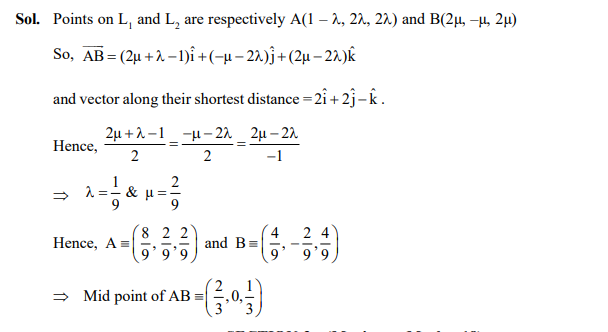
Let $\mathrm{L}_1$ and $\mathrm{L}_2$ denotes the lines
$$
\begin{aligned}
& \overrightarrow{\mathrm{r}}=\hat{\mathrm{i}}+\lambda(-\hat{\mathrm{i}}+2 \hat{\mathrm{j}}+2 \hat{\mathrm{k}}), \lambda \in \mathbb{R} \text { and } \\
& \overrightarrow{\mathrm{r}}=\mu(2 \hat{\mathrm{i}}-\hat{\mathrm{j}}+2 \hat{\mathrm{k}}), \mu \in \mathbb{R}
\end{aligned}
$$
respectively. If $\mathrm{L}_3$ is a line which is perpendicular to both $\mathrm{L}_1$ and $\mathrm{L}_2$ and cuts both of them, then which of the following options describe(s) $\mathrm{L}_3$ ?
Hello 👋 Welcome to Competishun – India’s most trusted platform for JEE & NEET preparation. Need help with JEE / NEET courses, fees, batches, test series or free study material? Chat with us now 👇