Most materials have therefractive index, $n>1$. So, when a light ray from air enters a naturally occurring material, then by Snells' law, $\frac{\sin \theta_1}{\sin \theta_2}=\frac{n_2}{n_1}$, it is understood that the refracted ray bends towards the normal.
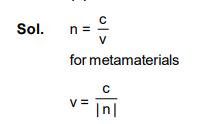
But it never emerges on the same side of the normal as the incident ray. According to electromagnetism, the refractive index of the medium is given by the relation, $n=\left(\frac{c}{v}\right)= \pm \sqrt{\varepsilon_r \mu_r}$ where $c$ is the speed of electromagnetic waves in vacuum, $v$ its speed in the medium, $\varepsilon_r$ and $\mu_r$ are negative, one must choose the negative root of n . Such negative refractive index materials can now be artificially prepared and are called meta-materials. They exhibit significantly different optical behavior, without violating any physical laws. Since n is negative, it results in a change in the direction of propagation of the refracted light. However, similar to normal materials, the frequency of light remains unchanged upon refraction even in meta-materials.
Choose the correct statement.
Select the correct option:
A
The speed of light in the meta-material is $\mathrm{v}=\mathrm{c}|\mathrm{n}|$
B
The speed of light in the meta-material is $v=\frac{c}{|n|}$
C
The speed of light in the meta-material is $\mathrm{v}=\mathrm{c}$.
D
The wavelength of the light in the meta-material $\left(\lambda_{\mathrm{m}}\right)$ is given by $\lambda_{\mathrm{m}}=\lambda_{\mathrm{air}}|\mathrm{n}|$, where $\lambda_{\mathrm{ar}}$ is the wavelength of the light in air.
Hello 👋 Welcome to Competishun – India’s most trusted platform for JEE & NEET preparation. Need help with JEE / NEET courses, fees, batches, test series or free study material? Chat with us now 👇