JEE Main Physics PYQ Chapter Wise 2027: Best Practice Strategy
JEE Main PYQs · Competishun
JEE Main Physics PYQ Chapter Wise 2027: Best Practice Strategy
Start with the 1,527 unique Physics patterns, not the full 4,369 questions. Practise chapter by chapter, most repeated patterns first, and use the four verified chapters below as your first targets. This guide maps every Physics chapter, shows the verified numbers, and gives a five step cycle you can repeat for each chapter.
Physics is the subject where chapter-wise PYQ practice pays off fastest, and also where it goes wrong fastest. The subject is wide, the chapters link to each other, and a paper-by-paper routine hides all of that. You finish papers, feel busy, and still meet new-looking questions every week.
The fix is to practise by chapter and by pattern. A chapter gives you one set of ideas at a time. A pattern tells you which questions inside that chapter actually return. Together, they turn a pile of 4,369 questions into 1,527 patterns you can own, one chapter at a time.
This guide stays honest about numbers. It prints verified counts only: the subject totals from the full 2019 to 2026 classification, and four chapter counts verified question by question from the 2024 to 2026 papers. Every other chapter gets a practice approach, not an invented count.
In this guide
Physics PYQ Chapter Wise: The Short Answer
Most aspirants practise Physics PYQs paper by paper. That feels complete, but it hides the structure of the subject. The same patterns return across shifts, so paper order makes you re-solve what you already know while new patterns stay hidden.
- Unique first: solve the 1,527 unique Physics patterns before touching repeats. Repeats become speed practice, not discovery.
- Chapter by chapter: finish one chapter fully before opening the next. Mixed papers mix learnt and unlearnt chapters, so a low score tells you nothing.
- Most repeated first: rank each chapter patterns by Repeat Frequency, and solve the high frequency set first. The exam has already told you these matter.
- Cluster every miss: for each missed pattern, solve its repeat set the same day, timed, until you spot it instantly.
- Revisit timed: re-solve the misses after seven days without peeking. A pattern solved once is not a pattern owned.
The rest of this guide turns that short answer into a plan. You get the verified numbers, the full chapter map, the four chapters with verified counts, a five step cycle, and a four week plan that starts with those four chapters.
What 4,369 Physics PYQs Actually Mean: 1,527 Unique Patterns
Between 2019 and 2026, JEE Main Paper 1 asked 4,369 Physics questions across all shifts. Classified pattern by pattern, only 1,527 of them are unique. The other 2,842 are repeats of patterns already asked.
Swipe to see all four numbers
| Subject | Total PYQs (2019 to 2026) | Unique | Repeats | Unique Share |
|---|---|---|---|---|
| Physics | 4,369 | 1,527 | 2,842 | 35% |
| Chemistry | 3,781 | 1,242 | 2,539 | 33% |
| Mathematics | 3,868 | 1,579 | 2,289 | 41% |
| Total (PCM) | 12,018 | 4,348 | 7,670 | 36% |
| Full classification, JEE Main Paper 1, 2019 to 2026, all shifts. | ||||
Swipe the table sideways to see all columns
Physics split, 2019 to 2026. About two out of three Physics PYQs repeat a pattern already asked.
Physics sits between Chemistry and Maths. Chemistry compresses fastest at about 33 percent unique, and Maths is widest at about 41 percent. Physics, at about 35 percent unique, means roughly two out of three Physics questions you meet are repeats.
That split decides the strategy. Solving all 4,369 questions in paper order spends most of your time on repeats. Solving the 1,527 unique patterns first, ranked by Repeat Frequency, covers the same ground in about a third of the questions.
Read the split as a promise, not as a shortcut. The unique set is smaller, but it still needs real work: theory first, then timed practice, then revision. What it removes is wasted work, not hard work.
Four Physics Chapters With Verified 2024 to 2026 Counts
Most chapter-wise count tables on the internet are guesses. This guide prints counts only where our own quiz sets verified every question against the 2024 to 2026 papers. Four Physics chapters clear that bar so far.
Questions asked in JEE Main 2024 to 2026, from our verified quiz sets. Bars are scaled to the largest count, 85.
| Chapter | Questions asked, 2024 to 2026 | How to read it |
|---|---|---|
| Geometrical Optics | 85 | Highest verified count of the four. Start here if you want the biggest recent bank first. |
| Electrostatics | 77 | About 223 raw questions from 2019 to 2026 compress to roughly 80 unique patterns. |
| Current Electricity | 61 | Method heavy chapter. Most misses come from circuit reduction, not from missing formulas. |
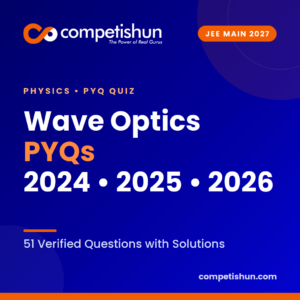
| Wave Optics | 51 | Smallest verified count of the four, but concept heavy, so a small pattern set covers it well. |
| Counts from our verified quiz sets. Each question was checked against the JEE Main 2024 to 2026 papers. Together, the four chapters account for 274 questions. | ||
Swipe the table sideways to see all columns
These four chapters alone account for 274 verified questions across three years. That is why they make good first targets. A chapter with a verified count lets you plan honestly, because you know exactly how many questions the recent papers asked.
For every other Physics chapter, this guide gives no count. No count is printed unless it is verified, and a missing count is not a small chapter. It only means the count is not verified yet.
The Full JEE Main Physics Chapter Map
The map below lists the standard JEE Main Physics chapters in groups, with a practice approach for each group. Chapter names follow the standard NCERT and JEE Main syllabus. No question counts appear here, because only the four chapters above carry verified counts.
| Chapter group | Chapters in the group | How to practise it |
|---|---|---|
| Mechanics | Units and Measurements, Kinematics, Laws of Motion, Work Energy and Power, Rotational Motion, Gravitation | Practise with free body diagrams and energy methods first. Mechanics feeds every other group, so fix it early. |
| Heat and Thermodynamics | Thermodynamics, Kinetic Theory of Gases | Learn the sign conventions and the standard cycles first. Then drill numerical patterns, not theory notes. |
| Oscillations and Waves | Simple Harmonic Motion, Waves and Sound | Practise phase, energy and wave equation patterns together. Small chapters, quick to finish once the basics click. |
| Electrostatics and Current | Electrostatics, Current Electricity, Capacitors | Study Electrostatics before Current Electricity. Capacitor and circuit patterns build directly on field and potential ideas. |
| Magnetism, EMI and AC | Moving Charges and Magnetism, Magnetism and Matter, Electromagnetic Induction, Alternating Current | Practise direction rules and induced EMF patterns as one family. AC circuits reward phasor and RMS practice. |
| Optics | Ray Optics and Optical Instruments, Wave Optics | Fix the sign convention once, then drill lens, mirror and interference patterns. Ray optics first, wave optics next. |
| Modern Physics | Dual Nature of Matter, Atoms, Nuclei, Semiconductors and Communication Systems | Practise as short, regular sets. These chapters are compact, and they reward frequent revision more than long sittings. |
| Standard JEE Main Physics chapters, grouped by theme. Practice approach per group, no invented counts. | ||
Swipe the table sideways to see all columns
Work the groups in the order your syllabus finishes, not in the order of this table. A chapter practised right after its theory is fresh beats a chapter practised months later from a cold start.
- Mechanics first: it feeds every other group. Free body diagrams, energy methods and rotation return inside Electrostatics, Magnetism and Modern Physics questions too.
- Electrostatics before Current Electricity: capacitor and circuit patterns build directly on field and potential ideas. Reversing the order makes both chapters harder.
- Ray optics before Wave optics: lens and mirror practice makes interference and diffraction easier, because the ray picture stays in your head.
- Modern Physics in short, regular sets: these chapters are compact, so they reward frequent revision more than long sittings. A little, often, beats a lot, once.
- Keep one chapter open at a time: finish the five step cycle for a chapter before opening the next. Two half-finished chapters help less than one finished chapter.
The 5-Step Chapter-Wise PYQ Cycle for Physics
One cycle fits every Physics chapter. Learn it once, then repeat it chapter by chapter until the whole map is covered. The order matters, because each step fixes a different failure.
The five step cycle, one chapter at a time
Learn the chapter first
Theory, NCERT lines and basic practice until every core concept can be stated in one line.
Solve its unique questions
Take on the chapter unique bank at exam pace, most repeated patterns first.
Where marks hideName each pattern
Before moving on, name the pattern in one line, without the numbers. If you cannot name it, you have not learnt it.
Pattern checkCluster the misses
For every missed pattern, solve its repeat set the same day, timed, until you spot it instantly.
Revisit timed after 7 days
Re-solve the misses without peeking. Whatever fails again stays in the log with a new date.
Practise loopTwo habits make the cycle work. First, name every pattern before moving on, even the ones you got right. Second, time the unique set. A pattern recognised slowly is not yet an exam mark, and the clock is the only honest test of that.
- Log every miss by type: concept miss, calculation miss, or silly mistake. The type decides the fix, so never log a miss without its type.
- Re-solve, do not re-read: reading a solution feels like learning, but it is not. Close the solution and solve the question again from scratch.
- Keep the error log short: one line per pattern, with a revisit date. A long log nobody opens is decoration, not a tool.
- End each chapter with a mixed set: a short timed set drawn only from that chapter, mixing its patterns together. It proves the chapter is really done.
A chapter is done when you can name its patterns on sight and solve its unique set timed without peeking. Until then, the chapter stays open, and that is fine. An open chapter with a plan beats a ticked chapter with gaps.
The Four Verified Chapters, Pattern by Pattern
Electrostatics: 77 Questions in 2024 to 2026
Electrostatics is the best return on effort in this set. About 223 raw questions from 2019 to 2026 compress to roughly 80 unique patterns, close to 2.8 to 1. Own those patterns, and the chapter stops feeling endless.
- Coulomb law and field patterns: field of point charges and charge distributions, with the same setup returning under new values and arrangements.
- Gauss law patterns: field of spheres, cylinders and planes, where the symmetry call decides the whole question.
- Potential and equipotential patterns: potential difference, work done moving a charge, and equipotential surfaces.
- Capacitor patterns: series and parallel combinations, energy stored, and dielectrics, often mixed into one question.
- Dipole patterns: field and potential of a dipole, torque on a dipole in a uniform field.
Learn this chapter by naming the charge arrangement first, before any formula. Most misses come from solving the wrong arrangement, not from a wrong formula.
Current Electricity: 61 Questions in 2024 to 2026
Current Electricity rewards method more than memory. Most misses come from a wrong circuit reduction or a sign error, not from a missing formula. Draw the reduced circuit before writing any equation.
- Kirchhoff law patterns: loop and junction equations, where a clean diagram matters more than speed.
- Wheatstone bridge and meter bridge patterns: balance conditions and unknown resistance, returning with new resistor values.
- Potentiometer patterns: null point and EMF comparison, where the setup is the same every time.
- Resistivity patterns: resistance with temperature, series and parallel combinations of wires.
- Cell patterns: internal resistance, grouping of cells, and maximum power transfer.
Practise this chapter with a pen and a diagram for every question. A circuit solved in your head is a circuit half solved, and the missing half is usually where the marks go.
Geometrical Optics: 85 Questions in 2024 to 2026
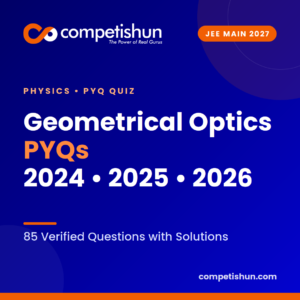
Geometrical Optics carries the highest verified count of the four, at 85 questions in 2024 to 2026. Sign convention errors cause most misses here. Fix the convention once, and a whole family of questions turns easy.
- Mirror and lens formula patterns: image formation with the sign convention applied the same way every time.
- Refraction patterns: refraction at plane and spherical surfaces, apparent depth, and lateral shift.
- Total internal reflection patterns: critical angle and its applications, often mixed with prism questions.
- Prism patterns: angle of deviation, minimum deviation, and dispersive power.
- Optical instrument patterns: microscope and telescope basics, magnifying power and resolving power.
Keep one sign convention card on your desk while practising this chapter. Check every answer against it until the convention runs on its own. Then the chapter becomes fast, because the questions are mostly the same few setups.
Wave Optics: 51 Questions in 2024 to 2026
Wave Optics is smaller, at 51 verified questions, but it is concept heavy. Interference and diffraction questions repeat the same few setups, so a small pattern set covers the chapter well.
- Young double slit patterns: fringe width, path difference, and fringe shifts with new slit and screen values.
- Interference patterns: constructive and destructive conditions, thin film interference basics.
- Diffraction patterns: single slit minima and maxima, and the width of the central maximum.
- Polarisation patterns: Malus law and Brewster angle, where the concept decides the question in one step.
Learn Wave Optics by drawing the setup first: slits, screen, and path difference. A drawn setup makes the formula obvious, and a memorised formula without the setup makes every new question look new.
These pattern families are qualitative descriptions of question types, not counts. Only the chapter totals above are verified numbers, and only the Electrostatics compression, about 223 raw questions to roughly 80 unique patterns, is a verified ratio.
How UPO Clusters and Repeat Frequency Work for Physics
UPO groups similar PYQs into clusters. One representative question heads each cluster, and every repeat sits inside it. Clusters rank by Repeat Frequency, highest first, so the most repeated patterns come first.
| Repeat Frequency | What it means | What to do |
|---|---|---|
| High | The pattern has returned many times across the pool | Must-do first. These are the important questions of the chapter. |
| Medium | The pattern has returned a few times | Important, after the high set. Practise them next. |
| Low | The pattern has returned once or twice | Low value for now. Cover them after the higher sets. |
| First appearance | The pattern has appeared once, with no repeat yet | New, not unimportant. Watch it, but do not rank it first. |
| Read RF highest to lowest. The ranking is the identification of the important set. | ||
Swipe the table sideways to see all columns
UPO for JEE Main 2027
2019 to 2026 · Physics, Chemistry and Maths
All 12,018 JEE Main PYQs analysed and clustered: solve the 4,348 unique questions first, ranked by Repeat Frequency, with every repeat one tap away in its cluster and written, express and detailed solutions for each question.
PYQ Express
Video + Text Solutions · Chapter & Topic-wise
JEE Main PYQs sorted chapter-wise and topic-wise, with express video solutions for fast methods, detailed video solutions and step-by-step text solutions.
Use the three solution formats for different jobs. Written solutions pin down the exact step missed. Express video rebuilds speed when the method is clear but slow. Detailed video rebuilds the concept when it feels shaky.
If you practise from a book instead, run the same order by hand. Flag repeats as you meet them, and never finish a missed pattern without solving at least one of its repeats.
Worth repeating: if a chapter set is already going well, finish it. Bring UPO in for the remaining chapters, then run one quick UPO cycle as revision. Jumping ship halfway through a set that works helps no one.
Your 4-Week Physics PYQ Plan
Four weeks, four verified chapters first, then the rest of the map. The plan assumes your theory for each chapter is already done. If it is not, learn the theory first and shift the week.
| Week | Focus chapter | Daily work | Done means |
|---|---|---|---|
| Week 1 | Electrostatics | Learn the chapter, solve its 77 verified questions most repeated first, cluster every miss the same day. | You can name its patterns on sight and solve the set timed. |
| Week 2 | Current Electricity | Solve its 61 verified questions, draw every reduced circuit before writing equations, log sign errors. | Circuit reduction runs without hesitation, and Kirchhoff problems finish inside time. |
| Week 3 | Geometrical Optics | Solve its 85 verified questions, fix the sign convention first, then drill lens, mirror and prism patterns. | Sign convention errors stop appearing, and ray diagrams take seconds, not minutes. |
| Week 4 | Wave Optics plus mixed revision | Solve its 51 verified questions, then run one timed mixed set across all four chapters. | All 274 verified questions are covered, and the error log shows which patterns still fail. |
| One verified chapter per week, then a mixed revision week. Extend the same rhythm to the rest of the map after week 4. | |||
Swipe the table sideways to see all columns
- One timed mixed set every weekend: a short set drawn from the chapters covered so far, with every miss logged by type and tier.
- Weekly error log revision: work through the past week error log entries again, timed, without peeking at solutions first.
- Monthly high frequency cycle: each month, re-test just the high Repeat Frequency patterns plus twice-failed chapters. Deliberately short, the final filter before the last phase.
- No new chapter before the old one closes: a chapter closes when its unique set runs timed without peeking. Until then, it stays the priority.
After four weeks, repeat the cycle for the next group on the map. Mechanics next, then Magnetism and Modern Physics, always in the same five step order. The plan never changes, only the chapter does.
Mistakes That Waste Physics PYQ Practice
- Solving paper by paper: papers throw learnt and unlearnt chapters together, so each set feels tough for the wrong reasons, and weak patterns hide inside an average score.
- Counting questions instead of patterns: a solved tally climbs while coverage hardly shifts. Count patterns identified, not questions attempted.
- Skipping theory to reach PYQs faster: a PYQ from a chapter you have not learnt only measures what you do not know. Learn first, solve second.
- Memorising answers instead of methods: a changed number defeats a memorised answer. Learn the method behind each pattern, so any variation is solvable.
- Practising without a timer: untimed practice hides slow patterns. A pattern recognised slowly is not yet an exam mark.
- Never revisiting the error log: an error log written and never opened again is just decoration. The method lives in the revisit dates, not in the writing.
- Trusting invented chapter counts: exact per-chapter counts without a verified classification are guesses. Stick to verified totals and the Repeat Frequency ranking.
Chapter-wise Physics PYQ practice works when the chapter comes first and the pattern comes second. Learn the chapter, solve its unique patterns most repeated first, cluster every miss, and revisit timed. Start with the four verified chapters, then work the map, one chapter at a time.
Explore the method on the UPO page, and use the Electrostatics quiz and the analysis guide linked below to see the cycle running on real questions.
Start With the Physics Patterns That Return
Solve the 1,527 unique Physics PYQs first, ranked by Repeat Frequency, with every repeat inside its cluster and written, express and detailed solutions on one screen.
About Competishun
Competishun is an online JEE and NEET coaching platform with programs for Class 11, Class 12 and droppers, PYQ courses and books, study material and an All India Test Series, taught by experienced senior faculty. More than 2.2 million students follow the Competishun YouTube channel for free concept lectures and PYQ solutions.
Physics PYQ Chapter Wise for JEE Main 2027
Follow Competishun for daily PYQ solutions, concept lectures and JEE Main 2027 updates.
Read These Next
Clusters, Repeat Frequency and three solution formats, explained on the UPO page.
Every JEE Main PYQ from 2019 to 2026, sorted chapter-wise and topic-wise, with text and video solutions.
77 verified Electrostatics questions from JEE Main 2024 to 2026, with answers and explanations.
Frequently Asked Questions
Tags