JEE Main Modern Physics PYQs 2024, 2025 and 2026: All Questions with Solutions
JEE Main Modern Physics PYQs 2024, 2025 and 2026: All Questions with Solutions
Verified JEE Main Modern Physics questions from 2024, 2025 and 2026, shift by shift. The 2024, 2025 and 2026 sets are interactive now: pick an option or enter a number and check instantly. Attempt timed, check the method only after answering, and log every miss by pattern.
How to use this quiz
1. Attempt one year timed, without looking at the method.
2. Click an option, or type a number and press Check, for instant right or wrong feedback.
3. Read the short method only after answering, then log the miss by pattern.
4. Rework your weak patterns the same day, then reattempt the year.
2024 Questions (39)
The radius of third stationary orbit of electron for Bohr's atom is R. The radius of fourth stationary orbit will be:
If Rydberg's constant is R, the longest wavelength of radiation in Paschen series will be α7 R, where α=
The electric potential at the surface of an atomic nucleus (z=50) of radius 9 × 10⁻¹³ cm is × 106 V
An object is placed in a medium of refractive index 3 . An electromagnetic wave of intensity 6 × 10⁸ W / m2 falls normally on the object and it is absorbed completely. The radiation pressure on the object would be (speed of light in free space =3 × 10⁸ m / s ):
The threshold frequency of a metal with work function 6.63eV is :
The atomic mass of 6 C12 is 12.000000 u and that of 6 C13 is 13.003354 u . The required energy to remove a neutron from 6 C13, if mass of neutron is 1.008665 u , will be
When a hydrogen atom going from n=2 to n=1 emits a photon, its recoil speed is x5 m / s. Where x=(. Use : mass of hydrogen atom .=1.6 × 10⁻²⁷ kg)
The de-Broglie wavelength of an electron is the same as that of a photon. If velocity of electron is 25% of the velocity of light, then the ratio of K.E. of electron and K.E. of photon will be:
Hydrogen atom is bombarded with electrons accelerated through a potential different of V, which causes excitation of hydrogen atoms. If the experiment is being formed at T=0 K. The minimum potential difference needed to observe any Balmer series lines in the emission spectra will be α10 V, where α=
Given below are two statements : Statement I : Most of the mass of the atom and all its positive charge are concentrated in a tiny nucleus and the electrons revolve around it, is Rutherford's model. Statement II : An atom is a spherical cloud of positive charges with electrons embedded in it, is a special case of Rutherford's model. In the light of the above statements, choose the most appropriate from the options given below. (1) Both statement I and statement II are false (2) Statement I is false but statement II is true (3) Statement I is true but statement II is false (4) Both statement I and statement II are true
Two sources of light emit with a power of 200" " W. The ratio of number of photons of visible light emitted by each source having wavelengths 300 nm and 500" " nm respectively, will be :
A electron of hydrogen atom on an excited state is having energy En =-0.85eV. The maximum number of allowed transitions to lower energy level is.......
The ratio of the magnitude of the kinetic energy to the potential energy of an electron in the 5th excited state of a hydrogen atom is :
The work function of a substance is 3.0eV. The longest wavelength of light that can cause the emission of photoelectrons from this substance is approximately:
When a metal surface is illuminated by light of wavelength λ, the stopping potential is 8" " V. When the same surface is illuminated by light of wavelength 3λ, stopping potential is 2" " V. The threshold wavelength for this surface is
If the wavelength of the first member of Lyman series of hydrogen is λ. The wavelength of the second member will be
A nucleus has mass number A1 and volume V1. Another nucleus has mass number A2 and volume V2. If relation between mass number is A2=4 A1, then V2V1=
The mass number of nucleus having radius equal to half of the radius of nucleus with mass number 192
In a photoelectric effect experiment a light of frequency 1.5 times the threshold frequency is made to fall on the surface of photosensitive material. Now if the frequency is halved and intensity is doubled, the number of photo electrons emitted will be:
For the photoelectric effect, the maximum kinetic energy (Ek) of the photoelectrons is plotted against the frequency (v) of the incident photons as shown in figure. The slope of the graph gives Ek (vertical axis) plotted against frequency v (horizontal axis): a straight line starting at the threshold frequency on the v-axis and rising at an angle theta to the v-axis.

The radius of a nucleus of mass number 64 is 4.8 fermi. Then the mass number of another nucleus having radius of 4 fermi is 1000x, where x is
The minimum energy required by a hydrogen atom in ground state to emit radiation in Balmer series is nearly :
The de Broglie wavelengths of a proton and an α particle are λ and 2λ respectively. The ratio of the velocities of proton and α particle will be :
A particular hydrogen - like ion emits the radiation of frequency 3 × 10¹⁵ Hz when it makes transition from n=2 to n=1. The frequency of radiation emitted in transition from n=3 to n=1 is x9 × 1015 Hz, when x=_____.
Monochromatic light of frequency 6 × 10¹⁴ Hz is produced by a laser. The power emitted is 2 × 10⁻³ W W. How many photons per second on an average, are emitted by the source ? (Given h=6.63 × 10⁻³⁴ Js )
A hydrogen atom changes its state from n=3 to n=2. Due to recoil, the percentage change in the wave length of emitted light is approximately 1 × 10−n. The value of n is ____ . [Given Rhc=13.6 eV, hc=1242 eVnm, h=6.6 × 10⁻³⁴ Js, mass of the hydrogen atom .=1.6 × 10⁻²⁷ kg]
Which figure shows the correct variation of applied potential difference (V) with photoelectric current (I) at two different intensities of light (I1<I2) of same wavelengths Four i-V graphs labelled (1) to (4): (1) both curves start at -V0 and saturate, I2 saturating higher than I1; (2) the I2 curve does not start at -V0; (3) both curves start at -V0 and rise to saturation, I2 higher than I1; (4) the two curves cross each other. (1) = A, (2) = B, (3) = C, (4) = D.

An electron rotates in a circle around a nucleus having positive charge Ze. Correct relation between total energy (E) of electron to its potential energy (U) is:
Given below are two statements: Statement-I: Figure shows the variation of stopping potential with frequency ( v ) for the two photosensitive materials M1 and M2. The slope gives value of he, where h is Planck's constant, e is the charge of electron. Statement-II: M2 will emit photoelectrons of greater kinetic energy for the incident radiation having same frequency. In the light of the above statements, choose the most appropriate answer from the options given below. Stopping potential V0 (vertical axis) plotted against frequency v (horizontal axis) for two photosensitive materials M1 and M2: two parallel straight lines, M1 with the lower threshold frequency and M2 with the higher threshold frequency.

Radius of a certain orbit of hydrogen atom is 8.48Å. If energy of electron in this orbit is E/x, then x=(Given a0 = 0.529Å, E = energy of electron in ground state)
In photoelectric experiment energy of 2.48eV irradiates a photo sensitive material. The stopping potential was measured to be 0.5 V. Work function of the photo sensitive material is :
The ratio of the shortest wavelength of Balmer series to the shortest wavelength of Lyman series for hydrogen atom is :
In an alpha particle scattering experiment distance of closest approach for the α particle is 4.5 × 10⁻¹⁴ m . If target nucleus has atomic number 80, then maximum velocity of α-particle is _______ approximately.(14 π ε0=9 × 10⁹ SI. unit, mass of α particle .=6.72 × 10⁻²⁷ kg)
Binding energy of a certain nucleus is 18 × 108 J. How much is the difference between total mass of all the nucleons and nuclear mass of the given nucleus:
A proton and an electron are associated with same de-Broglie wavelength. The ratio of their kinetic energies is: (Assume h=6.63 × 10⁻³⁴ J s, me=9.0 × 10⁻³¹ kg and mp=1836 times me)
Average force exerted on a non-reflecting surface at normal incidence is 2.4 × 10⁻⁴ N. If 360 W / cm2 is the light energy flux during span of 1 hour 30 minutes. Then the area of the surface is
A star has 100 % helium composition. It starts to convert three 4 He into one 12 C via triple alpha process as 4 He+ 4 He+ 4 He → 12 C+Q. The mass of the star is 2.0 × 1032 kg and it generates energy at the rate of 5.808 × 1030 W. The rate of converting these 4 He to 12 C is n × 1042 s−1, where n is [Take, mass of 4 He=4.0026 u, mass of 12 C=12 u
The energy equivalent of 1 g of substance is
A proton, an electron and an alpha particle have the same energies. Their de-Broglie wavelengths will be compared as:
UPO
Unique PYQs Only. Solve only what is new.
✓4,348 unique PYQs
✓Repeated questions grouped in clusters
PYQ Express
Every JEE Main PYQ in one place.
✓10,000+ PCM PYQs
✓Physics, Chemistry, Maths
2025 Questions (33)
An electron in the ground state of the hydrogen atom has the orbital radius of 5.3 × 10 − 11 m while that for the electron in third excited state is 8.48 × 10 − 10 m . The ratio of the de Broglie wavelengths of electron in the ground state to that in the excited state is
The work functions of cesium (Cs) and lithium (Li) metals are 1.9 eV and 2.5 eV , respectively. If we incident a light of wavelength 550 nm on these two metal surfaces, then photo-electric effect is possible for the case of
A light source of wavelength λ illuminates a metal surface and electrons are ejected with maximum kinetic energy of 2 eV . If the same surface is illuminated by a light source of wavelength λ2, then the maximum kinetic energy of ejected electrons will be (The work function of metal is 1 eV )
An electron projected perpendicular to a uniform magnetic field B moves in a circle. If Bohr's quantization is applicable, then the radius of the electronic orbit in the first excited state is :
A sub-atomic particle of mass 10−30 kg is moving with a velocity 2.21× 10⁶ m/s. Under the matter wave consideration, the particle will behave closely like ............ ( h=6.63× 10⁻³⁴ J.s )
In photoelectric effect an em-wave is incident on a metal surface and electrons are ejected from the surface. If the work function of the metal is 2.14 eV and stopping potential is 2 V, what is the wavelength of the em-wave ? (Given hc = 1242 eVnm where h is the Planck's constant and c is the speed of light in vaccum.)
An electron of mass 'm' with an initial velocity v = v0î( v0 > 0 ) enters an electric field E = - EOk̂ . If the initial de Broglie wavelength is λ 0, the value after time t would be
The ratio of the power of a light source S1 to that the light source S2 is 2 S1 is emitting 2 × 10¹⁵ photons per second at 600 nm . If the wavelength of the source S2 is 300 nm , then the number of photons per second emitted by S2 is______ × 1024.
The energy E and momentum p of a moving body of mass m are related by some equation. Given that e represents the speed of light, identify the correct equation
In photoelectric effect, the stopping potential (V0) v / s frequency (v) curve is plotted. (h is the Planck's constant and φ0 is work function of metal) (A) V0 ν / S v is linear. (B) The slope of V0 V / s ν curve =φ0 h (C) h constant is related to the slope of V0 V / S V line. (D) The value of electric charge of electron is not required to determine h using the V0 V / sv curve. (E) The work function can be estimated without knowing the value of h. Choose the correct answer from the options given below :
A proton of mass 'mP' has same energy as that of a photon of wavelength 'λ '. If the proton is moving at non-relativistic speed, then ratio of its de Broglie wavelength to the wavelength of photon is.
The frequency of revolution of the electron in Bohr's orbit varies with n, the principal quantum number as
Given below are two statements : one is labelled as Assertion (A) and the other is labelled. as Reason (R). Assertion (A) : Electromagnetic waves carry energy but not momentum. Reason (R) : Mass of a photon is zero. In the light of the above statements, choose the most appropriate answer from the options given below :
Given below are two statements : one is labelled as Assertion (A) and the other is labelled as Reason (R). Assertion (A) : Emission of electrons in photoelectric effect can be suppressed by applying a sufficiently negative electron potential to the photoemissive substance. Reason (R) : A negative electric potential, which stops the emission of electrons from the surface of a photoemissive substance, varies linearly with frequency of incident radiation. In the light of the above statements, choose the most appropriate answer from the options given below :
If λ and K are de Broglie wavelength and kinetic energy, respectively, of a particle with constant mass. The correct graphical representation for the particle will be Four 1/K against wavelength graphs labelled (A) to (D): (A) a curve rising from the origin with increasing slope; (B) a curve rising with decreasing slope; (C) a falling curve; (D) a straight line through the origin.

In an experiment with photoelectric effect, the stopping potential
The number of spectral lines emitted by atomic hydrogen that is in the 4th energy level, is
A monochromatic light is incident on a metallic plate having work function φ. An electron, emitted normally to the plate from a point A with maximum kinetic energy, enters a constant magnetic field, perpendicular to the initial velocity of electron. The electron passes through a curve and hits back the plate at a point B. The distance between A and B is : ( Given : The magnitude of charge of an electron is e and mass is m, h is Planck's constant and c is velocity of light. Take the magnetic field exists throughout the path of electron)
Considering Bohr's atomic model for hydrogen atom: (A) the energy of H atom in ground state is same as energy of He + ion in its first excited state. (B) the energy of H atom in ground state is same as that for Li + + ion in its second excited state. (C) the energy of H atom in its ground state is same as that of He + ion for its ground state. (D) the energy of He + ion in its first excited state is same as that for Li + + ion in its ground state. Choose the correct answer from the options given below :
An electron with mass ' m ' with an initial velocity (t=0) v=v0 î(v0>0) enters a magnetic field B=B0 ĵ. If the initial de-Broglie wavelength at t=0 is λ0 then its value after time ' t ' would be :
Assuming the validity of Bohr's atomic model for hydrogen like ions the radius of Li++ion in its ground state is given by 1X a0, where X= ____ (Where a0 is the first Bohr's radius.)
The work function of a metal is 3 eV. The color of the visible light that is required to cause emission of photoelectrons is
The radiation pressure exerted by a 450 W light source on a perfectly reflecting surface placed at 2 m away from it, is
An electron in the hydrogen atom initially in the fourth excited state makes a transition to nth energy state by emitting a photon of energy 2.86 eV The integer value of n will be ____
Given below are two statements: one is labelled as Assertion A and the other is labelled as Reason Assertion A : The Bohr model is applicable to hydrogen and hydrogen-like atoms only. Reason R : The formulation of Bohr model does not include repulsive force between electrons. In the light of the above statements, choose the correct answer from the options given below
A small mirror of mass m is suspended by a massless thread of length l . Then the small angle through which the thread will be deflected when a short pulse of laser of energy E falls normal on the mirror (c = speed of light in vacuum and g = acceleration due to gravity)
Considering the Bohr model of hydrogen like atoms, the ratio of the radius of 5th orbit of the electron in Li2 + and He + is
Given below are two statements: one is labelled as Assertion A and the other is labelled as Reason R Assertion A: In photoelectric effect, on increasing the intensity of incident light the stopping potential increases. Reason R: Increase in intensity of light increases the rate of photoelectrons emitted, provided the frequency of incident light is greater than threshold frequency. In the light of the above statements, choose the correct answer from the options given below
Given below are two statements : Statement (I): The dimensions of Planck's constant and angular momentum are same. Statement (II) : In Bohr's model electron revolve around the nucleus only in those orbits for which angular momentum is integral multiple of Planck's constant. In the light of the above statements, choose the most appropriate answer from the options given below :
In a hydrogen like ion, the energy difference between the 2nd excitation energy state and ground is 108.8 eV . The atomic number of the ion is:
For a hydrogen atom, the ratio of the largest wavelength of Lyman series to that of the Balmer series is
A photo-emissive substance is illuminated with a radiation of wavelength λi so that it releases electrons with de-Broglie wavelength λe. The longest wavelength of radiation that can emit photoelectron is λ0. Expression for de-Broglie wavelength is given by : (m : mass of the electron, h : Planck's constant and c. speed of light)
An electron is released from rest near an infinite non-conducting sheet of uniform charge density ' -σ '. The rate of change of de-Broglie wave length associated with the electron varies inversely as power of time. The numerical value of n is ______.
JEE Mates
Online Mock Test Series.
✓50 online mock tests
✓Video solutions + analysis
UTS
Ultimate Test Series.
✓20 full mocks + 6 special tests
✓Projected percentile after every test
2026 Questions (27)
If an alpha particle with energy 7.7 MeV is bombarded on a thin gold foil, the closest distance from nucleus it can reach is ____ m. (Atomic number of gold =79 and 14 π εo=9 × 10⁹ in SI units)
A light wave described by E=60[sin (3 × 10¹⁵) t+sin (12 × 1015) t] (in SI units) falls on a metal surface of work function 2.8 eV . The maximum kinetic energy of ejected photoelectron is (approximately) ____ eV. (h=6.6 × 10⁻³⁴. J.s. and .e=1.6 × 10⁻¹⁹ C)
A particle having electric charge 3 × 10⁻¹⁹ C and mass 6 × 10⁻²⁷ kg is accelerated by applying an electric potential of 1.21 V . Wavelength of the matter wave associated with the particle is α × 10−12 m. The value of α is ____ (Take Planck's constant =6.6 × 10⁻³⁴ J . S )
The energy of an electron in an orbit of the Bohr's atom is -0.04 E0 eV where E0 is the ground state energy. If L is the angular momentum of the electron in this orbit and h is the Planck's constant, then 2 π Lh is ____ :
7.9 MeV α-particle scatters from a target material of atomic number 79 . From the given data the estimated diameter of nuclei of the target material is (approximately) ____ m. [14 π ε0=9 × 10⁹ Nm2 / C2. and electron charge .=1.6 × 10⁻¹⁹ C]
The smallest wavelength of Lyman series is 91 nm. The difference between the largest wavelengths of Paschen and Balmer series is nearly ____ nm.
In hydrogen atom spectrum, (R → Rydberg's constant) A. the maximum wavelength of the radiation of Lyman series is 43 R B. the Balmer series lies in the visible region of the spectrum C. the minimum wavelength of the radiation of Paschen series is 9R D. the minimum wavelength of Lyman series is 54 R Choose the correct answer from the options given below :
The de Broglie wavelength of an oxygen molecule at 27° C is x × 10−12 m. The value of x is (take Planck's constant =6.63 × 10⁻³⁴ Js, Boltzmann constant =1.38 × 10⁻²³ J / K, mass of oxygen molecule =5.31 × 10⁻²⁶ kg )
The average energy released per fission for the nucleus of 92235 U is 190 MeV . When all the atoms of 47 g pure 92235 U undergo fission process, the energy released is α × 1023 MeV. The value of α is ____。 (Avogadro Number =6 × 10²³ per mole)
Which of the following pair of nuclei are isobars of the element?
Two electrons are moving in orbits of two hydrogen like atoms with speeds 3 × 10⁵ m / s and 2.5 × 10⁵ m / s respectively. If the radii of these orbits are nearly same then the possible order of energy states are ____ respectively.
When a light of a given wavelength falls on a metallic surface the stopping potential for photoelectrons is 3.2 V . If a second light having wavelength twice of first light is used, the stopping potential drops to 0.7 V . The wavelength of first light is ____ m. (h=6.63 × 10⁻³⁴ J . s, e=1.6 × 10⁻¹⁹ C, c=3 × 10⁸ m / s)
The ratio of de Broglie wavelength of a deutron with kinetic energy E to that of an alpha particle with kinetic energy 2E, is n: 1. The value of n is ____ . (Assume mass of proton = mass of neutron) :
Angular momentum of an electron in a hydrogen atom is 3 hπ, then the energy of the electron is ____ eV .
For a certain metal, when monochromatic light of wavelength λ is incident, the stopping potential for photoelectrons is 3 V0. When the same metal is illuminated by light of wavelength 2 λ, then the stopping potential becomes V0. The threshold wavelength for photoelectric emission for the given metal is α λ. The value of α is ____。
Using Bohr's model, calculate the ratio of the magnetic fields generated due to the motion of the electrons in the 2nd and 4th orbits of hydrogen atom ____ .
The de Broglie wavelength associated with an electron accelerated through a potential difference V is λe and the de Broglie wavelength associated with a proton accelerated through the same potential difference is λp. If their corresponding masses are me and mp, respectively, then the ratio of their de Broglie wavelengths (λeλp)is ____ .
In Rutherford's alpha-particle scattering experiment, only a few alpha particles rebound back because A. The size of gold nucleus is very small as compared to the size of gold atom. B. Alpha particle and gold nucleus have equal charge. C. The impact parameter is minimum for a few alpha particles. D. A few alpha particles have very high kinetic energy. E. Only a few alpha particles undergo head-on collision with the nuclei. Choose the correct answer from the options given below:
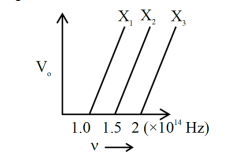
The graph shows variation of stopping potential V0 with the frequency v of the incident radiation for three photosensitive metals X1, X2 and X3. Which metal will give out electrons with greater kinetic energy, for the same wavelength of incident radiation? Stopping potential V0 (vertical axis) plotted against frequency v (horizontal axis) for three metals X1, X2 and X3: three parallel straight lines with threshold frequencies 1.0, 1.5 and 2 × 10¹⁴ Hz.
Light source having wavelength 331 nm is used to generate photo-electrons whose stopping potential is 0.2 V . The work function of the used metal in the experiment is α × 10−19 J. The value of α is ____ . (h=6.62 × 10⁻³⁴ Js, e=1.6 × 10⁻¹⁹ C and c=3 × 10⁸ m / s)
In the hydrogen atom, the electron makes a transition from the higher orbit (i) to a lower orbit (f). The ratio of the radius of the orbits in given by ri: rf=16: 4. The wavelength of photon emitted due to this transition is ____ nm . (Given Rydberg constant =1.0973 × 10⁷ / m )
An electron of mass m is moving in an electric field E=-2 Eo î(E0=. constant .>0), with an initial velocity V=vo î (v0=. constant .>0). If λo=h4 m vo, its de Broglie wavelength at time t is ____ .
An electron is travelling with a velocity v in free space and when it enters a medium, its velocity is reduced by 20 %. The de Broglie wavelength of electron in the medium is α λ0, where λ0 is its de Broglie wavelength in free space. The value of α is ____ .
The ratio of momentum of the photons of the 1st and 2nd line of Balmer series of Hydrogen atoms is α / β. The possible values of α and β are :
The de Broglie wavelength for an electron accelerated through the potential difference of V1 volt is λ1. When the potential difference is changed to V2 volt, the associated de Broglie wavelength is increased by 50 %. If (V1 / V2)=(9 / α), then the value of α is ____ .
K1 and K2 be the maximum kinetic energies of photoelectrons emitted from a surface of a given material for the light of wavelength λ1 and λ2, respectively. If λ1=2 λ2 then the work function of material is given by:
A monochromatic source of light operating at 15 kW emits 2.5 × 10²² photons / s. The region of an electromagnetic spectrum to which the emitted electromagnetic radiation belongs to ____ . (Take h= 6.6 × 10⁻³⁴ J . s and .c=3 × 10⁸ m / s).
Physics PYQ Book
JEE Main 5 Years Physics PYQ Book 2022-2026.
✓Chapter-wise solved papers
✓Detailed solutions
JEE Advanced Online
Online Mock Test Series.
✓10 online mock tests
✓Video solutions + analysis
Frequently Asked Questions
Tags